Root Access Sudo Bug Found to Affect macOS Big Sur

A sudo bug that can grant an attacker root access has been discovered to affect macOS Big Sur (via ZDNet).
sudo bug macos

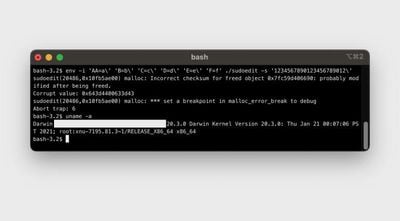
The security vulnerability, identified last week as "CVE-2021-3156" by the Qualys Security Team, affects sudo, which is a program that allows users to run commands with the security privileges of another user, such as an administrator. The bug triggers a "heap overflow" in sudo that changes the current user's privileges to enable root-level access. This can give an attacker access to the entire system. An attacker would need to gain low-level access to a system first to be able to exploit the bug, such as via planted malware.

Sudo is part of many Unix-like systems, including macOS, but it was initially unknown if the vulnerability affected Mac machines since it was only tested by Qualys on Ubuntu, Debian, and Fedora. Security researcher Matthew Hickey has now confirmed that the most recent version of macOS, macOS Big Sur 11.2 can be subject to the sudo attack.

Last week, there was speculation that the macOS Big Sur 11.2 update may address the sudo vulnerability, though it was not definitively known at the time if the bug would affect macOS. While it was found that sudo was left unchanged in macOS Big Sur 11.2, it is now clear that macOS is affected by the exploit.

With some minor modifications, Hickey found that the sudo bug could be used to grant attackers access to macOS root accounts, and the discovery has now been verified by Carnegie Mellon University vulnerability analyst Will Dormann.

Apple has reportedly been notified of the CVE-2021-3156 vulnerability, and due to the severity of the issue, a patch will likely be released soon.


Popular Stories

imac video apple feature

Apple Unveils First New Products of 2026

Monday January 26, 2026 1:55 pm PST by
Apple today introduced its first two physical products of 2026: a second-generation AirTag and the Black Unity Connection Braided Solo Loop for the Apple Watch. Read our coverage of each announcement to learn more:Apple Unveils New AirTag With Longer Range, Louder Speaker, and More Apple Introduces New Black Unity Apple Watch BandBoth the new AirTag and the Black Unity Connection Braided...
iPhone 5s

iPhone 5s Gets New Software Update 13 Years After Launch

Monday January 26, 2026 3:56 pm PST by
Alongside iOS 26.2.1, Apple today released an updated version of iOS 12 for devices that are still running that operating system update, eight years after the software was first released. iOS 12.5.8 is available for the iPhone 5s and the iPhone 6, meaning Apple is continuing to support these devices for 13 and 12 years after launch, respectively. The iPhone 5s came out in September 2013,...
Second Generation AirTag Feature

Apple Unveils New AirTag With Longer Range, Louder Speaker, and More

Monday January 26, 2026 6:07 am PST by
Apple today introduced the second-generation AirTag, with key features including longer range for tracking items and a louder speaker. For those who are not familiar, the AirTag is a small accessory that you can attach to your backpack, keys, or other items. Then, you can track the location of those items in the Find My app on the iPhone, iPad, Mac, Apple Watch, and iCloud.com. The new...
Apple Logo Spotlight

Apple to Launch These 20+ Products This Year

Sunday January 25, 2026 6:02 pm PST by
2026 promises to be yet another busy year for Apple, with the company rumored to be planning more than 20 product announcements over the coming months. Beyond the usual updates to iPhones, iPads, Macs, and Apple Watches, Apple is expected to release its all-new smart home hub, which was reportedly delayed until the more personalized version of Siri is ready. Other unique products rumored for ...
M5 MacBook Pro

Apple Reportedly Aiming to Upgrade the MacBook Pro Twice This Year

Sunday January 25, 2026 11:46 am PST by
Apple plans to release new MacBook Pro, MacBook Air, Mac Studio, and Studio Display models in the first half of this year, according to Bloomberg's Mark Gurman. In his Power On newsletter today, Gurman added that redesigned MacBook Pro models with an OLED touch screen "should be hitting toward the end of 2026," meaning that the MacBook Pro line would be upgraded twice this year. First up...

Top Rated Comments

AttoA Avatar
65 months ago

Apple rushing beta software to market, again.
This vulnerability has been present for more than a decade in all sorts of UNIXes! It's not something at all limited to Apple's QA...
Score: 34 Votes (Like | Disagree)

Havalo Avatar
65 months ago


Attachment Image
Score: 31 Votes (Like | Disagree)
mannyvel Avatar
65 months ago

So, mostly free OSes. That's much of a defense....

Devs knew about the potential, and chose not to address it. They would rather rush a beta product to market.
One day you will learn more about software and you will look back at this comment and say "wow, I was totally clueless back then."
Score: 27 Votes (Like | Disagree)
Gabebear Avatar
65 months ago

Wow I thought this would have been patched out in 11.2. Hopefully we will get a
supplemental patch shortly.
It turns most fairly minor security issues into full-blown root exploits… fairly terrifying.
Score: 9 Votes (Like | Disagree)
opfor Avatar
65 months ago

I'd think we'd have better tools/procedures for finding bugs like this a lot sooner.

Is there not an automated tool that can look at some code and say "hey, right here it's possible for a heap overflow to occur and there's no error handling code to deal with it"?
Sure there are tools that catch some of these problems via static analysis etc and there are languages where this class of problems might not even occur.

But it is also true that the day that the CVE was released I updated my Linux servers and got a fixed/patched sudo, while even macOS 11.3 beta1 still has the issue, so this is also indicative of Apple release engineering capabilities, or lack of them.
Score: 8 Votes (Like | Disagree)
justperry Avatar
65 months ago

So is this a zero day, drive-by vulnerability? Or does the attacker have to have physical access?
Nope

"An attacker would need to gain low-level access to a system first to be able to exploit the bug, such as via planted malware."
Score: 8 Votes (Like | Disagree)