iPhone XS Max Signal Strength Compared to OnePlus 7 Pro and Samsung Galaxy S10

The Samsung Galaxy S10 and the new OnePlus 7 Pro are both flagship smartphones that are designed to compete with the iPhone XS Max, and to see how their LTE chips compare, PCMag teamed up with Cellular Insights to test the signal strength of the new devices.

Apple's ‌iPhone‌ XS Max is equipped with an XMM7560 modem chip from Intel, while the Galaxy S10 and the OnePlus 7 Pro are using Qualcomm's X24 modem, which theoretically offers better performance.
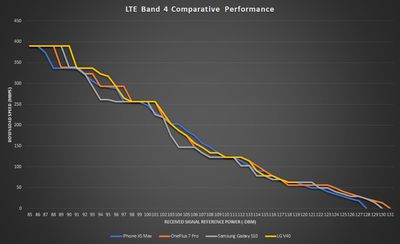
iphonexsmaxsignalcomparisongood

‌iPhone‌ XS Max in blue, OnePlus 7 Pro in orange, Samsung Galaxy S10 in gray, and LG V40 in yellow

The Intel XMM7560 modem in the ‌iPhone‌ XS Max supports supports 5-carrier aggregation but offers 1Gb/s maximum theoretical data transfer speeds, while the Qualcomm X24 in the Galaxy S10 has max theoretical speeds of 2Gb/s (it uses 7-carrier aggregation) and the OnePlus 7 Pro has max theoretical speeds of 1.2Gb/s (lower because it uses 5-carrier aggregation like the ‌iPhone‌).

In testing on LTE band 4 with good signal, there wasn't a lot of difference in performance between the ‌iPhone‌ XS Max, the newer smartphones from Samsung and OnePlus, and the LG V40, which PCMag added in because it was 2018's best performing phone in terms of cellular speed.

All of the smartphones performed similarly, but the Samsung Galaxy S10 did see some of the slowest speeds, and at peak signal, the ‌iPhone‌ XS came in behind the OnePlus 7 Pro and the LG V40.

In a test with poorer LTE signal, the ‌iPhone‌ XS Max saw the slowest speeds and was outperformed by all of the Qualcomm chips. The ‌iPhone‌ XS Max was quite a bit slower than the Galaxy S10 and the OnePlus 7 Pro specifically.
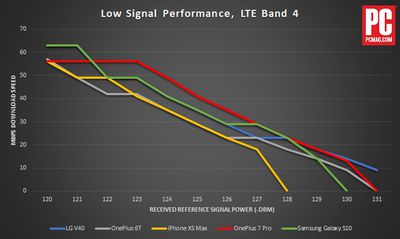
lteperformancepoorsignal
Starting in 2020, Apple is no longer going to use Intel chips and is instead going to transition to Qualcomm's 5G chips. Intel has decided that it's exiting the 5G smartphone modem chip business leaving Apple no choice but to rely on Qualcomm technology and perhaps some chips from Samsung.

Apple and Qualcomm recently settled a vicious legal battle which had seen Apple refusing to use Qualcomm chips. Because of the dispute, Apple used Intel chips in the 2018 iPhones, and is expected to continue to use Intel chips for the 2019 iPhones.

Though the legal battle is over, Apple isn't likely to have time to swap over to Qualcomm modem chips for the 2019 iPhones, and Intel has confirmed that it's going to continue to supply 4G chips to meet its current obligations.

Popular Stories

maxresdefault

Apple Shows Off a Key Reason to Upgrade to the iPhone 17

Saturday February 7, 2026 9:26 am PST by
Apple today shared an ad that shows how the upgraded Center Stage front camera on the latest iPhones improves the process of taking a group selfie. "Watch how the new front facing camera on iPhone 17 Pro takes group selfies that automatically expand and rotate as more people come into frame," says Apple. While the ad is focused on the iPhone 17 Pro and iPhone 17 Pro Max, the regular iPhone...
Finder Siri Feature

Why Apple's iOS 26.4 Siri Upgrade Will Be Bigger Than Originally Promised

Friday February 6, 2026 3:06 pm PST by
In the iOS 26.4 update that's coming this spring, Apple will introduce a new version of Siri that's going to overhaul how we interact with the personal assistant and what it's able to do. The iOS 26.4 version of Siri won't work like ChatGPT or Claude, but it will rely on large language models (LLMs) and has been updated from the ground up. Upgraded Architecture The next-generation...
wwdc sans text feature

Apple Rumored to Announce New Product on February 19

Thursday February 5, 2026 12:22 pm PST by
Apple plans to announce the iPhone 17e on Thursday, February 19, according to Macwelt, the German equivalent of Macworld. The report, citing industry sources, is available in English on Macworld. Apple announced the iPhone 16e on Wednesday, February 19 last year, so the iPhone 17e would be unveiled exactly one year later if this rumor is accurate. It is quite uncommon for Apple to unveil...
apple wallet drivers license feature iPhone 15 pro

Apple Says These 7 U.S. States Plan to Offer iPhone Driver's Licenses

Monday February 9, 2026 6:24 am PST by
In select U.S. states, residents can add their driver's license or state ID to the Apple Wallet app on the iPhone and Apple Watch, and then use it to display proof of identity or age at select airports and businesses, and in select apps. The feature is currently available in 13 U.S. states and Puerto Rico, and it is expected to launch in at least seven more in the future. To set up the...
14 inch MacBook Pro Keyboard

New MacBook Pros Could Now Arrive in March

Sunday February 8, 2026 6:02 am PST by
New MacBook Pro models with the M5 Pro and M5 Max chips could arrive as soon as Monday, March 2, according to Bloomberg's Mark Gurman. In today's "Power On" newsletter, Gurman said that the release of new MacBook Pro models is tied to the release of macOS Tahoe 26.3. The launch is said to be slated for as early as the week of March 2. He added that the M4 Pro and M4 Max models on sale today...

Top Rated Comments

mi7chy Avatar
88 months ago
Thats not so bad, so wondering why it feels so bad in realworld, iphone reception is really bad in low signal area
The test is cherry picking band 4 which isn't primary band for most carriers. They need to do a comprehensive multi-band test.
Score: 28 Votes (Like | Disagree)
macduke Avatar
88 months ago
The Intel XMM7560 modem in the iPhone XS Max supports supports 5-carrier aggregation but offers 1Gb/s maximum theoretical data transfer speeds, while the Qualcomm X24 in the Galaxy S10 has max theoretical speeds of 2Gb/s (it uses 7-carrier aggregation) and the OnePlus 7 Pro has max theoretical speeds of 1.2Gb/s (lower because it uses 5-carrier aggregation like the iPhone).
I don't even know why they bother mentioning max theoretical speeds. Like yeah, if nobody else is connected to the tower, and you're standing 10ft away from the tower, and the weather is perfect and the sun is down and general network congestion on the ISP and backbones are low, and if you're not holding it but have it mounted from a specific point using a tripod that has non-metal contact points then maybe. Meanwhile in the real world, you've hit the jackpot if you get close to 100Mbps on any given speed test, and typically can expect 30-60Mbps.
Score: 15 Votes (Like | Disagree)
imran5720 Avatar
88 months ago
That's not so bad, so wondering why it feels so bad in real-world, iPhone Max reception is really bad in low signal area
Score: 9 Votes (Like | Disagree)
decypher44 Avatar
88 months ago
In reality, it’s actually worse. This is by far the worst iPhone I’ve ever owned (Max). I was going to upgrade early, but I guess I’ll wait until 2020.
Score: 9 Votes (Like | Disagree)
Freida Avatar
88 months ago
did they really need each chart with different colours? Couldn't they keep the same one for simplicity? :D :D :D
Score: 8 Votes (Like | Disagree)
GeneralChang Avatar
88 months ago
C'mon, PCMag, was it too hard to keep the colors consistent from one graph to the next?
Score: 8 Votes (Like | Disagree)