Skip to Content

iOS 26: Reduce Transparency of Apple's Liquid Glass Design

by

Apple's iOS 26 update, currently in beta, introduces a striking visual overhaul with its new Liquid Glass design language. However, if the translucent elements are causing readability issues or you simply prefer a more opaque interface, there's a quick accessibility setting that can help tone things down.
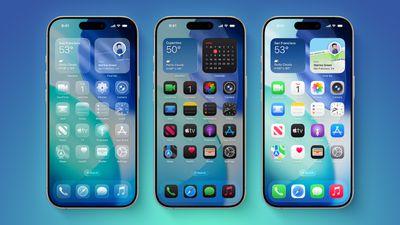
iOS 26 on Three iPhones
The Liquid Glass design brings transparency effects throughout the system interface and stock apps. On the Home Screen, you'll notice the search bar, dock, and app folders all feature translucent backgrounds. App icons themselves now sport a new layered glass appearance that adds visual depth and dimension to your device – plus there's a new Clear appearance option that ups the ante even more.

While visually impressive, these transparency effects can sometimes interfere with readability, especially for anyone with certain visual needs. Fortunately, Apple has included accessibility options to make the interface more accessible.

How to Reduce Transparency

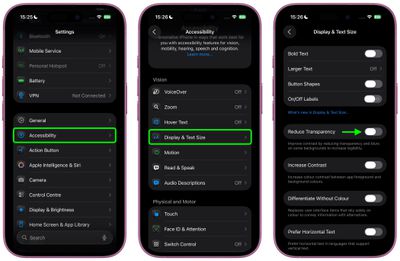
The quickest way to make iOS 26's interface more opaque is through the Reduce Transparency setting:

  1. Open Settings on your iPhone.
  2. Tap Accessibility.
  3. Select Display & Text Size.
  4. Toggle on Reduce Transparency.

settings

This setting adds darker backgrounds to translucent areas like Control Center, app icons, and app folders, so you should see increased contrast between elements throughout the system.

Note that Reduce Transparency doesn't completely eliminate all translucent elements or change button shapes – it simply makes translucent areas more opaque while maintaining the overall iOS 26 aesthetic.

Add Reduce Transparency to Control Center

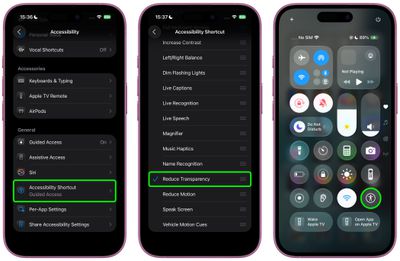
For quick access to this setting, you can add it to your Accessibility Shortcuts to get to it from the Control Center interface:

  1. Go to Settings ➝ Accessibility.
  2. Scroll down and tap Accessibility Shortcut.
  3. Select Reduce Transparency in the list.
settings

If you like, you can add the Accessibility Shortcut button to Control Center (long press a space between the interface's buttons, then tap Add Control). After you've done that, you can quickly toggle the setting on and off directly from Control Center, making it easy to switch between the full Liquid Glass experience and a more opaque interface as needed.

Additional Contrast Options

If you're still having legibility issues after enabling Reduce Transparency, return to Settings ➝ Accessibility ➝ Display & Text Size, then toggle on Increase Contrast. Note that enabling both Reduce Transparency and Increase Contrast will cause icons to lose most of their translucency.

The Liquid Glass design is still in beta, so Apple will likely continue refining the visual effects based on feedback. A wider official rollout of iOS 26 is expected sometime in September.

Top Rated Comments

turbineseaplane Avatar
7 months ago
Shamefully bad UI team.

Users shouldn't need to enable a whole bunch of accessibility settings to get basic legibility and clarity.
Score: 78 Votes (Like | Disagree)
sjalfr Avatar
7 months ago

Shamefully bad UI team.

Users shouldn't need to enable a whole bunch of accessibility settings to get basic legibility and clarity.
Right. Now I feel like it's my fault that I can't see anything on the washed out default screen. What are they thinking? I wish they'd stop making things so white and polished just because it looks slick and cool at the price of readability and functionality.
Score: 38 Votes (Like | Disagree)
7 months ago
Apple UI overhaul team is probably the same team behind Siri!
Score: 28 Votes (Like | Disagree)
7 months ago
Essential tweak for me. It looks so much better.
Score: 26 Votes (Like | Disagree)
Astuces iOS Avatar
7 months ago

Shamefully bad UI team.

Users shouldn't need to enable a whole bunch of accessibility settings to get basic legibility and clarity.
True at this point it should be an option on general or something
Score: 23 Votes (Like | Disagree)
VulchR Avatar
7 months ago
Honestly I wish Apple would spend more time on more important issues in iOS, like using AI better to correct grammar and spelling mistakes by looking at the semantic content of text rather than looking a word at a time (which misses 'tot he' for 'to the' for instance). Indeed, you'd think the new computing power in iPhones, iOS would use simple AI to learn the kinds of typing mistakes one makes and correct them (possibly even adjusting the sizes and positions of keys to reduce errors - e.g., I keep hitting n instead of space, so why not make the n smaller and nudge it away from space by a few pixels?) rather than faffing about with GUI features that actually reduce visibility. We all want elegant design, but part of elegance is functionality. Just my two cents.
Score: 19 Votes (Like | Disagree)

Popular Stories

Multicolored Low Cost A18 Pro MacBook Feature

Apple Accidentally Leaks 'MacBook Neo'

Tuesday March 3, 2026 7:00 am PST by
Apple appears to have prematurely revealed the name of its rumored lower-cost MacBook model, which is expected to be announced this Wednesday. A regulatory document for a "MacBook Neo" (Model A3404) has appeared on Apple's website. Unfortunately, there are no further details or images available yet. While the PDF file does not contain the "MacBook Neo" name, it briefly appeared in a link...
imac video apple feature

Apple Unveils Two New Products

Monday March 2, 2026 7:49 am PST by
Apple today introduced two new devices, including the iPhone 17e and an updated iPad Air. iPhone 17e features the same overall design as the iPhone 16e, but it gains Apple's A19 chip, MagSafe for magnetic wireless charging and magnetic accessories, Apple's second-generation C1X modem for faster 5G, and a doubled 256GB of base storage. In the U.S., the iPhone 17e starts at $599, just like the ...
MacBook Neo Feature Pastel 1

Apple Announces $599 'MacBook Neo' With A18 Pro Chip

Wednesday March 4, 2026 6:15 am PST by
Apple today announced the "MacBook Neo," an all-new kind of low-cost Mac featuring the A18 Pro chip for $599. The MacBook Neo is the first Mac to be powered by an iPhone chip; the A18 Pro debuted in 2024's iPhone 16 Pro models. Apple says it is up to 50% faster for everyday tasks than the bestselling PC with the latest shipping Intel Core Ultra 5, up to 3x faster for on-device AI workloads,...