If you're running out of space on your Mac's internal drive, macOS Sequoia 15.1 includes a handy new feature that lets you install large apps directly to external storage. Here's how to use it to preserve space on your boot drive.
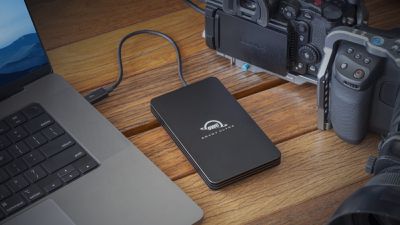
MacBook Pro OWC Envoy Ultra
Apple is known for charging customers a very high markup for additional storage when buying a new Mac. Given that internal storage usually can't be upgraded after purchase, it's no wonder that external drives are a popular solution for many Mac users who want the extra space but don't want to pay a premium for the privilege.

Until recently, macOS automatically installed new apps downloaded from the Mac App Store to a Mac's boot drive, which was not particularly helpful to users with dwindling internal storage. In macOS Sequoia 15.1, however, Apple has added a new option that lets you download and install apps that require more than 1GB of storage to an external drive. Anyone working with large apps like Final Cut Pro or Logic Pro, or gamers with space-consuming titles, will surely welcome this ability to download and install large apps to a separate disk.

Installing Mac Apps to External Storage

  1. Connect your external drive to your Mac.
  2. Open the App Store.
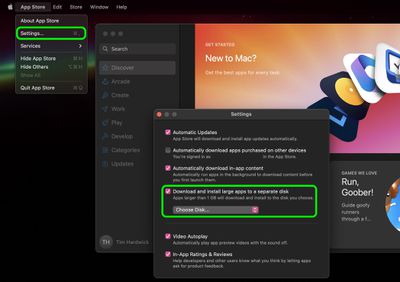
  3. Click App Store in the menu bar and select Settings....
  4. Check the box next to "Download and install large apps to a separate disk."
  5. Select your external drive from the dropdown menu.
install apps external disk mac app store

Some considerations to keep in mind: The feature only works with apps larger than 1GB, and your external drive must be connected when enabling the setting. (Make sure the drive you connect is APFS formatted.) Additionally, while apps will install to your external drive, bear in mind that, depending on the app, some app data may still be stored on your main drive.

It's also worth noting that you can't choose installation locations using this method on a per-app basis – it's an all-or-nothing setting for qualifying apps. Lastly, for the best experience, use a fast external SSD (or an internal SSD in an external enclosure) to ensure optimal app performance.


Top Rated Comments

Slix Avatar
16 months ago
This is convenient! You could always move big apps after downloading them to the external disk, since day one essentially on the Mac. But having it automatically happen for big apps is a nice option.
Score: 12 Votes (Like | Disagree)
kirky29 Avatar
16 months ago
Once again, a very Apple way of doing this... :-/
Score: 12 Votes (Like | Disagree)
turbineseaplane Avatar
16 months ago
Anything other than "no longer charging extortion level SSD upgrade pricing", it would seem

:confused:
Score: 11 Votes (Like | Disagree)
CharlesS Avatar
16 months ago
Why would anyone need this? It's always been possible to have your apps on a separate drive. Just drag them over. LaunchServices will detect the apps in their new location and they'll just work. It's one of the best things about the Mac, and it's been that way basically since the beginning.


Score: 10 Votes (Like | Disagree)
fathergll Avatar
16 months ago

A tiny step in the right direction. I don't know why it had to be this limited.

This is an absolute requirement to even begin to be taken seriously for games. Steam has had very flexible support for multiple libraries on multiple disks in whatever subfolder you choose, for like ten years.
Score: 9 Votes (Like | Disagree)
CarAnalogy Avatar
16 months ago
A tiny step in the right direction. I don't know why it had to be this limited.

This is an absolute requirement to even begin to be taken seriously for games. Steam has had very flexible support for multiple libraries on multiple disks in whatever subfolder you choose, for like ten years.
Score: 7 Votes (Like | Disagree)

Popular Stories

imac video apple feature

Apple Unveils First New Products of 2026

Monday January 26, 2026 1:55 pm PST by
Apple today introduced its first two physical products of 2026: a second-generation AirTag and the Black Unity Connection Braided Solo Loop for the Apple Watch. Read our coverage of each announcement to learn more:Apple Unveils New AirTag With Longer Range, Louder Speaker, and More Apple Introduces New Black Unity Apple Watch BandBoth the new AirTag and the Black Unity Connection Braided...
iPhone 5s

iPhone 5s Gets New Software Update 13 Years After Launch

Monday January 26, 2026 3:56 pm PST by
Alongside iOS 26.2.1, Apple today released an updated version of iOS 12 for devices that are still running that operating system update, eight years after the software was first released. iOS 12.5.8 is available for the iPhone 5s and the iPhone 6, meaning Apple is continuing to support these devices for 13 and 12 years after launch, respectively. The iPhone 5s came out in September 2013,...
Second Generation AirTag Feature

Apple Unveils New AirTag With Longer Range, Louder Speaker, and More

Monday January 26, 2026 6:07 am PST by
Apple today introduced the second-generation AirTag, with key features including longer range for tracking items and a louder speaker. For those who are not familiar, the AirTag is a small accessory that you can attach to your backpack, keys, or other items. Then, you can track the location of those items in the Find My app on the iPhone, iPad, Mac, Apple Watch, and iCloud.com. The new...
Apple Logo Spotlight

Apple to Launch These 20+ Products This Year

Sunday January 25, 2026 6:02 pm PST by
2026 promises to be yet another busy year for Apple, with the company rumored to be planning more than 20 product announcements over the coming months. Beyond the usual updates to iPhones, iPads, Macs, and Apple Watches, Apple is expected to release its all-new smart home hub, which was reportedly delayed until the more personalized version of Siri is ready. Other unique products rumored for ...
M5 MacBook Pro

Apple Reportedly Aiming to Upgrade the MacBook Pro Twice This Year

Sunday January 25, 2026 11:46 am PST by
Apple plans to release new MacBook Pro, MacBook Air, Mac Studio, and Studio Display models in the first half of this year, according to Bloomberg's Mark Gurman. In his Power On newsletter today, Gurman added that redesigned MacBook Pro models with an OLED touch screen "should be hitting toward the end of 2026," meaning that the MacBook Pro line would be upgraded twice this year. First up...