The prolonged wait for updated MacBook Pros continue without any major hints at when they might arrive. A report last week suggested that a shortage of Intel notebook chips could be contributing to the delay.
MacRumors has heard that the MacBook Pro supplies to retailers have abruptly become constrained, possibly suggesting that updates could be imminent.
Meanwhile, one MacRumors reader emailed Steve Jobs directly about concerns about how long he's had to wait for the new MacBook Pro updates and Apple's recent focus on the iPad. He wrote "I recognise the need for secrecy etc but I am really losing heart in the lack of vision for the MBP and Mac Pros. Not expecting a response but as someone who has personally switched dozens of people onto the mac way this is a sad email for me to compose."
As he's been occasionally known to do, Steve Jobs reportedly responded with a short reply that simply said "Not to worry."
The New York Times reports that Apple has struck a deal with Perseus Books Group, an independent publisher and the largest distributor of works from other independent publishers, to bring its content to the iBookstore.
Perseus Books Group, a large independent publisher that also distributes works from 330 other smaller presses including Grove Atlantic, Harvard Business School Press, Zagat and City Lights Books, signed a deal last week with Apple, following five of the six biggest publishers that have already signed agreements with Apple.
The deal is similar to those struck with other publishers, with Perseus setting eBook pricing while Apple takes a 30% cut of revenue. Publishers distributing through Perseus will have the option to join the deal.
Tom Neumayr, an Apple spokesman, confirmed that it had signed a deal with Perseus. In an e-mail statement, David Steinberger, chief executive of Perseus, said, "We're working with Apple to make books from The Perseus Books Group and the independent publishers we represent available on the iBookstore starting on April 3. As the leading provider of distribution services for independent publishers, including digital distribution through our Constellation digital service, Perseus is thrilled to be making our books available on the iPad."
The report notes that Apple has required in its dealings with publishers that other retailers not be permitted to undercut its prices. The demand, embraced by the publishers, has led several major publishers to seek modifications to their existing arrangements with distributors such as Amazon and Barnes & Noble that would permit them to shift to an agency model similar to that they now hold with Apple that permits publishers rather than distributors to set prices.
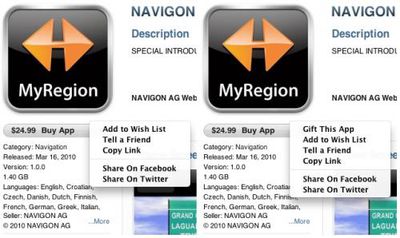
Comparison of old (left) and new (right) drop-down app options
Users logging into or attempting to purchase from the iTunes Store today were met with a dialog box requiring that they accept a modified version of the iTunes Store and App Store terms and conditions. In addition to some clarifications regarding intellectual property rights and liability, the updated terms also address a "Gifts" section (new in App Store terms and modified in iTunes Store terms) that now includes discussion of a newly-added ability to gift App Store applications to other users.
The "Gifts" section of the iTunes Store Terms of Sale has been changed to clarify that Gifts may not be used for in-app purchases, upgrades, or the iPod Touch OS, to explain that some gifts require compatible hardware and parental control settings so they can be redeemed, and to notify you that, while gifts are non-refundable, this is without prejudice to your statutory rights to a refund in the event that a gift is faulty or has been misdescribed.
A new "Gifts" section has been added to the App Store T&C explaining the conditions under which Apps can be gifted, including an explanation that Gifts may not be used for in-app purchases, upgrades or the iPod Touch OS, and to explain that some gifts require compatible hardware and parental control settings so that they can be redeemed, and to notify you that, while gifts are non-refundable, this is without prejudice to your statutory rights to a refund in the event that a gift is faulty or has been misdescribed.
Selecting the "Gift This App" option next to an application takes users to a special screen where they can fill in their name, the recipient's name and email address, and a message to the recipient. Users may specify multiple recipients and will be billed according to the number of email addresses listed.
Boy Genius Report this weekend noted that Sprint has released a new television commercial using Apple's iPhone to promote the carrier's new Overdrive 3G/4G mobile hotspot device. The commercial claims that connecting an iPhone to Sprint's 4G network via the Overdrive hotspot can achieve speeds up to ten times higher than that available through AT&T's 3G network.
My friend Steve's iPhone is cool, but it's limited to AT&T's 3G speeds. So I'm gonna use the Overdrive 4G mobile hotspot to make it up to ten times faster.
Verizon has similarly been viewing the iPad as an opportunity to promote its MiFi service, another of the growing number of small devices capable of creating local Wi-Fi networks by connecting to carriers' cellular networks.
Sprint, Clearwire, and a consortium of other broadband and technology companies have been working together to deploy WiMAX technology, which is being branded as 4G service, around the United States. The move comes ahead of the rollout of 4G LTE services, which will be built upon existing 3G networks, by providers such as AT&T, Apple's current U.S. partner for the iPhone.
Amazon has posted a page on its site describing upcoming Kindle apps for Tablet Computers, where the iPad is specifically mentioned. The iPad app will have the same functionality as the one currently available for the iPhone, including Amazon's Whispersync technology for syncing bookmarks, notes, last page read, and more across multiple devices.
Also mentioned is the ability for users to shop for more Kindle eBooks. Amazon does not state, however, whether this functionality will be built into the iPad app, which would put it in direct competition with Apple's iBooks app that will offer the ability to purchase ebooks through the iTunes store. In the iPhone Kindle app, a link to purchase eBooks is provided that opens the Safari browser to an iPhone-optimized version of the Kindle eBook store. eBooks purchased there are downloaded automatically to the iPhone the next time the Kindle app is opened.
The iPad Kindle app, demonstrated to a New York Times reporter last week, will offer virtual page turning and various ways to present an eBook library to a user, including one "where large images of book covers are set against a backdrop of a silhouetted figure reading under a tree" and the "suns position in that image varies with the time of day."
According to the report, Amazon has stated that it will not take advantage of Apple's official invitation to developers to submit iPad apps and will instead wait to test it on an iPad after its April 3rd release. Amazon has also disclosed that it is not one of the entities that received advance access to an iPad for development and testing.
Amazon's acknowledgement that an iPad application is in development follows a similar disclosure from Barnes & Noble earlier this month.
The San Jose Mercury News last Friday reported that Apple CEO Steve Jobs made a rare public appearance alongside California governor Arnold Schwarzenegger to promote a new bill in that state to encourage drivers to sign up as organ donors, drawing on his own experience with a liver transplant he received last year in Memphis, Tennessee as motivation for his support.
"I was almost one of the ones that died waiting for a liver in California last year," said Jobs, whippet-thin but healthy. He appeared at a brief event with Gov. Arnold Schwarzenegger to unveil a new legislative effort to greatly expand the number of California organ donors.
In his first public description of his much-rumored but long-secret crisis, Jobs said "there were simply not enough livers in California to go around, and my doctors here advised me to enroll in a transplant program in Memphis, where the supply-demand ratio of livers is more favorable than it is in California."
Jobs noted that he had been fortunate enough to access to a private plane and the resources to be ferried to Memphis within the brief window of time available once a matching donor liver became available, and that California residents of all income levels should have greater access to donor organs in their own state.
As a result of his experience, Jobs worked with California first lady Maria Shriver to spur Schwarzenegger's office to draft legislation that would require driver's license applicants in California to provide either a "yes" or "no" answer to a question regarding their placement on the state's organ donor registry before being issued a license. While applicants are currently offered the ability to add themselves to the registry through the Department of Motor Vehicles, a response is not required, and it appears that many applicants simply skip the question.
The bill also provides for the creation of a "California Living Donor Registry," which aims to connect those in need of a kidney transplant with compatible strangers who have signaled their willingness to donate one of their own kidneys.
A video of the event is available, with Jobs' comments beginning at the 13-minute mark.
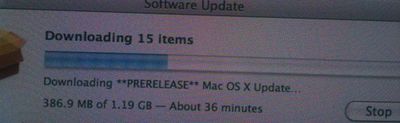
TUAW late last week reported on a customer who purchased a new 27-inch iMac earlier in the week and allegedly received a prerelease version of Mac OS X 10.6.3 via Software Update. Mac OS X 10.6.3 has not yet been released to the public, with the latest version being seeded to developers just this past Friday. That version, Build 10D572, is the same as the one somehow received automatically by the iMac customer.
This kind of update does not normally appear in the wild on Software Update. Prerelease, and specifically "**PRERELEASE**", updates refer to Apple-internal builds distributed to any Apple employee who has access to Apple's VPN. A **PRERELEASE** build is typically seeded to employees 24 to 48 hours before the build goes public via Software Update.
It is unclear how a brand-new retail machine would automatically have access to Apple internal builds, and there have been no other public reports of such access at this time. Consequently, it is difficult to assess the veracity of the claim, although it would add to the growing evidence of an imminent Mac OS X 10.6.3 public release if true.
Apple has begun promoting 10-pack iPad bundles for educational institutions, offering minor discounts while also reducing packaging by eliminating separate retail boxing for the devices. Each package contains ten iPads with USB-to-Dock Connector cables and power adapters along with a single set of documentation.
Only Wi-Fi iPad models are currently available for order through the program, with bundle pricing offering a discount of $20 per iPad for hardware-only purchases and $40 per iPad if purchased with AppleCare.
BF822LL/A: iPad Wi-Fi (16GB) $4,790 BF825LL/A: iPad Wi-Fi (16GB) with AppleCare Protection Plan for iPad - Auto Enroll $5,580 BF823LL/A: iPad Wi-Fi (32GB) $5,790 BF826LL/A: iPad Wi-Fi (32GB) with AppleCare Protection Plan for iPad - Auto Enroll $6,580 BF824LL/A: iPad Wi-Fi (64GB) $6,790 BF827LL/A: iPad Wi-Fi (64GB) with AppleCare Protection Plan for iPad - Auto Enroll $7,580
Individual Wi-Fi iPad pricing is set at $499/$599/$699, with two-year AppleCare available for $99. No discount is offered for individual purchases made through Apple's education stores.
Apple today officially invited developers to begin submitting iPad applications to the App Store for inclusion in the grand opening of the iPad App Store at its launch on April 3rd. In the e-mail sent to developers, Apple invites app submissions for an initial review of their readiness for the iPad.
iPad will begin shipping soon and your opportunity to be part of the grand opening of the iPad App Store starts today. Submit your iPad app now for an initial review by the App Review Team and receive feedback on its readiness for the grand opening.
Submit Your App by March 27.
- Build and test your iPad app using iPhone SDK 3.2 beta 5 available on the iPhone Dev Center. Only iPad apps built with iPhone SDK 3.2 beta 5 will be accepted for this initial review.
- Upload your distribution signed app through iTunes Connect by Saturday, March 27, 5pm PDT.
- The App Review Team will review your app on iPad and email you details about the readiness of your app.
- You will also receive additional information about submitting your app for final review before iPad ships.
- Only apps submitted for the initial review will be considered for the grand opening of the iPad App Store.
Apple has provided iPads to a select set of developers under tight security in order to assist them with preparing their apps for the iPad's launch. The vast majority of developers will, however, have to rely on the iPad simulator included in the iPhone SDK 3.2 for iPad for testing their apps.
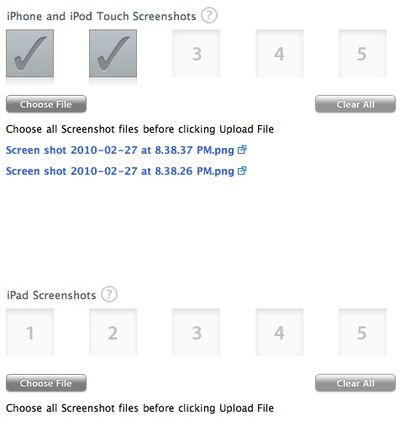
Update: 9 to 5 Mac has posted screenshots of the revised iTunes Connect interface, showing separate areas for uploading iPhone/iPod touch and iPad screenshots for display in the App Store.
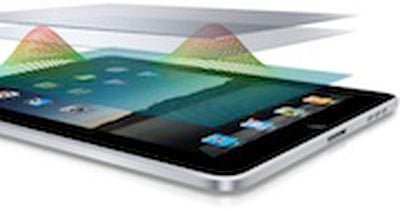
DigiTimes reports on an article from Taiwanese newspaper Liberty Times claiming that Apple's touchscreen manufacturing partner Wintek is the source of issues that have slightly delayed the release of the iPad to April 3rd from Apple's originally planned window of late March and have reportedly resulted in lower launch quantities of the device than desired by Apple.
The report claimed that Wintek is facing a manufacturing bottleneck in its touch panel production, and its low yield rate for touch panels has hampered its shipments to Apple.
Wintek claims, however, that all of its operations are running as planned, although it has declined to discuss specific orders in its statement.
Several reports earlier this month addressed the supply delays and shortages before Apple officially announced a launch date for the iPad, although the reports offered conflicting information on the source of the problems. Initial claims of a "production problem" were apparently disputed in a later report, which indicated that the issue was not the result of "glass or manufacturing process delays". A subsequent report from Daring Fireball's John Gruber indicated that the delay was likely simply due to Apple putting the finishing touches on the software for the iPad.
Meanwhile, The Korea Times reports (via 9 to 5 Mac) that Apple has contracted with Samsung for an additional 3 million iPad screens beyond an initial batch of 10 million screens ordered from LG.
The H Security reports (via The Inquirer) that noted cybersecurity researcher Charlie Miller is set to announce the discovery of twenty new zero-day holes in Mac OS X that could offer hackers means of entry to compromise computers running the operating system. As zero-day holes, Apple is currently not aware of their existence, and thus has not yet had the opportunity to address them.
Using the controversial "security through obscurity" argument, Miller claims that Mac OS X users have typically been relatively free of malware threats due to a lack of hacker interest in the relatively small user base, not necessarily due to Mac OS X being more secure than other operating systems.
"Mac OS X is like living in a farmhouse in the country with no locks, and Windows is living in a house with bars on the windows in the bad part of town."
Miller is set to reveal his methods of finding the vulnerabilities, which include "fuzzing" systems by bombarding them with an overwhelming quantity of corrupted data, at the prominent CanSecWest conference next week in Vancouver. He is not, however, planning to disclose details of the security holes.
The Financial Timesreports (registration required) that China Mobile continues to express interest in bringing the iPhone to its network, but that little progress has been made on convincing Apple to adopt the TD-SCDMA standard utilized by the carrier.
Wang Jianzhou, China Mobile chairman and chief executive, said at the group's annual results yesterday that "including TD-SCDMA is not that hard to do - RIM is doing it". But he added that Apple had not yet responded to his proposal.
Wang's comments suggest that essentially no progress has been made since a September report indicating that TD-SCDMA remained the major stumbling block for Apple and China Mobile. China Mobile is the world's largest mobile carrier with over 500 million customers, representing a significant market opportunity for Apple should an agreement be reached.
The carrier's 3G customer base remains small, however, as it seeks to boost its numbers from 3.4 million customers to over 10 million in the next year. As it has struggled to roll out its 3G service, smaller rivals such as China Unicom and China Telecom have been grabbing an increasing percentage of new subscribers.
Apple has offered the iPhone in China since last October through China Unicom, which uses the same 3GSM/UMTS standard available on the rest of the iPhone's carrier partners around the world.
Bloomberg BusinessWeek reports that select developers have been provided access to the iPad ahead of its official April 3rd launch, allowing them the opportunity to build and test their application directly on the device rather than having to rely on simulator tools built into the Software Development Kit offered by Apple as part of its developer program for the platform.
The access comes with a price, however, as the lucky developers are obligated to sign a 10-page confidentiality agreement requiring them to utilize a number of security measures to prevent unauthorized access to or removal of the iPad in their possession.
Would-be testers of the tablet-style computer, due to be released Apr. 3, must promise to keep it isolated in a room with blacked-out windows, according to four people familiar with the more than 10-page pact that bars partners from disclosing information about the iPad.
To ensure that it can't be removed, the iPad must also remain tethered to a fixed object, said the people, who asked not to be named because their plans for the iPad have not been made public. Apple (AAPL) won't send out an iPad until potential partners send photographic evidence that they've complied.
Not all developers requesting early access to iPads have been granted the benefit, but Apple's desire to offer compelling content at the time of the device's launch has apparently resulted in partnerships with a few key developers.
In fact, News Corp. CEO Rupert Murdoch mentioned earlier this month that The Wall Street Journal was one of those entities that had been provided access to an iPad, noting that the device was "under padlock and key" and that the key was "turned by Apple every night".
The security measures are reminiscent of those apparently visible in leaked photos of the iPad that appeared just prior to its official introduction and that show the device bolted to a table and covered with a black cloth. Apple has reportedly routinely utilized such measures in its own labs as it works to maintain as much secrecy as possible surrounding upcoming products.
DigiTimes reports that Intel is currently experiencing tight supply of its Core i3, i5, and i7 notebook chips introduced in January. Apple is expected to use several of the chips in a highly-anticipated refresh to its notebook lines.
Intel is giving priority to major clients, and second-tier and smaller notebook players have to wait much longer before receiving supply of the CPUs, the sources noted.
The report notes that Acer has placed a particularly large order for the chips in anticipation of upcoming increases in consumer demand. Not mentioned is where Apple might fall on Intel's priority list, although the company has traditionally received good access to Intel's products.
Apple's MacBook Pro and MacBook Air are due for updates, and numerous hints and rumors over the past few months have many Apple fans waiting anxiously for the updated models to appear.
Apple yesterday updated its Logic Pro and Logic Express audio workstation packages, addressing a number of issues and updating system requirements.
Logic Pro 9.1.1, which weighs in at 191.87 MB, delivers several improvements related to stability and compatibility.
- Improved stability of the 32-Bit Audio Unit Bridge - Compatibility with Novation's Automap feature in 64-bit mode. - Compatibility with Euphonix Eucon protocol in 64-bit mode.
Logic Express 9.1.1, which did not receive a January update corresponding to Logic Pro 9.1, sees a number of new features. The 9.1.1. update weighing in at 138.79 MB offers the following highlighted changes:
- Support for 64-bit native mode - Compatibility with 64-bit Audio Unit plug-ins - File names with over 32 characters are now supported - Samples are now mapped correctly when using the "Contiguous Zones" option in the EXS editor
Both Logic Pro and Logic Express now carry updated system requirements, with 32-bit mode requiring Mac OS X 10.5.7 or later and 64-bit mode requiring Mac OS X 10.6.2 or later.
iPhone in Canada yesterday reported that Apple has seeded Build 10D572 of Mac OS X 10.6.3 to developers. The new release comes just two days after the previous seed and carries only a single increment in build number, suggesting that public release of the third maintenance update to Snow Leopard may be right around the corner.
According to reports, the current build focuses on Graphics Drivers, Quicktime, Images & Photos, Mail, and Security Certificates.
As with the previous build, the new seed contains one documented known issue involving the reoffering of last week's Safari 4.0.5 update via Software Update after upgrading to the new build.
The last update to Snow Leopard, Mac OS X 10.6.2, was released in early November.
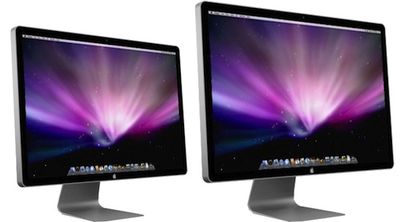
Mockup of existing 24" LED display (left) next to 27" model (right)
AppleInsider reports that Apple is preparing to launch a 27-inch LED Cinema Display and a refresh of its Mac Pro lineup, pegging a release window of "by June" for both products. The 27-inch LED Cinema Display is said to use the same panel as that used in Apple's 27-inch iMac and will closely resemble the existing 24-inch LED Cinema Display released in October 2008.
Two people familiar with the upcoming display say its been lingering in Apple's labs for quite sometime, where it's frequently referenced by the unique identifier/codename "K59." The Mac maker is believed to have been waiting patiently for the cost of the larger LCD panels, which sport a resolution of 2560 by 1440 pixels, to shed some of their premium before introducing the model to market.
As for the Mac Pro, the report's sources indicate that Apple will stick to Intel's Xeon processors, utilizing members of the 5600 series released earlier this week. While the Mac Pro is due for a refresh and recent rumors had suggested that a release might be imminent, the report similarly offers a window of "by June" for the refresh.
The Wall Street Journal reports that Apple is tempering its own expectations for launch content on the iPad as it continues to struggle with finalizing deals with publishers ahead of the device's April 3rd launch date. In particular, television content and iPad-specific presentation of newspaper, magazine, and textbook content are said to have been set aside as Apple focuses its efforts on other content that stands a chance of meeting the launch deadline.
Yet the company is still negotiating with media companies for a price cut on TV shows that people can download onto the device, said people familiar with the matter. Apple also hoped to work closely with newspaper, magazines and textbook publishers on new ways to digitally present print content on the iPad, but has for now put the effort on backburner in favor of focusing on other content, said one of those people.
The report notes that potential partners have been reluctant to sign on with Apple, weighing the benefits of bringing their content to new platforms against risks to their revenue streams as they consider forging new revenue models.
Presumably Apple has been focusing a significant amount of attention on eBooks, as it seeks to roll out its iBooks application and associated iBookstore in the U.S. as the device launches. Apple has also been working to provide tools to developers to allow them to move their iPhone and iPod touch App Store applications to the iPad and bring new providers on board.
The report also cites a source claiming that Apple has already sold "hundreds of thousands" of iPads since it went on sale last Friday, with the potential to outsell the original iPhone over the respective devices' initial three months' of sales. U.S. customers are currently able to pre-order any of Apple's six iPad models, with Wi-Fi models scheduling for launch on April 3rd and 3G-capable models to follow in late April. International availability of all models is also scheduled to follow at that time.
Update: The Wall Street Journal's report has been expanded to include discussion of Apple's hopes for television content on the iPad, disclosing that Apple has put on hold its plans for a "Best of TV" subscription service in favor of working to convince networks to drop existing episode pricing to $0.99 to spur demand. Rumors of Apple's pricing strategy surfaced in late January, but networks have been reluctant to sign on.
It has put on hold its idea to offer TV subscriptions that would be viewable through the iPad, because few media companies were interested. Instead, Apple is discussing dropping the price of TV shows to 99 cents from the $1.99 and $2.99 charged for most shows on its iTunes store, said people familiar with the situation.
Apple hasn't yet reached a deal with many major TV producers on the price cut, these people said. Some are concerned a price cut could hurt their existing businesses, these people said, including jeopardizing the tens of billions of dollars in subscription fees they are paid by cable and satellite companies for their traditional TV networks.