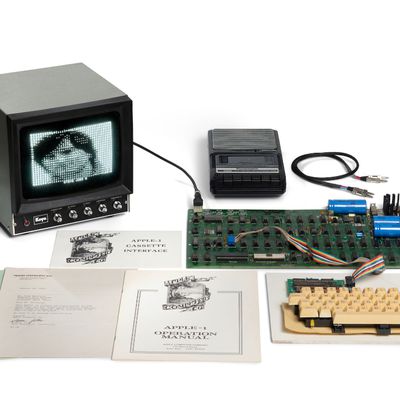
A rare, operational Apple-1 Computer was recently put up for auction, and it ended up selling for $375,000. The Apple-1 was the first computer sold by Apple co-founders Steve Jobs and Steve Wozniak, and so few remain that they fetch high prices at auction.
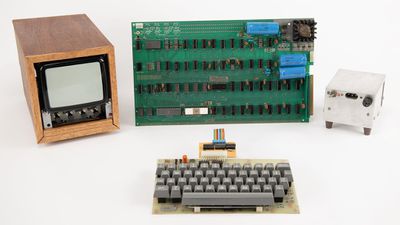
The Apple-1 that sold is known as the "Bayville" Apple-1, and it is number 91 on the Apple-1 Registry. The Apple-1 Registry aggregates all known remaining Apple-1 computers, and it includes details and a history for each one. The registry has 104 Apple-1 machines listed.
The Bayville Apple-1 was part of the first batch of Apple-1 machines sold in 1976, and it has a handwritten serial number that was likely penned by Steve Jobs. It was sold with an original manual with a handwritten note by Daniel Kottke, who was Apple employee number 12.
The Apple-1 was sold alongside many other Apple-related items as part of a "Steve Jobs and the Apple Revolution" auction event. A 1976 Apple Computer check signed by Steve Jobs sold for $112,054, and a sealed, first-generation 4GB iPhone sold for $87,514.
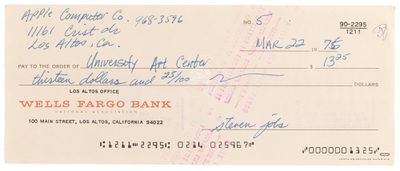
Another check signed by Steve Jobs sold for $62,500, and an Apple Lisa Computer sold for $56,818. The auction earned a total of $1,308,251.
Tuesday January 13, 2026 6:11 am PST by Joe Rossignol
Apple today introduced a new Apple Creator Studio bundle that offers access to six creative apps, as well as exclusive AI features and content, as part of a single subscription. In the U.S., pricing is set at $12.99 per month or $129 per year.

Here are the six apps included with an Apple Creator Studio subscription:Final Cut Pro on the Mac and iPad
Logic Pro on the Mac and iPad
Pixelmator...
Wednesday January 14, 2026 10:18 am PST by Joe Rossignol
Verizon is experiencing a major outage across the U.S. today, with hundreds of thousands of customers reporting issues with the network on the website Downdetector. There are also complaints across Reddit and other social media platforms.
iPhone users and others with Verizon service are generally unable to make phone calls, send text messages, or use data over 5G or LTE due to the outage....
Wednesday January 14, 2026 7:09 am PST by Joe Rossignol
While the iPhone 18 Pro models are still around eight months away, a leaker has shared some alleged details about the devices.
In a post on Chinese social media platform Weibo this week, the account Digital Chat Station said the iPhone 18 Pro and iPhone 18 Pro Max will have the same 6.3-inch and 6.9-inch display sizes as the iPhone 17 Pro and iPhone 17 Pro Max.
Consistent with previous...
Monday January 12, 2026 1:15 pm PST by Joe Rossignol
Apple today seeded the second beta of iOS 26.3, nearly a month after the first beta. So far, the update includes a couple of new features for iPhones.
iOS 15.3 through iOS 18.3 were all released in late January over the years, so it is thereby likely that iOS 26.3 will be released towards the end of this month as well. The update is compatible with the iPhone 11 series and newer.
Below,...
Tuesday January 13, 2026 11:29 am PST by Joe Rossignol
Apple today released a firmware update for the AirPods Pro 3. The latest firmware has a version number of 8B34, up from the previous version 8B30.
Apple has a support document for AirPods firmware updates, and it indicates that the 8B34 update contains unspecified "bug fixes and other improvements."
No other AirPods models received firmware updates today.
How to install AirPods Pro...
The average home price in the United States… makes sense.
Edit: I don’t know if it’s worse that the average home costs as much as an historic Apple computer or that an old Apple computer costs as much as the average American home.
It looks interesting but I wonder what this computer could do ?
This: The Apple I, introduced in 1976, was Apple’s first personal computer and a pioneer in the early personal computing era.
Key Features: • Processor: Equipped with a MOS Technology 6502 microprocessor running at approximately 1.023 MHz. • Memory: Came standard with 4 KB of RAM, expandable up to 8 KB on the motherboard, and further to 64 KB with additional expansion cards. • Display: Featured built-in video output, allowing users to connect to a composite video monitor or a standard television via an RF modulator. This capability provided a 40×24 character display, facilitating direct interaction without the need for specialized equipment. • Input: Required an external ASCII keyboard for user input, enabling users to type commands and programs directly. • Storage: An optional cassette interface allowed data storage and retrieval using standard audio cassette tapes, making it possible to save and load programs.
Functional Capabilities: • Programming: Users could write and execute programs in machine code or using a BASIC interpreter, facilitating the creation of custom applications and simple games. • Text Display: The system could display text on the screen, supporting basic word processing and text-based applications. • Educational Use: Served as a learning tool for computer enthusiasts and hobbyists, offering hands-on experience with programming and computer operations.