Apple Walks Back iPhone 13 Display Repair Restriction That Disabled Face ID
Following the launch of the iPhone 13 models, iFixit and other independent repair outlets found that replacing the iPhone's display renders Face ID non-functional, limiting repairs to Apple itself, Apple Authorized Service Providers, and Apple-associated repair shops. The change made it much more difficult for smaller, independent repair shops to perform iPhone 13 display repairs on broken devices.
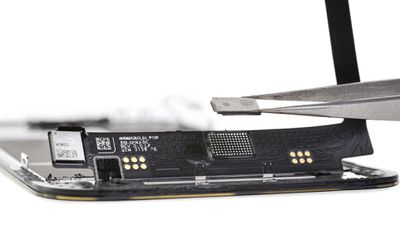
Image via iFixit
Given the blowback from repair providers unhappy with the restriction, Apple has decided to change its policy. Apple told The Verge that it plans to introduce a software update that will allow for standard display repairs that do not disable Face ID.
With the iPhone 13 models, Apple added a small microcontroller that pairs the iPhone 13 to its display. When performing a display repair, this microcontroller must be paired to the new display using Apple's tools, which independent repair shops do not have access to. Without this pairing process, swapping an iPhone 13 display with a new display results in an error message that says "Unable to activate Face ID on this iPhone."
Repair shops without access to Apple's pairing tools could take the microcontroller from the original display and add it to a new display, but it's a finicky process that requires soldering and a microscope to perform.
The software update that Apple plans to implement will remove the restriction that requires the microcontroller to be transferred to a new display when a repair is made, so independent shops will once again be able to repair screens without impacting the functionality of Face ID.
There is no word yet on when Apple will add the software update to simplify iPhone display repairs for independent repair providers, but iOS 15.2 is in beta testing at the current time and the feature could be introduced in that update.
Popular Stories
Apple today shared an ad that shows how the upgraded Center Stage front camera on the latest iPhones improves the process of taking a group selfie.
"Watch how the new front facing camera on iPhone 17 Pro takes group selfies that automatically expand and rotate as more people come into frame," says Apple. While the ad is focused on the iPhone 17 Pro and iPhone 17 Pro Max, the regular iPhone...
In select U.S. states, residents can add their driver's license or state ID to the Apple Wallet app on the iPhone and Apple Watch, and then use it to display proof of identity or age at select airports and businesses, and in select apps.
The feature is currently available in 13 U.S. states and Puerto Rico, and it is expected to launch in at least seven more in the future.
To set up the...
New MacBook Pro models with the M5 Pro and M5 Max chips could arrive as soon as Monday, March 2, according to Bloomberg's Mark Gurman.
In today's "Power On" newsletter, Gurman said that the release of new MacBook Pro models is tied to the release of macOS Tahoe 26.3. The launch is said to be slated for as early as the week of March 2. He added that the M4 Pro and M4 Max models on sale today...
Apple plans to announce the iPhone 17e on Thursday, February 19, according to Macwelt, the German equivalent of Macworld.
The report, citing industry sources, is available in English on Macworld.
Apple announced the iPhone 16e on Wednesday, February 19 last year, so the iPhone 17e would be unveiled exactly one year later if this rumor is accurate. It is quite uncommon for Apple to unveil...
It has been a slow start to 2026 for Apple product launches, with only a new AirTag and a special Apple Watch band released so far. We are still waiting for MacBook Pro models with M5 Pro and M5 Max chips, the iPhone 17e, a lower-cost MacBook with an iPhone chip, long-rumored updates to the Apple TV and HomePod mini, and much more.
Apple is expected to release/update the following products...