AliveCor Files Antitrust Suit Against Apple for Preventing Third-Party Irregular Heart Rhythm Analysis on Apple Watch

AliveCor, a company that that has developed an ECG 'KardiaBand' for the Apple Watch, today filed an antitrust lawsuit against Apple that accuses the Cupertino company of "monopolistic conduct."
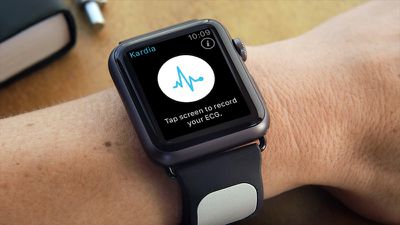
Kardia Band apple watch
According to AliveCor, Apple's decision to exclude third-party heart rate analysis providers from the Apple Watch has harmed AliveCor and impacted patients and consumers. To go along with the KardiaBand, AliveCor created the SmartRhythm app, which uses data from the Apple Watch's heart rate algorithm to determine when a heart rate is irregular and suggest people take an ECG with the KardiaBand.

The KardiaBand received FDA approval in 2017, and in 2018, Apple debuted the Apple Watch Series 4 with built-in ECG capabilities and its own irregular heart rhythm notifications followed. AliveCor claims that Apple saw the success of the KardiaBand and changed the functionality of watchOS to sabotage KardiaBand and "corner the market for heart rate analysis on Apple Watch."

AliveCor claims that the SmartRhythm app was initially allowed in the App Store, but Apple later claimed that it violated ‌App Store‌ guidelines. AliveCor says that it was forced to adapt SmartRhythm multiple times to adjust to Apple's rules, and then Apple "made changes to watchOS's heart rate algorithm" to ensure that SmartRhythm and other competing apps would not work. Apple allegedly changed the heart rate algorithm in watchOS 5 to prevent third-party apps from being able to identify irregular heart rate situations.

The algorithm was virtually the same on the first four versions of watchOS, but, with the introduction of the Series 4 Apple Watch and Apple's introduction of its competing heartrate analysis app, Apple released watchOS5, which, among other things, "updated" the Watch's heartrate algorithm. That update did not improve the user experience for Apple Watch purchasers; instead, its purpose and effect was simply to prevent third parties from identifying irregular heartrate situations and, thus, from offering competing heartrate analysis apps.

Prior to Apple's alleged sabotage, AliveCor says that its SmartRhythm app was "simply better at identifying worrisome heart-related health events," and could have successfully competed with the ECG function built into the Apple watch. AliveCor was forced to pull SmartRhythm from the ‌App Store‌ because the irregular rhythm functionality no longer worked.

All of this has been devastating to competition, as Apple today commands 100% share of heartrate analysis apps on watchOS devices and, if viewed in the alternative as part of either the U.S. ECG-capable smartwatch or U.S. ECG-capable wearable devices market, over 70% market share. With a single update, Apple thus eliminated competition that consumers clearly wanted and needed, depriving them of choice for heartrate analysis that is better than what Apple can provide.

AliveCor has previously filed several patent infringement lawsuits against Apple, alleging that Apple copied AliveCor's cardiological detection and analysis technology. Those lawsuits have not yet been resolved, and with today's antitrust suit, AliveCor is seeking damages and an injunction that would require Apple to "cease its abusive conduct."

This is just one of several antitrust battles that Apple is facing. A high-profile lawsuit brought by Epic Games wrapped up earlier this week, and there are also antitrust investigations into Apple's ‌App Store‌ fees in the UK and in the United States, among other countries.

Popular Stories

Apple Logo Black

Apple Just Made Its Second-Biggest Acquisition Ever After Beats

Thursday January 29, 2026 10:07 am PST by
Apple today confirmed to Reuters that it has acquired Q.ai, an Israeli startup that is working on artificial intelligence technology for audio. Apple paid close to $2 billion for Q.ai, according to sources cited by the Financial Times. That would make this Apple's second-biggest acquisition ever, after it paid $3 billion for the popular headphone and audio brand Beats in 2014. Q.ai has...
imac video apple feature

Apple Unveils First New Products of 2026

Monday January 26, 2026 1:55 pm PST by
Apple today introduced its first two physical products of 2026: a second-generation AirTag and the Black Unity Connection Braided Solo Loop for the Apple Watch. Read our coverage of each announcement to learn more:Apple Unveils New AirTag With Longer Range, Louder Speaker, and More Apple Introduces New Black Unity Apple Watch BandBoth the new AirTag and the Black Unity Connection Braided...
iPhone 5s

iPhone 5s Gets New Software Update 13 Years After Launch

Monday January 26, 2026 3:56 pm PST by
Alongside iOS 26.2.1, Apple today released an updated version of iOS 12 for devices that are still running that operating system update, eight years after the software was first released. iOS 12.5.8 is available for the iPhone 5s and the iPhone 6, meaning Apple is continuing to support these devices for 13 and 12 years after launch, respectively. The iPhone 5s came out in September 2013,...
Apple Creator Studio

Apple's Next Launch is Today

Tuesday January 27, 2026 2:39 pm PST by
Update: Apple Creator Studio is now available. Apple Creator Studio launches this Wednesday, January 28. The all-in-one subscription provides access to the Final Cut Pro, Logic Pro, Pixelmator Pro, Motion, Compressor, and MainStage apps, with U.S. pricing set at $12.99 per month or $129 per year. A subscription to Apple Creator Studio also unlocks "intelligent features" and "premium...
apple silicon 1 feature

Apple Responds to Skyrocketing RAM and Storage Chip Prices

Thursday January 29, 2026 2:40 pm PST by
On an earnings call with equity analysts today, Apple CEO Tim Cook responded to fast-rising RAM and SSD storage chip prices in the supply chain. Prices for RAM and NAND storage chips are surging lately due to high demand from companies building out AI servers, resulting in supply constraints. Cook said that rising memory chip prices had a "minimal impact" on Apple's gross margin in the...

Top Rated Comments

thisisnotmyname Avatar
61 months ago

Send your complaint to the FDA.
They did get FDA approval per the article but their complaint is that they are dependent upon Apple devices to trigger their own device's operation and Apple has changes its API so they can no longer trigger that process. If I were making a medical device that was dependent on Siemens imaging equipment to trigger my operation I wouldn't be at all surprised if Siemens unilaterally changed their interfaces either. That would have been a risk I took on by making my device dependent upon another manufacturer without contractual agreements in place to support said interface. They're taking a shot in the courts but it won't work out in their favor.

edit: typo
Score: 44 Votes (Like | Disagree)
calikid78 Avatar
61 months ago
It's nuts. You build your own platform, O/S and now you get sued because you won't give everyone access to your proprietary, hard work. Sounds like all these idiots should go invent their own tech and O/S and stop complaining about Apple's.
Score: 39 Votes (Like | Disagree)
nattK Avatar
61 months ago
Is suing Apple a trendy thing right now? It feels like everyone and their grandmother are out suing Apple nowadays.
Score: 37 Votes (Like | Disagree)
Mebsat Avatar
61 months ago
So Apple is using its monopoly power to dominate the Apple Watch ECG market?
Score: 37 Votes (Like | Disagree)
WiseAJ Avatar
61 months ago
Yeah Apple clearly copied them, because it's not like they were working for years on the ecg function for the Apple Watch and got it designed and FDA approved in under a year. :rolleyes:.

They need to start handing out shirts that say "I sued Apple and all I got was this T-Shirt"

This is getting ridiculous.
Score: 27 Votes (Like | Disagree)
swingerofbirch Avatar
61 months ago
What's sad is that AliveCor actually is better, too.

They've been doing this for a long time. Their a-fib detection is superior because it actually analyzes rates that are typical for a-fib, whereas Apple caps their detection to low pulse rates. AliveCor's algorithms have gotten really good and are approved for more diagnoses by the FDA than Apple's.

Tim Cook talks about reading letters of people's lives he's saved, and then they cut out a competitor that actually has a better and less expensive product. How many lives has that impacted?
Score: 22 Votes (Like | Disagree)