Apple Launches Study into Whether Apple Watch Can Detect COVID-19
Apple is launching a study into whether the Apple Watch can be used to detect respiratory illnesses such as coronavirus or flu, in partnership with the University of Washington and the Seattle Flu Study.
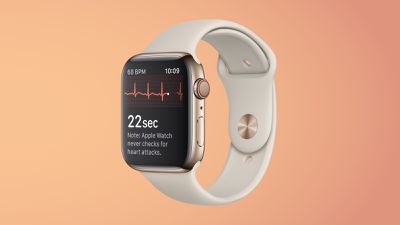
Apple initially announced the study at its Time Flies event in September last year, it but has only recently launched, as spotted by Apple Insider.
The goal of the study is to see if the information collected by the Apple Watch and iPhone can detect early signs of respiratory illnesses like COVID-19. If you are eligible and decide to participate, you will be provided an Apple Watch to wear. The watch will collect information about your health and activity. You will also be asked to answer simple survey questions in the Apple Research app on your iPhone about respiratory symptoms and lifestyle on a weekly and monthly basis.
If you get sick during the study, you will be provided with a free, at-home nasal swab to be tested for COVID-19 and other respiratory illnesses, and you will be asked to take some additional health measurements using your Apple Watch.
The study is expected to take "up to six months" and participants accepted into the program will be provided with an Apple Watch for research purposes, which they will be expected to wear "throughout the study, both day and night." Enrolment is open now for individuals in the greater Seattle area who are age 22 or older and have an Apple iPhone 6s or newer.
A previous independent study by Mount Sinai researchers found that an Apple Watch can effectively predict a positive COVID-19 diagnosis up to a week before current PCR-based nasal swab tests, which may be reinforced by the findings of this new study.
Previous independent Apple Watch studies have shown that the smartwatch's heart sensors may be able to detect early signs of diabetes and provide early warning signs of atrial fibrillation.

Popular Stories
Apple is planning to launch new MacBook Pro models as soon as early March, but if you can, this is one generation you should skip because there's something much better in the works.
We're waiting on 14-inch and 16-inch MacBook Pro models with M5 Pro and M5 Max chips, with few changes other than the processor upgrade. There won't be any tweaks to the design or the display, but later this...
Wednesday February 11, 2026 10:07 am PST by
Juli CloverApple today released iOS 26.3 and iPadOS 26.3, the latest updates to the iOS 26 and iPadOS 26 operating systems that came out in September. The new software comes almost two months after Apple released iOS 26.2 and iPadOS 26.2.
The new software can be downloaded on eligible iPhones and iPads over-the-air by going to Settings > General > Software Update.
According to Apple's release notes, ...
It has been a slow start to 2026 for Apple product launches, with only a new AirTag and a special Apple Watch band released so far. We are still waiting for MacBook Pro models with M5 Pro and M5 Max chips, the iPhone 17e, a lower-cost MacBook with an iPhone chip, long-rumored updates to the Apple TV and HomePod mini, and much more.
Apple is expected to release/update the following products...
Apple plans to announce the iPhone 17e on Thursday, February 19, according to Macwelt, the German equivalent of Macworld.
The report said the iPhone 17e will be announced in a press release on the Apple Newsroom website, so do not expect an event for this device specifically.
The iPhone 17e will be a spec-bumped successor to the iPhone 16e. Rumors claim the device will have four key...
Apple acquired Canadian graph database company Kuzu last year, it has emerged.
The acquisition, spotted by AppleInsider, was completed in October 2025 for an undisclosed sum. The company's website was subsequently taken down and its Github repository was archived, as is commonplace for Apple acquisitions.
Kuzu was "an embedded graph database built for query speed, scalability, and easy of ...