Accurate and rapid COVID-19 testing has become a critical hallmark in the battle against the pandemic. Unfortunately, getting tested on a mainstream level currently requires a trip to a clinic or government instituted site.
However, in a possible breakthrough of what it means to get tested, Kroger Health today announced it's planning to obtain FDA approval for the first smartphone-enabled COVID-19 rapid antigen test.
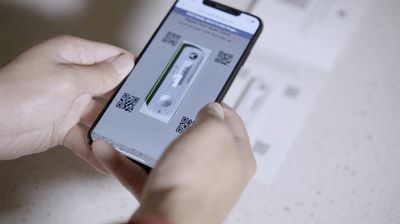
According to a press release, patients will administer a nasal swab themselves and complete a rapid antigen test. Then, patients will scan the rapid test using the app on their iPhone, and using AI technology, the app will provide their results "within seconds."
What the app aims to do is remove any doubt of the actual results of the test by using AI to correctly determine the location of the results line. In COVID-19 rapid antigen tests, the presence and location of a line in different areas determines whether the patient tests positive or negative for COVID-19, and some patients may misinterpret the lines, leading to a false understanding of what their result actually is.
In compliance with U.S. law, the app will automatically share the results with appropriate public health agencies and abides by all HIPAA rules and regulations. The hope is that this new test will increase the number of people who can get tested for COVID-19 themselves with a higher level of accuracy.
The new test is awaiting FDA approval, and clinical trial results submitted to the agency shows the test has a "93% positive agreement and 99% negative percent agreement compared to high-sensitivity, emergency-use-authorized PCR tests," according to Kroger Health.
Wednesday January 21, 2026 10:54 am PST by Joe Rossignol
In addition to updating many of its existing products, Apple is expected to unveil five all-new products this year, including a smart home hub, a Face ID doorbell, a MacBook with an A18 Pro chip, a foldable iPhone, and augmented reality glasses.
Below, we have recapped rumored features for each product.
Smart Home Hub
Apple home hub (concept)
Apple's long-rumored smart home hub should...
Apple is planning to debut a high-end secondary version of AirPods Pro 3 this year, sitting in the lineup alongside the current model, reports suggest.
Back in September 2025, supply chain analyst Ming-Chi Kuo reported that Apple is planning to introduce a successor to the AirPods Pro 3 in 2026. This would be somewhat unusual since Apple normally waits around three years to make major...
Wednesday January 21, 2026 12:31 pm PST by Juli Clover
Apple is working on a small, wearable AI pin equipped with multiple cameras, a speaker, and microphones, reports The Information. If it actually launches, the AI pin will likely run the new Siri chatbot that Apple plans to unveil in iOS 27.
The pin is said to be similar in size to an AirTag, with a thin, flat, circular disc shape. It has an aluminum and glass shell, and two cameras at the...
Tuesday January 20, 2026 2:34 am PST by Tim Hardwick
Over the last few months, rumors around the iPhone 18 Pro's front-panel design have been conflicted, with some supply-chain leaks pointing to under-display Face ID, reports suggesting a top-left hole-punch camera, and debate over whether the familiar Dynamic Island will shrink, shift, or disappear entirely.
Today, Weibo-based leaker Instant Digital shared new details that appear to clarify the ...
Thursday January 22, 2026 9:31 am PST by Joe Rossignol
Apple is expected to release MacBook Pro models with M5 Pro and M5 Max chips soon, but you might want to pass on them, as bigger changes are around the corner.
It has been reported that the MacBook Pro will be receiving a major redesign in late 2026 or in 2027. Six new features have been rumored so far, including an OLED display, touch capabilities, a Dynamic Island, M6 Pro and M6 Max chips...
The overlooked factor is the self administered nasal swap. Having had a swab myself I know how uncomfortable it is (it feels like the swab is scraping your brain) and I would seriously doubt how reliably the average person would be able to self-administer this. Not going far enough up the nose likely won't gather the required antigens resulting in false negative results. In the UK dome doctors have esitmate that 1 in 3 negative test results may be invalid, presumably due to this.
I know it's hard to perfectly copyedit stories, given the short time you have to write and post them. But even by the relaxed standards of internet publishing, this is the worst article I've ever seen on this site.
The first three sentences, in particular, are amazing. While I'm pretty sure I can figure out what the author meant to say, what they actually wrote was virtually babble. "tested on a mainstream level"? "breakthrough of what it means to get tested"?
The issue is the reliability of the rapid COVID-19 test:
if a person is asymptomatic, they might not have high enough levels of virus in their mucus to test positive.
And this is the real concern with using rapid testing:
Experts warn that you shouldn't treat rapid testing as a free pass to attend a party or wedding ('https://www.womenshealthmag.com/health/a32400011/how-to-see-friends-and-family-once-quarantine-ends/').