Skip to Content

Apple's T2 Chip Has Unpatchable Security Flaw, Claims Researcher [Updated]

Intel Macs that use Apple's T2 Security Chip are vulnerable to an exploit that could allow a hacker to circumvent disk encryption, firmware passwords and the whole T2 security verification chain, according to team of software jailbreakers.
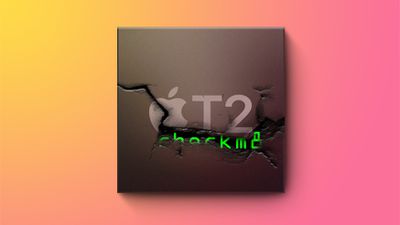
t2checkm8 1
Apple's custom-silicon T2 co-processor is present in newer Macs and handles encrypted storage and secure boot capabilities, as well as several other controller features. In a blog post, however, security researcher Niels Hofmans notes that because the chip is based on an A10 processor it's vulnerable to the same checkm8 exploit that is used to jailbreak iOS devices.

This vulnerability is reportedly able to hijack the boot process of the T2's SepOS operating system to gain access to the hardware. Normally the T2 chip exits with a fatal error if it is in Device Firmware Update (DFU) mode and it detects a decryption call, but by using another vulnerability developed by team Pangu, Hofmans claims it is possible for a hacker to circumvent this check and gain access to the T2 chip.

Once access is gained, the hacker has full root access and kernel execution privileges, although they can't directly decrypt files stored using FileVault 2 encryption. However, because the T2 chip manages keyboard access, the hacker could inject a keylogger and steal the password used for decryption.

According to Hofmans, the exploit can also bypass the remote device locking function (Activation Lock) that's used by services like MDM and FindMy. A firmware password won't help prevent this either because it requires keyboard access, which requires the T2 chip to run first.

For security reasons, SepOS is stored in the T2 chip’s read-only memory (ROM), but this also prevents the exploit from being patched by Apple with a software update. On the plus side, however, it also means the vulnerability isn't persistent, so it requires a "hardware insert or other attached component such as a malicious USB-C cable" to work.

Hofmans says he has reached out to Apple about the exploit but is still awaiting a response. In the meantime, average users can protect themselves by keeping their machines physically secure and by avoiding plugging in untrusted USB-C cables and devices.

Lastly, the researcher notes that upcoming Apple Silicon Macs use a different boot system, so it's possible that they won't be impacted by the vulnerability, although this is still being actively investigated.

Update: The original report incorrectly referred to Niels Hofmans as the cybersecurity expert who carried out the research. Hofmans is in fact an industry consultant who provided impact analysis of the T2 and checkm8. This has now been corrected.

Popular Stories

Multicolored Low Cost A18 Pro MacBook Feature

Apple Accidentally Leaks 'MacBook Neo'

Tuesday March 3, 2026 7:00 am PST by
Apple appears to have prematurely revealed the name of its rumored lower-cost MacBook model, which is expected to be announced this Wednesday. A regulatory document for a "MacBook Neo" (Model A3404) has appeared on Apple's website. Unfortunately, there are no further details or images available yet. While the PDF file does not contain the "MacBook Neo" name, it briefly appeared in a link...
imac video apple feature

Apple Unveils Two New Products

Monday March 2, 2026 7:49 am PST by
Apple today introduced two new devices, including the iPhone 17e and an updated iPad Air. iPhone 17e features the same overall design as the iPhone 16e, but it gains Apple's A19 chip, MagSafe for magnetic wireless charging and magnetic accessories, Apple's second-generation C1X modem for faster 5G, and a doubled 256GB of base storage. In the U.S., the iPhone 17e starts at $599, just like the ...
Apple iPhone 17e feature

Apple Announces iPhone 17e With A19 Chip, MagSafe, and More

Monday March 2, 2026 6:07 am PST by
Apple today announced the iPhone 17e, featuring the A19 chip, MagSafe connectivity, faster charging, and more. The iPhone 17e contains the A19 chip introduced in iPhone 17. It features a 6-core GPU and a 4-core GPU. Apple pointed out that this makes it up to 2x faster than the iPhone 11. The new 16-core Neural Engine is optimized for large generative models. The iPhone 17e also contains...

Top Rated Comments

Bug-Creator Avatar
71 months ago

Apple isn't ready, willing, or able to do the groundwork necessary to keep their chips secure.
How many exploits and hacks have we seen on Intel/AMD chips? How many on non-Apple ARM? How many on support chips (SSD-controllers, WIFI/4G-modems)?

How many in Win/Android vs macOS/iOS?

In the end nothing is ever gonna be 100% safe for ever, but so far Apple's track record is quite good.
Score: 107 Votes (Like | Disagree)
71 months ago

Another reason why Apple Silicon is a horrible idea. Apple isn't ready, willing, or able to do the groundwork necessary to keep their chips secure. Get used to the Mac going from one of the most secure platforms out there to being ridden with horrible, unpatchable bugs and security exploits.

It's one thing when you can make the OS a walled garden, like with iOS. When you can control the software, you don't need to worry about the hardware being buggy. But unless we're going to have the Mac App Store be the only source for Mac apps, get used to having your computer pwned on a daily basis once Apple Silicon is a reality.
umm, have you seen or heard about intel exploits...
Score: 75 Votes (Like | Disagree)
twistedpixel8 Avatar
71 months ago

How many exploits and hacks have we seen on Intel/AMD chips? How many on non-Apple ARM? How many on support chips (SSD-controllers, WIFI/4G-modems)?

How many in Win/Android vs macOS/iOS?

In the end nothing is ever gonna be 100% safe for ever, but so far Apple's track record is quite good.
Well yes but on a chip whose sole purpose is security...? That’s not great is it.
Score: 36 Votes (Like | Disagree)
jclardy Avatar
71 months ago

Another reason why Apple Silicon is a horrible idea. Apple isn't ready, willing, or able to do the groundwork necessary to keep their chips secure. Get used to the Mac going from one of the most secure platforms out there to being ridden with horrible, unpatchable bugs and security exploits.

It's one thing when you can make the OS a walled garden, like with iOS. When you can control the software, you don't need to worry about the hardware being buggy. But unless we're going to have the Mac App Store be the only source for Mac apps, get used to having your computer pwned on a daily basis once Apple Silicon is a reality.
I guess you already forgot about Meltdown and Spectre? Intel has been shipping vulnerable chips for years.
Score: 34 Votes (Like | Disagree)
71 months ago

Apple isn't ready, willing, or able to do the groundwork necessary to keep their chips secure.
did u miss the part where I said this is fixed in the A12 and intel chips have even worse security issues..
Score: 28 Votes (Like | Disagree)
71 months ago

Another reason why Apple Silicon is a horrible idea. Apple isn't ready, willing, or able to do the groundwork necessary to keep their chips secure. Get used to the Mac going from one of the most secure platforms out there to being ridden with horrible, unpatchable bugs and security exploits.

Patently false. Such a stupid comment. Apple sold over a billion iPhones (their core business) and you're saying they're not taking necessary steps to keep their chips secure? Sorry, but that's one of the most ridiculous things I've ever heard on this forum.
Score: 25 Votes (Like | Disagree)