Skip to Content

Apple Interested in Developing ARM-Based Mac Processors and iPhone Modems in House

Apple is continuing to expand manufacturing efforts related to the production of its own chips, according to a new report today by Nikkei, which stated that the company aims to "better compete" in the artificial intelligence field and reduce reliance on major suppliers like Intel and Qualcomm. Nikkei's sources said Apple's interest lies in building "core processors for notebooks, modem chips for iPhones, and a chip that integrates touch, fingerprint and display driver functions."

Apple has reportedly "invested in research and development" for baseband modem chips -- currently sourced from Intel and Qualcomm -- which are required for cellular communication features on Apple's mobile devices. Analysts pointed towards Apple's legal fight with Qualcomm, and its poaching of Qualcomm modem chip engineer Esin Terzioglu, as examples to bolster the theory that the Cupertino company is ready to build its own modem chips.
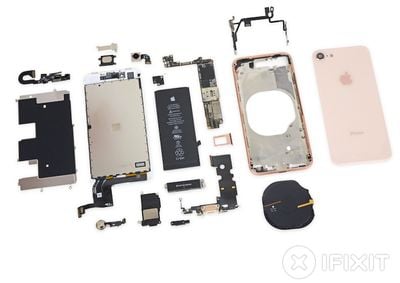
ifixit teardown iphone 8

iPhone 8 teardown by iFixit

Building its own core processor chips for MacBooks would reduce Apple's dependence on Intel, with two industry sources stating that Apple would instead build its notebook chips using ARM Holding's technology, a British company that designs ARM architecture and licenses it out to other companies. Apple's interest in designing chips that integrate touch, fingerprint and display driver functions is said to be because the company "wants to control next-generation display technology and some related key components."

Multiple analysts provided theories behind Apple's move to design more of its own chips for its products, which included staying on the forefront of artificial intelligence, lowering production costs, better protecting proprietary technology, and more.

"By designing its own chips, Apple can better differentiate itself from others. Further, depending too much on other chip suppliers in the age of artificial intelligence will deter its development," said Mark Li, a Hong Kong-based analyst with Sanford C. Bernstein.

"We believe that more system houses will design their own chips. The purposes are to develop and protect their proprietary technology information, to make more efficient chips for their unique need, to lower [costs] and to do inventory control better and keep all logistic operation confidentially," Samuel Wang, a U.S.-based analyst at research company Gartner, said..

Apple has long designed and built the core processing chips found in iPhones and iPads, but this year reports began to emerge of the company's hope to expand the amount of internal iOS device components that it creates on its own. In April, Apple informed Imagination Technology that it would stop using its graphics technology over the next two years, aiming to make its own graphics processing chips and lessen its reliance on the supplier. Less official was a prediction by analyst Karsten Iltgen that Apple would drop Dialog Semiconductor from its supply chain and move to its own in-house power management chips for iPhones by 2019.

This week, Apple was part of a consortium that purchased Toshiba's much-sought-after NAND memory chip unit for $17.7 billion, another move that will eventually allow Apple to be less reliant on other suppliers for device components. Still, many of Apple's in-house chip production lines are many years off, with analyst Mark Li stating that it's "unlikely" Apple will be able to debut its own components -- specifically referring to the modem chips -- within the next two years.
Tag: Nikkei

Popular Stories

MacBook Neo Feature Pastel 1

First MacBook Neo Benchmarks Are In: Here's How It Compares to the M1 MacBook Air

Thursday March 5, 2026 4:07 pm PST by
Benchmarks for the new MacBook Neo surfaced today, and unsurprisingly, CPU performance is almost identical to the iPhone 16 Pro. The MacBook Neo uses the same 6-core A18 Pro chip that was first introduced in the iPhone 16 Pro, but it has one fewer GPU core. The MacBook Neo earned a single-core score of 3461 and a multi-core score of 8668, along with a Metal score of 31286. Here's how the...
imac video apple feature

Apple Unveils Seven New Products

Friday March 6, 2026 11:48 am PST by
Apple this week unveiled seven products, including an iPhone 17e, an iPad Air with the M4 chip, updated MacBook Air and MacBook Pro models, a new Studio Display, a higher-end Studio Display XDR, and an all-new MacBook Neo that starts at just $599. iPhone 17e features the same overall design as the iPhone 16e, but it gains Apple's A19 chip, MagSafe for magnetic wireless charging and magnetic...
Apple MacBook Pro M4 hero

Apple Planning 'MacBook Ultra' With Touchscreen and Higher Price

Sunday March 8, 2026 8:05 am PDT by
Apple is planning to launch an all-new "MacBook Ultra" model this year, featuring an OLED display, touchscreen, and a higher price point, Bloomberg's Mark Gurman reports. Gurman revealed the information in his latest "Power On" newsletter. While Apple has been widely expected to launch new M6-series MacBook Pro models with OLED displays, touchscreen functionality, and a new, thinner design...


Top Rated Comments

110 months ago
Macs can't move to ARM unless they invent x86 to ARM instruction set translation without performance penalty - Mac doesn't make sense without ability to run x86 virtual machines (Linux, Windows).
Score: 30 Votes (Like | Disagree)
110 months ago
I have said this for years and every one goes no no intel this intel that processor change this processor that. I go look apple is going to start the process of having the entire OS written in a higher level language or a modern level C so that they can combine it and all the built in libraries over to ARM. Then it is a simple re-compile for most not all applications to join the ARM OS X train. This is where apple is going. There is no reason to update the Dock or Finder ETC with a total re-write to a new language otherwise. They are moving the ball slowly and in clear view to ARM. The first mechanical cooled ARM chip is now in the ATV. They are getting ready to see how far they can push the Atv it is a low risk product with low sales currently. They can latter on push it hard and if they fail they have good understanding of thermal loads in the wild. They are going to make a MacBook A series chip. This is going to happen when is the only question I have left. They have several sub-systems left to migrate on the UI side of the house. They also need to start to get developers into the idea that the apps need to be universal again. This push will come with a new heavy push for the App Store. This why the universal binaries are handled on the back end away from the user. The arm user will not know they are using arm unless they look at the specs. This is where they want to go. So you can write it one time and have it run multi thread monster on the Mac Pro or multi thread mini on the ARM in the MacBook scales perfectly and is universal. This is where apple has pointed the ship. Intel has nothing on the road map at the sub 15 watt chip size that punches. I know now I will get the people who go but arm is not intel the benchmarks don't compare etc etc. This is going to happen. So strap in for the next decade cause it will be ARM and it will be universal binaries and it will all feel like a throw back to the early 2k.
Score: 28 Votes (Like | Disagree)
WiiDSmoker Avatar
110 months ago
Lots of companies are gonna be in for a world of financial hurt when Apple pulls their contracts and no longer needs them.
Score: 16 Votes (Like | Disagree)
Scottsoapbox Avatar
110 months ago
Apple keeps claiming the A series is as powerful as Intel's chips yet the switch hasn't come.

To bad notebooks can't run on marketing hype.
Score: 15 Votes (Like | Disagree)
zorinlynx Avatar
110 months ago
No doubt they have prototypes in Cupertino leveraging ARM/Intel hybrids and internal versions of macOS rigged on ARM probably running iPad-like apps, but I'm curious if they'd make the investment on a platform that is responsible for less than 20% of their revenue, a platform some would call "legacy computing"... certainly the Mac is an important business segment, but with the "maintain course mode" it has been on for the past 5 or so years, would they bother re-engineering it significantly as they did when they moved from PPC to Intel in '06.
Macs are not "legacy computing". Try using an iPad to do any sort of real work for any length of time; you will want to throw it at a wall. You still need a Mac (or even a Windows or Linux PC, let's be fair) to do real work. You still need a real computer to do software development.

Like it or not, iPads and iPhones are best at consuming content, communication, etc... They are not good productivity tools. Sure, there are things you can do on an iPad, but once the scope of work becomes more involved, you're going to want a real computer.

If I had to depend solely on an iPad to do my job I would go crazy in short order.
Score: 13 Votes (Like | Disagree)
110 months ago
not surprising at all. Microsoft demoed Windows running on ARM snapdragon 835. If apple wants to create a Mac Laptop with bootcamp support for Windows ARM, they could. Can't wait for the "Transition Keynote" "Motorola to PPC, PPC to intel and now Intel to Arm"
Score: 12 Votes (Like | Disagree)