Intel's Upcoming Ultra-Fast Optane SSD May Come to MacBooks - MacRumors
Skip to Content

Intel's Upcoming Ultra-Fast Optane SSD May Come to MacBooks

Last summer, Intel announced 3D Xpoint, a new class of memory labeled as a "major breakthrough in memory process technology." 3D Xpoint is 1,000 times faster and more durable than NAND Flash storage, as well as 10 times denser than the DRAM chips used in computers.

The innovative, transistor-less cross point architecture creates a three-dimensional checkerboard where memory cells sit at the intersection of word lines and bit lines, allowing the cells to be addressed individually. As a result, data can be written and read in small sizes, leading to faster and more efficient read/write processes.

Intel has promised that the first 3D Xpoint (pronounced "crosspoint") product will be coming in early 2016 in the form of its Optane solid state drives, which may be of interest to Apple. According to Macworld, 3D Xpoint is compatible with NVM Express (NVMe), an SSD protocol that offers improved latency and performance over the older AHCI protocol.
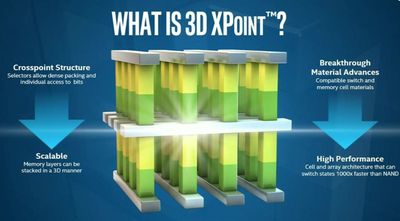
intel3dxpoint
Apple's Retina MacBooks already use NVMe technology, and it's likely Skylake Macs set to be released across 2016 will also support NVMe. With NVMe compatibility built into 3D Xpoint, Apple could adopt Intel's Optane solid state drives for super fast performance speeds that significantly outpace what's possible with current SSDs. As Macworld points out, Apple is often an early adopter of emerging technology, having been the first company to implement Thunderbolt and chip technology from Intel.

While Intel is planning to make its Optane SSDs available in 2016, the technology is unlikely to see widespread adoption right away. 3D Xpoint storage solutions will likely exist alongside NAND Flash options until prices become affordable enough for use in mass-produced products. Intel is also working on Optane memory DIMMs.

If Apple does choose to use Intel's Optane SSDs in future Macs, it could be some time before Optane-equipped machines are available. Upgraded Macs that are expected in 2016 will likely continue to use NAND Flash, but as mentioned previously, speed improvements could come in the form of wider NVMe adoption.

Skylake chips appropriate for many of Apple's Macs are currently available or will be available in the near future, so we may begin seeing the the first Mac upgrades in the next few months, perhaps at Apple's annual Worldwide Developers Conference.

Popular Stories

Tim Cook Rainbow

Apple CEO Tim Cook Stepping Down, John Ternus Taking Over

Monday April 20, 2026 1:33 pm PDT by
Apple CEO Tim Cook is stepping down as Apple's chief executive officer, and hardware engineering chief John Ternus is set to take over, Apple announced today. Cook will continue on as Apple CEO through the summer, with Ternus set to join Apple's Board of Directors and take over as CEO on September 1, 2026. Cook is going to transition to executive chairman, and he will "assist with certain...
Four iPhone 18 Pro Colors Mock Feature

iPhone 18 Pro Launching in September With These 10 New Features

Monday April 20, 2026 7:13 am PDT by
While the iPhone 18 Pro and iPhone 18 Pro Max are not launching until September, there are already plenty of rumors about the devices. It was initially reported that the iPhone 18 Pro models would have fully under-screen Face ID, with only a front camera visible in the top-left corner of the screen. However, the latest rumors indicate that only one Face ID component will be moved under the...
macOS 27 on MacBook Pro

macOS 27 Will Mark the End of an Era

Saturday April 18, 2026 6:45 am PDT by
During its Platforms State of the Union segment at WWDC 2025, Apple revealed that macOS 26 Tahoe is the final major macOS version for Intel-based Macs. The upcoming macOS 27 release will be compatible with Apple silicon Macs only, meaning that you will need a Mac with an M-series chip or a MacBook Neo with an A18 Pro chip in order to install the software update. macOS 27 should be available...


Top Rated Comments

132 months ago
Apple's Retina MacBooks ('https://www.macrumors.com/2015/04/11/nvme-mac-os-x/') already use NVMe technology, and it's likely Skylake Macs set to be released across 2016 will also support NVMe.
Except for iMacs, which will continue to use 5400rpm HDDs.
Score: 102 Votes (Like | Disagree)
132 months ago
Except for iMacs, which will continue to use 5400rpm HDDs.
Na. They’ll upgrade to 16GB of flash.
Score: 27 Votes (Like | Disagree)
pushingrobot Avatar
132 months ago
Except for iMacs, which will continue to use 5400rpm HDDs.
Don't worry, I hear Apple is working with Intel to develop a 5400rpm Xpoint.
Score: 25 Votes (Like | Disagree)
132 months ago
Except for iMacs, which will continue to use 5400rpm HDDs.
"ENTITLED!!!1!"
"Stop being cheap!!"
"Apple doesn't owe you anything!"
"If you want better storage, simply pay more."

/s
Score: 22 Votes (Like | Disagree)
132 months ago
This is one of those things that just sounds insanely awesome. Hopefully it will be standard in all Macs...Or at least SSD be standard in all Macs.
Knowing Apple, it is probably going to be a pricey upgrade option.
Score: 13 Votes (Like | Disagree)
keysofanxiety Avatar
132 months ago
Apple is typically first to adopt Intels new stuff, so I can totally see the new MBP's utilizing this and TB3/USB3.1.
Hate to say it; but DDR4 gaming laptops, and workstations with 16-core Xeon chips, would refute that statement.
Score: 11 Votes (Like | Disagree)