Aside from the "all-day" battery life that comes alongside the upgrade to Intel's Haswell processors in the new MacBook Air, one of the other major improvements is the adoption of PCIe-based flash storage for much faster performance. The new PCIe flash will also be coming to Apple's radically redesigned Mac Pro later this year, and undoubtedly other Macs as well.
Available in capacities up to 512GB, this next-generation flash storage is up to 9x faster than a traditional 5400-rpm notebook hard drive. And it’s up to 45 percent faster than the flash storage in the previous-generation MacBook Air. So when you flip open MacBook Air, it’s ready to go right away. Even after a month in standby mode, the screen springs to life.
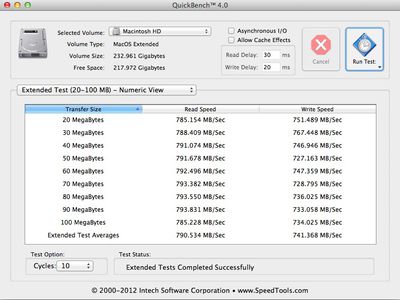
AnandTech has taken a closer look at flash storage performance and other benchmarks in the new MacBook Air, finding that read/write speeds are approaching 800 MB/s.
The drive in my system uses a Samsung controller, although I've heard that SanDisk will have a PCIe solution for Apple as well. A quick run through Quick Bench reveals peak sequential read/write performance of nearly 800MB/s.
This is a pretty big deal, as it is probably the first step towards PCIe storage in a mainstream consumer device that we've seen.
Beyond battery life and flash storage enhancements and the shift to Haswell, Apple's new MacBook Air brings several other enhancements as well, including faster 802.11ac Wi-Fi and dual microphones for reducing background noise.

Wednesday February 11, 2026 10:07 am PST by Juli Clover
Apple today released iOS 26.3 and iPadOS 26.3, the latest updates to the iOS 26 and iPadOS 26 operating systems that came out in September. The new software comes almost two months after Apple released iOS 26.2 and iPadOS 26.2.
The new software can be downloaded on eligible iPhones and iPads over-the-air by going to Settings > General > Software Update.

According to Apple's release notes, ...

Tuesday February 10, 2026 4:27 pm PST by Juli Clover
Apple is planning to launch new MacBook Pro models as soon as early March, but if you can, this is one generation you should skip because there's something much better in the works.
We're waiting on 14-inch and 16-inch MacBook Pro models with M5 Pro and M5 Max chips, with few changes other than the processor upgrade. There won't be any tweaks to the design or the display, but later this...
Thursday February 12, 2026 11:17 am PST by Joe Rossignol
Apple plans to release an iPhone 17e and an iPad Air with an M4 chip "in the coming weeks," according to the latest word from Bloomberg's Mark Gurman.
"Apple retail employees say that inventory of the iPhone 16e has basically dried out and the iPad Air is seeing shortages as well," said Gurman. "I've been expecting new versions of both (iPhone 17e and M4 iPad Air) in the coming weeks."...
Apple acquired Canadian graph database company Kuzu last year, it has emerged.
The acquisition, spotted by AppleInsider, was completed in October 2025 for an undisclosed sum. The company's website was subsequently taken down and its Github repository was archived, as is commonplace for Apple acquisitions.
Kuzu was "an embedded graph database built for query speed, scalability, and easy of ...
Tuesday February 10, 2026 1:51 pm PST by Joe Rossignol
Apple plans to announce the iPhone 17e on Thursday, February 19, according to Macwelt, the German equivalent of Macworld.
The report said the iPhone 17e will be announced in a press release on the Apple Newsroom website, so do not expect an event for this device specifically.
The iPhone 17e will be a spec-bumped successor to the iPhone 16e. Rumors claim the device will have four key...
I disagree with complaints out there that the MBA upgrades were optimized primarily for battery life, and not performance. As an example, the clock speeds were lowered to further extend battery life - keeping Geekbench performance roughly on par with last year's machines rather than providing the standard 20% improvement.
For one thing, this new Flash architecture isn't something to sneeze at.
But more importantly, I bet you anything the rMBP's are where they will look more to performance. Which only makes sense, as it would continue differentiating the two lines.
And if that's the case, going all-in for battery life is the right decision for their consumer-grade notebooks.
As an aside - 9to5mac anecdotally reports double the battery life on a 2008 MBP running Mavericks. Imagine combining those OS gains with the new Haswell machines!!!