In November 2020, Apple updated the Mac mini with the first Apple silicon chip for the Mac, the M1 chip. However, Apple continues to sell its older, Intel-based Mac mini. The Intel Mac mini last received a significant update in 2018, so why is Apple still selling its older Mac mini?
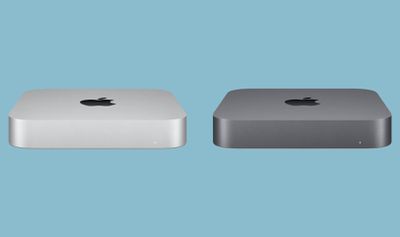
Curiously, rather than making the older model available for a lower price, Apple is presenting the Intel-based Mac mini as a high-end option, starting at $1,099, which is substantially more than the $699 starting price of the Apple silicon-based Mac mini. Our guide helps to answer the question of how to decide which of these two Mac minis is best for you.
Comparing the M1 Mac mini and the Intel Mac mini
The M1 Mac mini and the Intel Mac mini share a large number of important features such as design, storage capability, and USB-A ports. Apple lists these same features of the two devices:
Similarities
- Compact industrial design
- Up to 2TB storage
- Bluetooth 5.0 wireless technology
- Two USB-A ports
- HDMI 2.0 port
- Gigabit Ethernet or optional 10Gb Ethernet
Although the two Mac minis share a number of features, the two machines have more in contrast than they do in common, including memory capacity, ports, and external display capability.
Differences
M1 Mac mini
- Eight-core Apple M1 chip with eight-core GPU and 16-core Neural Engine
- Up to 16GB unified memory
- Support for one display up to 6K and one display up to 4K
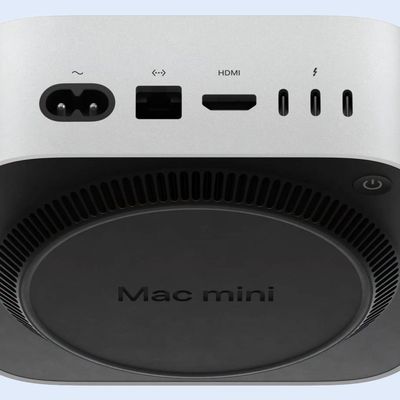
- Two Thunderbolt / USB 4 ports
- 802.11ax Wi-Fi 6
- Silver
Intel Mac mini
- Up to six-core Intel Core i7 processor with Intel UHD Graphics 630
- Up to 64GB memory
- Support for up to three 4K displays or one 5K display and one 4K display
- Four Thunderbolt 3 (USB-C) ports
- 802.11ac Wi-Fi
- Space Gray
Read on for a closer look at each of these aspects, and see exactly where Apple's Mac minis differ.
Performance
The key difference between the two Mac minis is their processors. The main Mac mini Apple now sells contains the M1 chip, which is Apple's first custom silicon SoC for the Mac. The M1 has an eight-core CPU with four performance cores and four efficiency cores, and an eight-core GPU.
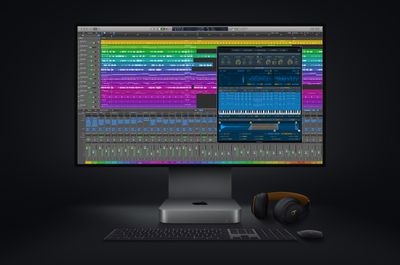
Apple also offers the Mac mini with two different Intel processors, a 3.0GHz 6-core Intel Core i5 with Turbo Boost up to 4.1GHz, and a 3.2GHz 6-core Intel Core i7 with Turbo Boost up to 4.6GHz. Both come with Intel UHD Graphics 630.
In Geekbench 5 averages, the 3.0GHz 6-core Intel Core i5 achieves a single-core score of 998, while the more powerful 3.2GHz 6-core Intel Core i7 model comes in with a single-core score average of 1,101.

When looking at average multi-core scores, the 3.0GHz model comes in at 4,651 while the 3.2GHz model achieves an average score of 5,474.

Early benchmarks suggest that the M1 in the Apple silicon Mac mini achieves a much higher single-core score of 1,682 and a multi-core score of 7,097, and the M1's extremely impressive performance has been demonstrated in other benchmarks.

Since the M1 is clearly more powerful than either of the Intel offerings in the Mac mini, who should consider the Intel processors? If you need to run Windows via Boot Camp, virtual machine apps that virtualize x86_64 platforms, apps which you are concerned may not run well under Rosetta 2's translation layer, or use eGPUs, the Intel Mac mini offers a more reliable option. If your workflow is dependent on older technologies, it may be better to buy the Intel Mac mini until Apple Silicon becomes more mature.
For the vast majority of users, the M1 offers a major performance increase, but a small segment of "pro" users may be better suited to an Intel-based machine.
Memory
The M1 Mac mini only supports configurations of 8GB or 16GB of unified memory, but the Intel Mac mini can support up to 64GB of memory. While 8GB or 16GB should be sufficient for most users given the efficiency of having everything integrated on one chip, some pro workflows demand much larger amounts of memory. In these cases, the Intel Mac mini, which offers significantly higher 32GB and 64GB RAM configurations, will be a much more viable option.
Connectivity and Ports
Unlike memory, where the Intel Mac mini is clearly more capable, the picture is a bit mixed when it comes to connectivity and ports.
The M1 Mac mini has two Thunderbolt and USB 4 ports, while the Intel Mac mini has four Thunderbolt 3 and USB 3 ports. So, if you need more ports the Intel Mac mini is better, but if you need to connect USB 4 devices at maximum speeds, you will need the M1 Mac mini.
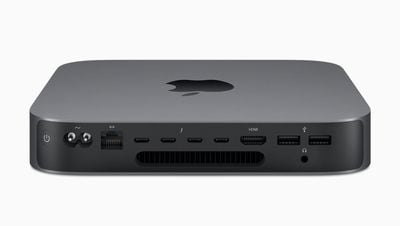
Both models come with Gigabit Ethernet as standard, with 10Gb Ethernet available on both as a $100 upgrade. On the other hand, the M1 Mac mini supports 802.11ax Wi-Fi 6, while the older Intel Mac mini only supports 802.11ac Wi-Fi.
As a result, neither of the Mac mini models is clearly better. Choosing between the two models will depend on what specific connectivity requirements you have. Generally, pro users may be better off getting the Intel model for now due to its additional USB ports, but each individual will have to weigh up what specific connectivity they need.
External Display
The picture between the Mac mini models is also mixed when it comes to external display support. The M1 Mac mini can support one display up to 6K and one display up to 4K, while the Intel Mac mini can support up to three 4K displays, or one 5K display and one 4K display.
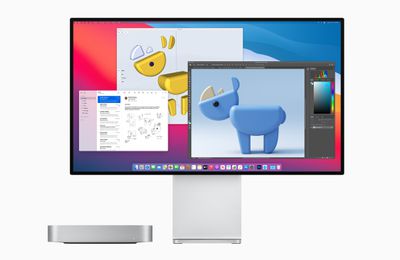
This means that to use a 6K display such as Apple's Pro Display XDR, you must have the M1 Mac mini. However, if you want to use three 4K displays, you must have the Intel Mac mini. You cannot use three displays with the M1 Mac mini. Users should therefore carefully consider their external display setup before deciding on either machine.
Color
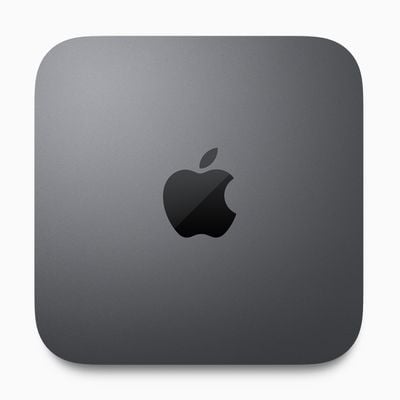
Although it may not be important to many users, it is worth noting that the M1 Mac mini comes in Silver, while the Intel Mac mini comes in Space Gray. There are no other color options for either machine.
Other Mac Options
Other Macs, such as the 24-inch iMac, contain the M1 chip. Most Macs have now transitioned to Apple silicon, but Apple is still in the process of updating its entire Mac lineup to add Apple silicon chips.
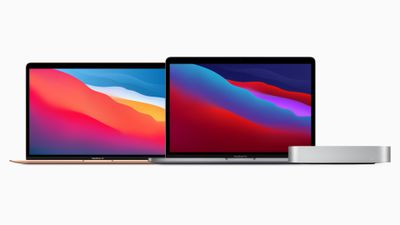
The M1 Mac mini holds a fairly unique place in the current Mac lineup as the only M1 Mac without a display, which makes it difficult to highlight specific alternatives to it. The Apple desktop closest to the Mac mini is the 24-inch iMac since it contains the M1 chip, but this is an all-in-one device.
Final Thoughts
Overall, it is clear that the two Mac mini models are significantly different from one another. You should only consider the older Intel-based Mac mini if you are dependent on an Intel architecture for tasks that do not work with Apple silicon. Similarly, if you require a large amount of RAM or want to have many USB devices attached directly to your machine, the Intel model is the only feasible option.
However, the M1 Mac mini is undoubtedly the more modern device and will be the best option for the vast majority of users. Not only is the M1 Mac mini markedly more powerful, but it is also less costly than its Intel predecessor. The Apple silicon M1 Mac mini is available to order now.