MacRumors

VentureBeat claims that Apple specifically asked Google not to use Multi-Touch in their Android platform and Google agreed. The report comes from an unidentified member of the Android team:

Apple, which of course makes the signature multi-touch mobile device, the iPhone, apparently asked Google not to implement it, and Google agreed, an Android team member tells us.

According to the report, Google wanted to avoid risking its relationship with Apple. The same source claims that Apple's relationships with Palm have significantly soured surrounding the recent public statements that Apple would aggressively protect the iPhone's intellectual property. Palm's new Pre Phone is the first mobile phone to offer multi-touch gestures similar to Apple's iPhone.

Related Forum: iPhone

051008 41bYgwfum2L 425

The big non-Apple tech news yesterday was Amazon's announcement of the Kindle 2. The Kindle was Amazon's first entry into the gadget market with an electronic book reader that was described as "the iPod of reading". The original Kindle offered sales of eBooks over the air through a wireless EVDO connection without a monthly contract.

The new Kindle has made a number of steady improvements over the original design. Features include:

- Thinner. 0.36 inches thick.
- 3G wireless, no monthly fees
- Improved 16 grey-shade display
- 25% longer battery life. "read for days"
- Faster page turns
- More storage (Up to 1500 books)
- Instant dictionary lookup
- Text-to-Speech

The new Kindle will cost $359 and ship on February 24th with pre-orders starting now.

With the introduction of the original Kindle, some Apple customers have hoped that Apple might also enter the eBook market. Jobs dismissed that possibility in early 2008 when asked about the Kindle:

"It doesn't matter how good or bad the product is, the fact is that people dont read anymore," he said. "Forty percent of the people in the U.S. read one book or less last year. The whole conception is flawed at the top because people dont read anymore."

Meanwhile, the iPhone may have inadvertently become the largest eBook reader with the introduction of various eBook apps through the iTunes App Store.

The main issue with these free iPhone readers, however, has been the lack of premium content (new releases) that is found on the Kindle. In the future, there may be more synergy between the technolgies as Amazon also announced last week that they would be working to make Kindle books available "on a range of mobile phones", leading some to believe that the iPhone could someday gain access to Amazon's digital library.


Apple has begun surveying new Apple TV owners to get an idea for what customers usage habits are surrounding the digital media appliance. The email sent to some Apple TV owners reads:

Please take a few minutes to complete this survey to help us understand how you use your Apple TV. Your responses will remain completely confidential and results will be viewed only in aggregate. We value and appreciate your input.

The questions of the survey asked about what sources video content came from, what hardware equipment that the Apple TV was used with and what other equipment the users own. It also asks the open-ended question of "If you could change one thing about your Apple TV, what would that be?". AppleInsider speculates that this information will shape the future of the Apple TV.

It certainly will help Apple profile the individuals who are buying their product. The Apple TV has long been described by Apple management as a "hobby" product rather than a serious revenue stream as the iPod, Mac and iPhones are.

Apple's plans for the Apple TV have always been a bit of a mystery, and, as a result, we have not featured it on our Buyer's Guide. As it stands, the Apple TV acts as a set-top iPod and has enough horsepower to play all the content required from the iTunes store. As a result, no regular updates are required to fulfill this basic need. When and if Apple decides to transition the Apple TV into a separate product on its own, we may then see more regular updates with additional features to drive sales.

Speculation about future Apple TV updates include the usual laundry list of suspects: DVR, Blu-Ray, DVD, App Store support and more.

Related Roundup: Apple TV
Buyer's Guide: Apple TV (Don't Buy)

Late last week, Apple issued a "carrier settings" update for iPhone users in the United States. While Apple provides few details on the contents of such updates, MobileCrunch discovered several image files in the new update package that appear to signal the iPhone's compatibility with AT&T's upcoming 3G MicroCell technology. The 3G MicroCell device connects to a user's existing broadband Internet service and provides enhanced 3G voice and data coverage within a 5000 square foot range.

Device Features:

- Enhanced coverage indoors - supports both voice and data up to 5000 square feet.
- Available unlimited minute plans - Individual or Family Plan.
- 3G handset compatible - works with any AT&T 3G Phone.
- Up to 4 simultaneous voice or data users supported.
- Device is secure - cannot be accessed by unauthorized users, easy and secure online management of device settings
- Seamless call hand-over - start calls on your 3G MicroCell and continue uninterrupted even if you leave the building.

Pricing and availability for the device and associated monthly plans have not yet been announced.

AppleInsider recently reported on AT&T's plans to deploy the 3G MicroCell technology and compared their so-called "femtocell" offering to related services provided by other carriers. Sprint's AIRAVE device costs $99.99, with an additional $4.99 monthly access fee and additional optional fees to upgrade to unlimited calling via the device, while Verizon's Network Extender device costs $249.99 upfront with no monthly fee.

Related Forum: iPhone

Google today announced the release of a beta version of Google Sync for iPhone. Google Sync serves to automatically synchronize Gmail contacts and calendar entries between a user's Google account and their mobile device. Originally released last year for the Blackberry, today's beta release extends the functionality to the iPhone and Windows Mobile devices, as well as providing contacts-only synchronization for SyncML-compatible devices.

Synchronize your contacts. Get your Google contacts quickly and easily to your iPhone. With Sync, you can have access to your address book at anytime and place that you need it.

Get calendar alerts. Using your iPhone's native calendar, you can now access multiple Google calendars, and be alerted for upcoming appointments with sound or vibration.

Always in sync. Your calendar and contacts stay synchronized whether you access them from your iPhone or from your computer. Add or edit contacts or calendar entries right on your device or on your Google account on the web.

Importantly, Google notes that enabling Google Sync will erase any existing contacts and calendar data on the mobile device, so users should be sure to back up any needed data. Google also notes several limitations present in the beta version.

Related Forum: iPhone

Interfax reports on details of the lengthy negotiations between Apple and China Mobile over bringing the iPhone to China. According to their source, China Mobile president Wang Jianzhou revealed in a recent visit to the China Mobile Research Institute that talks between the two companies have broken down three times over the past year and a half.

The negotiations, which have reportedly involved both Steve Jobs and Tim Cook, initially stalled over Apple's request that China Mobile share 20-30% of their monthly iPhone revenues with Apple. While this business model was initially utilized in the United States with AT&T and the original iPhone, Apple has shifted away from revenue-sharing deals with carriers to more traditional arrangements involving handset subsidies. Apple and China Mobile, however, were also unable to come to an agreement on subsidies, with China Mobile objecting to Apple's demand that the carrier pay $600 per iPhone.

The most recent round of talks has broken down over Apple's App Store and China Mobile's reluctance to relinquish their tight control over China's mobile Internet offerings.

The third and final round of negotiations also broke down over Apple's insistence that it, rather than China Mobile, sell iPhone applications directly to customers via its online store. Wang saw the offer as a threat to China Mobile's dominance of China's mobile Internet industry, as Apple rather than China Mobile would collect money directly from customers under the deal.

"Wang said China Mobile should operate the application store itself in order to maintain its advantage," the source said.

Wang also pointed out that iPhone users in other parts of the world pay for applications by credit card, a model which would not be successful in China, where users prefer to pay through deposits in their mobile phone accounts. Under the latter arrangement, China Mobile would have to play a part in administering the purchase of iPhone applications in China, the source said.

Related Forum: iPhone

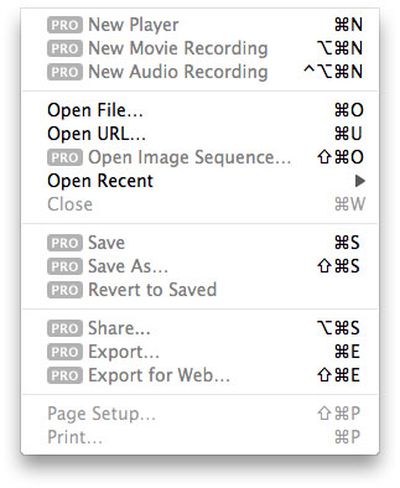
The latest Mac OS X 10.6 Snow Leopard seeds suggest that Apple may be eliminating the 'QuickTime Pro' upgrade that is currently offered as a $29.99 upgrade to Mac users.

Apple has long reserved several additional features for QuickTime Pro that are not available in the standard QuickTime Player. Some of these features include editing (cut, copy, paste), exporting to different codecs, and saving web QuickTime movies to hard drive. In a standard Mac OS X installation, these features are dimmed out in the QuickTime Player application:

033958 quicktimepro
QuickTime Player in 10.5

In the latest Snow Leopard builds, however, all features are reported to be fully enabled. In addition, the "Buy QuickTime Pro" and "Registration" links have been completely eliminated as menu options and the registration control panel also removed from the System Preferences.

These changes suggest that Apple may finally be incorporating all the Pro features into the standard QuickTime installation. Apple has announced that it would be revamping QuickTime in Snow Leopard with the introduction of QuickTime X. Apple will be incorporating technology from the iPhone into QuickTime X to optimize support for modern audio and video formats.

214159 01 425

ABC officially announced the cast list for Season 8 of their reality TV show Dancing with the Stars and Apple co-founder Steve Wozniak is listed amongst the contestants for this year's show.

A Silicon Valley icon and philanthropist for the past three decades, Steve Wozniak, a.k.a. "The Woz," helped shape the computer industry with his design of Apple's first line of products, the Apple I and II, and influenced the popular Macintosh. After leaving Apple Computer Inc. in 1985, Wozniak was involved in various business and philanthropic ventures, focusing primarily on computer capabilities in schools and stressing hands-on learning and encouraging creativity for students. In 2000, he was inducted into the Inventors Hall of Fame and was awarded the prestigious Heinz Award for Technology, The Economy and Employment. Wozniak is also a published author with the release of his New York Times Best Selling autobiography, iWoz: From Computer Geek to Cult Icon, in September 2006.

Dancing with the Stars is a "reality"-based competition in which stars are paired with professional dancers to compete in various styles of ballroom dancing. At home viewers vote for their favorite dancing couple by phone.

Steve Wozniak along with Steve Jobs co-founded Apple, Inc. Wozniak was the engineer behind many of the early Apple computer designs. While he is said to remain an official employee of Apple, Wozniak plays no role in the day to day operations of the company.

Dancing with the Stars premieres on ABC on Monday, March 9th at 8 p.m.

075516 leaves 220

The Webkit blog reports that the latest WebKit builds now support explicit animations in CSS.

CSS Animations is one of the enhancements to CSS proposed by the WebKit project that weve been calling CSS Effects (eg. gradients, masks, transitions). The goal is to provide properties that allow Web developers to create graphically rich content. In many cases animations are presentational, and therefore belong in the styling system. This allows developers to write declarative rules for animations, replacing lots of hard-to-maintain animation code in JavaScript.

The features are presently unique to WebKit but can be viewed by using one of the beta nightly builds or simply through your iPhone/iPod Touch. Apple has already implemented these animations, as well as 3D support, within the iPhone's mobile Safari.

Those browsing using an iPhone or a nightly Webkit build can see the sample pages in action: falling leaves (pictured), bouncing box, and pulse ("the new blink").

These features should eventually make their way into Mac OS X's Safari builds and the features have also been proposed for inclusion into the actual CSS standard. As we've previously detailed, Apple has been making efforts to push web-standard technologies possibly as a way to reduce dependance on Adobe's Flash player. The incorporation of animation into CSS could certainly threaten one of the major uses of Flash on the internet. Apple has also been investing in other core web technologies as the basis for their Mobile Me web applications.

Related Forum: iPhone

It's long been observed that songs featured prominently in Apple's ads have seen a sudden boost in popularity. Lesser known artists such as Feist and Yael Naim have seen instant fame following the airing of Apple's iPod Nano (1234) and MacBook Air (New Soul) ads.

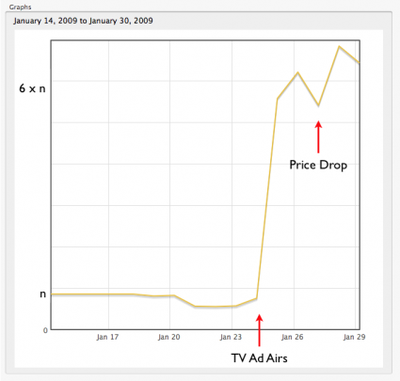
This phenomenon appears to extend to iPhone applications as well. Apple's recent iPhone ads have prominently featured a number of App Store apps. Andrew Kaz and Phill Ryu's Classics App [App Store] which was featured in Apple's "Read" commercial saw a remarkable boost in sales immediately following the ad's broadcast:

065626 salesgraph 425

Sales of the book reader immediately jumped up 6 times their previous baseline. Since then, Classics has managed to stay in the Top 15 paid apps.

While any prominent exposure will obviously help stimulate sales, even the developers were surprised at the magnitude of the response.

Related Forum: iPhone

After the iPhone 2.2.1 firmware update, some users found they had persistent problems with iTunes crashing with both iPhones and even iPods. Apple has issued the following email to some of the affected customers:

Dear Customer,

Recently, we uncovered an issue which was causing iTunes to unexpectedly quit when synced with an iPod or an iPhone. This issue impacted a small number of users, and we have identified your account as potentially being affected.

If you have experienced this issue, please follow these steps in order to sync your iPod or iPhone with iTunes:
1. Launch iTunes
2. Select "Deauthorize Computer" from the Store menu
3. Enter your iTunes Store Account ID and Password, then click the Deauthorize button
4. Next, choose "Authorize Computer" from the Store menu
5. Enter your iTunes Store Account ID and Password, then click the Authorize button

Once you have successfully deauthorized and reauthorized your computer, you should be able to sync your iPod or iPhone to iTunes.

I sincerely apologize for any inconvenience that you may have experienced as a result of this issue.

Thank you for being an iTunes Store customer.
iTunes Store Team

The fix has been circulating on the internet for a number of days and many readers have reported that this procedure corrects the problem. Some, however, have to take the additional step of "purchasing" a Free iTunes App after following the steps before syncing will work again.

Related Forums: iPhone, Mac Apps

Tinycomb reports `that Apple Retail stores no longer offer access to FaceBook.com, a popular social networking site:

In an effort to thwart off time-theft and loiterers, Apple has decided to add Facebook to the list of banned websites at retail locations nationwide. When I asked some of the genius today whether or not anyone noticed the change, they all said that Facebook stopped working sometime in the past week.

The reason for the banning, of course, is to prevent loitering at Apple stores. MySpace was similarly banned in 2007 according to the site.

Update: According to the Wall Street Journal, Apple has denied having an official policy of blocking Facebook from computers in their retail stores, although it appears that some individual stores may have blocked Facebook of their accord.

The latest version of Mac OS X 10.6 Snow Leopard seeded to developers is said to have included a few new hooks for developers. One new feature that has been adopted from the iPhone is the inclusion of "CoreLocation". CoreLocation is a software framework that allows developers to identify its current latitude and longitude based on available information. AppleInsider explains how it would work on Macs:

Since Macs don't include GPS technology like the iPhone 3G, CoreLocation will utilize a Mac's existing networking hardware to triangulate the system's location in a manner similar to the way the original iPhone was able to use the technology to emulate a true global positioning signal.

Apple is also said to be including a new Multi-Touch framework that would allow developers to more easily support Apple's Multi-Touch trackpads. While some developers have taken advantage of Apple's Multi-Touch trackpad, support has been sporadic.

Several readers have reported that Apple has sent out emails today indicating that the 17" MacBook Pro has been delayed by a couple of more weeks. The email indicated that ship dates were pushed back by about 10-14 days to February 19th, 2009:

To Our Valued Apple Customer:

Thank you again for your order! Wrapping up the new 17-inch MacBook Pro is taking a few days longer
than we projected. As a result, we will be unable to ship your 17-inch MacBook Pro until February 19, 2009.

These emails went out to those with the earliest orders placed immediately after the announcement that the 17" MacBook Pro at Macworld.

This, of course, means that the "Now Shipping" graphic that was briefly displayed on Apple's Canadian online store was a mistake.

Related Roundup: MacBook Pro

Google announced a new location tracking feature of Google Maps that will allow you to share your current location with your friends and family. The new service is called Latitude:

Latitude is a new feature of Google Maps for mobile, as well as an iGoogle gadget, that allows you to share your location with your friends and to see their approximate locations, if they choose to share them with you. You can use your Google account to sign in and easily invite friends to Latitude from your existing list of contacts or by entering their email addresses. Google Talk is integrated with Latitude, so you and your friends can update your status messages and profile photos on the go and see what everyone is up to. You can also call, SMS, IM, or email each other within the app.

Google addresses privacy concerns in a FAQ and notes that the entire service is opt-in. While launching initially on BlackBerry, Windows Mobile, Android and Symbian S60, Google hopes to release an iPhone version soon.

This video shows how the service works:


Google is not the first to attempt this sort of service. Startup company Loopt provides a very similar service and was featured at WWDC as one of the first Apps for the iPhone [App Store Link].

Related Forum: iPhone

Apple has issued a software update for Garageband '09.

This update improves overall stability and addresses specific issues with downloading lessons from the Learn to Play Lesson Store. It is recommended for all GarageBand 09 users.

GarageBand '09 was released as part of the iLife '09 suite in January.

Macitynet.it reports that Apple has seeded some developers with a new version of Mac OS X 10.6 Snow Leopard. The latest build is said to be 10A261. The prior version of Snow Leopard delivered to developers was in December (build 10A222).

According to Macity's sources, the latest version does not appear to contain any noticable changes but does seem more stable (translated):

The interface has not been revised and currently there are only small changes in System Preferences, have been resolved a few bugs in the Finder and little else. According to the sources of Macity the impression is that this release is more reliable than those previously distributed.

Apple has been rumored to be tweaking the user interface in Snow Leopard prior to its public release.

Snow Leopard is the codename for the next major revision of Mac OS X. Apple has said that they would be focusing on quality and performance in Snow Leopard. In particular, Apple has made it clear that there will be efforts to improve support for multi-core processors and GPU processing. These improvements will help developers more efficiently use these capabilities that already ship in Macs.

Update: Note: the update appears to be available to a limited audience at this time.

Arstechnica points out that a portion of Apple's new iLife '09 suite is now Intel-only. Specifically, the GarageBand '09 Learn to Play feature that was demonstrated at Macworld will not run on a PowerPC:

"GarageBand Learn to Play requires an Intel-based Mac with a dual-core processor or better."

This represents a long expected shift of support away from Apple's older PowerPC Macs. Apple first announced that they were switching from PowerPC to Intel processors in June 2005 and finally completed the transition in August 2006. Since then, all shipping Macs have contained Intel-based processors.

Apple is also rumored to officially drop PowerPC support from their next major Mac OS X release (Snow Leopard). Development, of course, has been ongoing, and Apple has recently begun seeding a new version of Snow Leopard internally. As a result, a new ADC developer version is expected very shortly. No word on what improvements have been made.

Snow Leopard is due for public release sometime this year.