Skip to Content

Amazon Adds Support for Passkeys, Allowing for More Secure Logins

Amazon today announced that it has added passkey support to its desktop sites and mobile apps, allowing customers to sign in to their accounts without the need for a password.
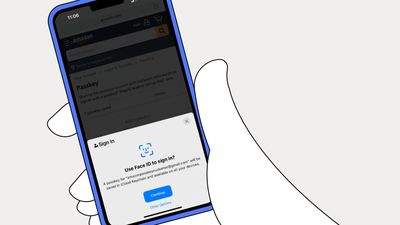
amazon app passkey
Passkeys are a more secure alternative to passwords because a passkey cannot be shared with another person through a phishing attempt or leaked online through a database hack. Passkeys do not require customers to remember a password or add a two-factor authentication code, but they do require a verified device.

Passkeys can be set up in the Amazon settings, and on an iPhone, iPad, or Mac, logging in to an Amazon account can be done with a Face ID or Touch ID scan once the feature is turned on. To enable it, go to Your Account > Login and Security, and choose the Set up option next to Passkeys.

Apple implemented support for passkeys with iOS 16 and macOS Ventura. Passkeys work through a public key that's stored on a website server and paired with a private key that's kept on a specific device. On Apple's devices, passkeys are authenticated with ‌Face ID‌ or ‌Touch ID‌, and two keys must match to allow for a user to log in.

Passkeys rely on iCloud Keychain, which in turn requires two-factor authentication for further protection. Passkeys sync across all of a user's ‌iPhone‌, ‌iPad‌, and Mac devices, but they can also be used on non-Apple devices through a QR code system.

Amazon says that passkey support is available today for all Amazon customers using browsers, and that it will be rolling out to the Amazon app for iOS devices in the near future.
Popular Stories

imac video apple feature

Apple Unveils Seven New Products

Friday March 6, 2026 11:48 am PST by
Apple this week unveiled seven products, including an iPhone 17e, an iPad Air with the M4 chip, updated MacBook Air and MacBook Pro models, a new Studio Display, a higher-end Studio Display XDR, and an all-new MacBook Neo that starts at just $599. iPhone 17e features the same overall design as the iPhone 16e, but it gains Apple's A19 chip, MagSafe for magnetic wireless charging and magnetic...
Apple MacBook Pro M4 hero

Apple Planning 'MacBook Ultra' With Touchscreen and Higher Price

Sunday March 8, 2026 8:05 am PDT by
Apple is planning to launch an all-new "MacBook Ultra" model this year, featuring an OLED display, touchscreen, and a higher price point, Bloomberg's Mark Gurman reports. Gurman revealed the information in his latest "Power On" newsletter. While Apple has been widely expected to launch new M6-series MacBook Pro models with OLED displays, touchscreen functionality, and a new, thinner design...
MacBook Neo Feature Pastel 1

First MacBook Neo Benchmarks Are In: Here's How It Compares to the M1 MacBook Air

Thursday March 5, 2026 4:07 pm PST by
Benchmarks for the new MacBook Neo surfaced today, and unsurprisingly, CPU performance is almost identical to the iPhone 16 Pro. The MacBook Neo uses the same 6-core A18 Pro chip that was first introduced in the iPhone 16 Pro, but it has one fewer GPU core. The MacBook Neo earned a single-core score of 3461 and a multi-core score of 8668, along with a Metal score of 31286. Here's how the...

Top Rated Comments

Michael Scrip Avatar
31 months ago

Face ID is hardly secure. Anyone can take your phone by force, hold you by force and open everything. Ask Hamas.
The same can be said for TouchID and plain ol' passwords, too.

If the bad guy is holding you and your phone hostage... and plans to use violence... you're gonna have a bad time.

Reminds me of this:


Hint: the wrench will win. ;)

But what's more likely to happen is someone from far away trying to get into your accounts remotely. They could be in another state or another country. It happens all the time.

It's those hackers who will be stopped by these new protective measures since they don't have your phone in their hands.

In short... there are more hackers online than people in the real world following me around with a wrench.

:p

Attachment Image
Score: 40 Votes (Like | Disagree)
jchap Avatar
31 months ago

Face ID is hardly secure. Anyone can take your phone by force, hold you by force and open everything. Ask Hamas.
In that scenario, they can also force you at gunpoint to reveal your passwords under threat of death, or force you to unlock your device with your fingerprint. Your comment has nothing to do with the security of Face ID as a general measure under normal circumstances to securely access your device and passwords.
Score: 14 Votes (Like | Disagree)
31 months ago

I'm about to do the same after spending 10 minutes looking through this damn Amazon app on my iPhone trying to find Passkeys...FFS!
Might I suggest you read the article before threatening to leave Amazon because you can't find a setting.
Score: 13 Votes (Like | Disagree)
sleep/to/dream Avatar
31 months ago

I'm about to do the same after spending 10 minutes looking through this damn Amazon app on my iPhone trying to find Passkeys...FFS!
from the article it doesn’t sound like it’s been added to the app yet. “in the near future”

edit: others are saying it’s available?
Score: 10 Votes (Like | Disagree)
31 months ago

Passkeys have been a flop. Far too complicated for regular users, with considerable inconveniences and opportunities for failure.

Rather than the tech companies coming up with a truly open and interoperable standard, passkeys are being used as a way to lock people into specific platform ecosystems.

Despite their flaws, passwords will continue to reign supreme in the long run.
Disagree. They work well for me, and remove a lot of friction, even though I work across platforms (i.e., Windows and iOS).

The Keychain option to populate the 2FA field for sites that don't support Passkey is also very good.
Score: 9 Votes (Like | Disagree)
31 months ago

Does using Passkeys vendor lock you into Apple, Microsoft, or Google? Are the passwords stored on the cloud in the big 3's servers?

Can you sign up for an account in 3rd party sites using only passkeys and no password? If so, what happens if Apple or Google bans your iCloud/Gmail account that contains all of those passwords? Are you forever not able to log back into those 3rd party sites?

What happens if you use Passkeys on Apple devices and then switch to Android? How does it work?
Google, Apple, and Microsoft all support passkeys, aka the FIDO standard. The passkeys are not stored in the cloud, they are stored on device. Exception: on iCloud it can store backups of passkeys, with end-to-end encryption enabled no one but you has access to the backups.

A website or app can theoretically let you use a passkey with no password if they chose to allow it. It’s up to each individual website or app to do this, and pretty much none have so far.

Your passkeys are on device, so my guess (I don’t have a way to confirm this without trying to get banned myself) is even without iCloud your passkeys are accessible by you on your device, you just can’t use your backups and you have to migrate your accounts. Not many people get banned from iCloud without straight up fraud happening with their account.

Most websites will be kind enough to let you recover your account through email or text messages even if you lost your passkey. So you will be able to migrate your account off passkeys if you had to.

If you switch to Android, as long as you can sign in with some method or another, you can add another passkey to your account. Android supports passkeys (with certain devices) so you can add them to your account, you can also use a USB key to sign in. You’re not restricted to one device forever on the FIDO standard.
Score: 8 Votes (Like | Disagree)