Apple Bans Employees From Using ChatGPT Amid Its Own AI Efforts
Apple has restricted employee use of ChatGPT and other external artificial intelligence utilities amid the development of its own similar technology, The Wall Street Journal reports.
According to a document seen by The Wall Street Journal and individuals who claim to be familiar with the matter, Apple is concerned that AI tools could leak the company's confidential data. In addition to ChatGPT, Apple has barred staff from using GitHub's Copilot, a tool that helps write code with autocompletion.
Many businesses, such as banks, financial services, and healthcare institutions, have avoided adopting ChatGPT out of fear that their employees could inadvertently give the chatbot sensitive proprietary information. Samsung banned employee use of generative AI utilities like ChatGPT after discovering that staff had uploaded sensitive source code to the platform. The company was said to be concerned that data transmitted to artificial intelligence platforms including Bing and Google Bard could end up being disclosed to other users. JPMorgan Chase and Verizon have similarly banned use of these AI tools.
OpenAI has already sold Morgan Stanley a private ChatGPT service that allows employees to ask questions and analyze content in thousands of the bank's market research documents. Microsoft is working on a version of ChatGPT targeted at business customers to address privacy concerns.
The move comes in the context of Apple apparently working on its own large language models and AI technologies, led by senior vice president of Machine Learning and AI Strategy John Giannandrea. Giannandrea previously worked for Google and now reports directly to Apple CEO Tim Cook. The Wall Street Journal did not provide more information about what Apple's AI efforts encompass at this time.
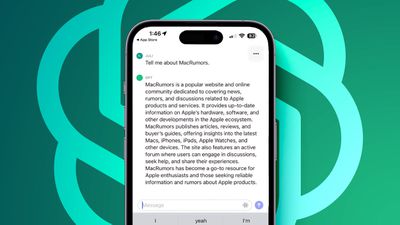
OpenAI's ChatGPT has been accessible on the web and via several third-party iOS apps for some time, but yesterday the company released the first official ChatGPT app for the iPhone and iPad.
Popular Stories
Apple is planning to launch new MacBook Pro models as soon as early March, but if you can, this is one generation you should skip because there's something much better in the works.
We're waiting on 14-inch and 16-inch MacBook Pro models with M5 Pro and M5 Max chips, with few changes other than the processor upgrade. There won't be any tweaks to the design or the display, but later this...
Wednesday February 11, 2026 10:07 am PST by
Juli CloverApple today released iOS 26.3 and iPadOS 26.3, the latest updates to the iOS 26 and iPadOS 26 operating systems that came out in September. The new software comes almost two months after Apple released iOS 26.2 and iPadOS 26.2.
The new software can be downloaded on eligible iPhones and iPads over-the-air by going to Settings > General > Software Update.
According to Apple's release notes, ...
It has been a slow start to 2026 for Apple product launches, with only a new AirTag and a special Apple Watch band released so far. We are still waiting for MacBook Pro models with M5 Pro and M5 Max chips, the iPhone 17e, a lower-cost MacBook with an iPhone chip, long-rumored updates to the Apple TV and HomePod mini, and much more.
Apple is expected to release/update the following products...
Apple plans to announce the iPhone 17e on Thursday, February 19, according to Macwelt, the German equivalent of Macworld.
The report said the iPhone 17e will be announced in a press release on the Apple Newsroom website, so do not expect an event for this device specifically.
The iPhone 17e will be a spec-bumped successor to the iPhone 16e. Rumors claim the device will have four key...
Apple acquired Canadian graph database company Kuzu last year, it has emerged.
The acquisition, spotted by AppleInsider, was completed in October 2025 for an undisclosed sum. The company's website was subsequently taken down and its Github repository was archived, as is commonplace for Apple acquisitions.
Kuzu was "an embedded graph database built for query speed, scalability, and easy of ...