An early look at an ongoing analysis of Apple's App Tracking Transparency suggests that the vast majority of iPhone users are leaving app tracking disabled since the feature went live on April 26 with the release of iOS 14.5.
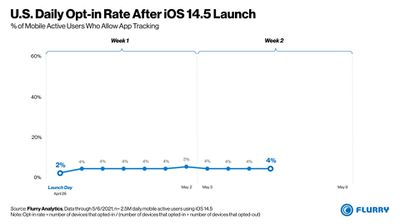
According to the latest data from analytics firm Flurry, just 4% of iPhone users in the U.S. have actively chosen to opt into app tracking after updating their device to iOS 14.5. The data is based on a sampling of 2.5 million daily mobile active users.
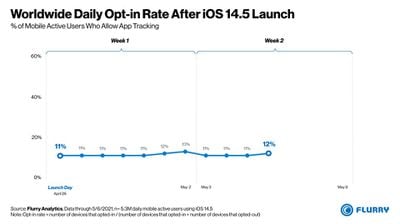
When looking at users worldwide who allow app tracking, the figure rises to 12% of users in a 5.3 million user sample size.
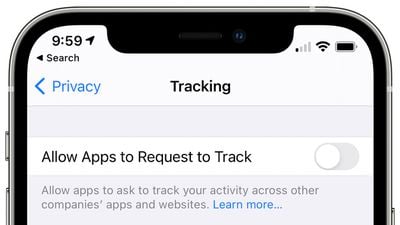
With the release of iOS 14.5, apps must now ask for and receive user permission before they can access a device's random advertising identifier, which is used to track user activity across apps and websites. Users can either enable or disable the ability for apps to ask to track them. Apple disables the setting by default.
Since the update almost two weeks ago, Flurry's figures show a stable rate of app-tracking opt-outs, with the worldwide figure hovering between 11-13%, and 2-5% in the U.S. The challenge for the personalized ads market will be significant if the first two weeks end up reflecting a long-term trend.
Facebook, a vociferous opponent of ATT, has already started attempting to convince users that they must enable tracking in iOS 14.5 if they want to help keep Facebook and Instagram "free of charge." That sentiment would seem to go against the social network's earlier claim that ATT will have a "manageable" impact on its business and could even benefit Facebook in the long term.
Flurry Analytics, owned by Verizon Media, is used in over 1 million mobile applications, providing aggregated insights across 2 billion mobile devices per month. Flurry intends to update its figures every weekday for the daily opt-in rate as well as the share of users that apps cannot ask to track, both in the U.S. and globally.
Thursday February 5, 2026 12:54 pm PST by Joe Rossignol
Apple turns 50 this year, and its CEO Tim Cook has promised to celebrate the milestone. The big day falls on April 1, 2026.
"I've been unusually reflective lately about Apple because we have been working on what do we do to mark this moment," Cook told employees today, according to Bloomberg's Mark Gurman. "When you really stop and pause and think about the last 50 years, it makes your heart ...
Tuesday February 3, 2026 7:47 am PST by Joe Rossignol
While the iOS 26.3 Release Candidate is now available ahead of a public release, the first iOS 26.4 beta is likely still at least a week away. Following beta testing, iOS 26.4 will likely be released to the general public in March or April.

Below, we have recapped known or rumored iOS 26.3 and iOS 26.4 features so far.
iOS 26.3
iPhone to Android Transfer Tool
iOS 26.3 makes it easier...
Tuesday February 3, 2026 12:45 pm PST by Joe Rossignol
Apple recently acquired Israeli startup Q.ai for close to $2 billion, according to Financial Times sources. That would make this Apple's second-biggest acquisition ever, after it paid $3 billion for the popular headphone maker Beats in 2014.
This is also the largest known Apple acquisition since the company purchased Intel's smartphone modem business and patents for $1 billion in 2019....
Thursday February 5, 2026 12:22 pm PST by Joe Rossignol
Apple plans to announce the iPhone 17e on Thursday, February 19, according to Macwelt, the German equivalent of Macworld.
The report, citing industry sources, is available in English on Macworld.
Apple announced the iPhone 16e on Wednesday, February 19 last year, so the iPhone 17e would be unveiled exactly one year later if this rumor is accurate. It is quite uncommon for Apple to unveil...
Friday February 6, 2026 3:06 pm PST by Juli Clover
In the iOS 26.4 update that's coming this spring, Apple will introduce a new version of Siri that's going to overhaul how we interact with the personal assistant and what it's able to do.
The iOS 26.4 version of Siri won't work like ChatGPT or Claude, but it will rely on large language models (LLMs) and has been updated from the ground up.
Upgraded Architecture
The next-generation...
The default is for tracking to be disabled when iOS 14.5 is installed. So in reality this is "4% of users have opted in to having apps ask whether to track or not". 96% of users have just done nothing.
Why would anyone ever choose to turn on tracking? Open to any use cases....
I had it disabled out interest. I just wanted to know which app had the audacity to ask me in the first place. Then I deleted the least important ones.