Skip to Content

Apple to Ban Apps That Reward Users for Enabling App Tracking

Apple says that it will ban and reject apps on the App Store that attempt to offer users monetary incentives to enable tracking through App Tracking Transparency (ATT), one of many measures the company is taking to ensure developers follow through with the new framework.
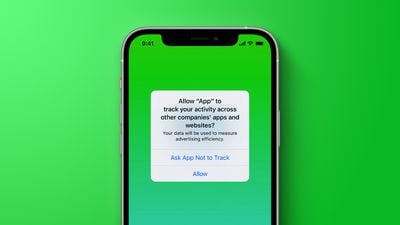
generic tracking prompt green
Yesterday the Cupertino tech giant released iOS and iPadOS 14.5 with several headlining features, including ATT. ATT is a new framework on iOS and iPadOS devices that requires apps to ask for users' permission before tracking them across others apps and websites.

It's received significant criticism from companies such as Facebook, which deems it a threat to its business. With the new framework, all apps on the ‌App Store‌ must present users with a pop-up that asks whether they wish to be tracked or not. Users are shown "Ask App Not to Track" and "Allow" in the pop-up.

Following ATT's release, Apple also updated its Human Interface Guidelines with a new section titled "Accessing User Data." In this section, offering a mix of new and previously known information, Apple outlines the design policies that all apps must follow when they attempt to ask a user for their permission to access personal data, device capabilities such as microphone and camera, and consent to track them across apps and websites.

Apple's senior vice president of software engineering, Craig Federighi, recently said that Apple can only enforce its privacy values through the policies to which apps on the ‌App Store‌ are subject to and that it entirely can't be done at a system level. Federighi referred to ATT, echoing that Apple will enforce the new change as vigorously as it can through the ‌App Store‌'s rules.

The new additions to the Human Interface Guidelines are reflective of Federighi's comments. Apple can expect to see some apps try to circumvent ATT with gimmicks such as imitation or limiting an app's functionality unless permission to track is given. To counter this, Apple's new guidelines bar apps from attempting to mislead users to enable "Allow" for ad tracking by imitation or using a graphic that mimics the system pop-up.

Most notably, however, Apple says that any app that attempts to offer monetary incentives to users to convince them to enable tracking will be banned from the ‌App Store‌.

Don't offer incentives for granting the request. You can't offer people compensation for granting their permission, and you can't withhold functionality or content or make your app unusable until people allow you to track them.

Don't display a custom message that mirrors the functionality of the system alert. In particular, don't create a button title that uses "Allow" or similar terms, because people don't allow anything in a pre-alert screen.

Don't show an image of the standard alert and modify it in any way.

Don't draw a visual cue that draws people's attention to the system alert's Allow button.

Apple also outlines the do's and don'ts on how apps can provide additional information for why users should enable ad-tracking. The native ATT pop-up offers developers the choice to customize the text to explain why tracking is needed.

Apps can also employ a splash screen before the pop-up appears that provides information about what the tracking is used for. These splash screens, however, must use wording like "Continue," "Next," and not "Allow," which may mislead and confuse users, according to Apple.

If you display a custom screen that precedes a privacy-related permission request, it must offer only one action, which must display the system alert. Use a word like "Continue" to title the action; don't use "Allow" or other terms that might make people think they're granting their permission or performing other actions within your custom screen.

The new section will be helpful for developers looking to make sure they're up to date with Apple's latest guidelines and can be an interesting read for users looking to learn more about ATT and the privacy aspects of ‌App Store‌ apps.

Popular Stories

Multicolored Low Cost A18 Pro MacBook Feature

Apple Accidentally Leaks 'MacBook Neo'

Tuesday March 3, 2026 7:00 am PST by
Apple appears to have prematurely revealed the name of its rumored lower-cost MacBook model, which is expected to be announced this Wednesday. A regulatory document for a "MacBook Neo" (Model A3404) has appeared on Apple's website. Unfortunately, there are no further details or images available yet. While the PDF file does not contain the "MacBook Neo" name, it briefly appeared in a link...
MacBook Neo Feature Pastel 1

Apple Announces $599 'MacBook Neo' With A18 Pro Chip

Wednesday March 4, 2026 6:15 am PST by
Apple today announced the "MacBook Neo," an all-new kind of low-cost Mac featuring the A18 Pro chip for $599. The MacBook Neo is the first Mac to be powered by an iPhone chip; the A18 Pro debuted in 2024's iPhone 16 Pro models. Apple says it is up to 50% faster for everyday tasks than the bestselling PC with the latest shipping Intel Core Ultra 5, up to 3x faster for on-device AI workloads,...

MacBook Neo Feature Pastel 1

First MacBook Neo Benchmarks Are In: Here's How It Compares to the M1 MacBook Air

Thursday March 5, 2026 4:07 pm PST by
Benchmarks for the new MacBook Neo surfaced today, and unsurprisingly, CPU performance is almost identical to the iPhone 16 Pro. The MacBook Neo uses the same 6-core A18 Pro chip that was first introduced in the iPhone 16 Pro, but it has one fewer GPU core. The MacBook Neo earned a single-core score of 3461 and a multi-core score of 8668, along with a Metal score of 31286. Here's how the...

Top Rated Comments

dwaltwhit Avatar
63 months ago
I’m actually a bit conflicted. Should I not be allowed to sell my own info? I’m all for transparency and will block every app from tracking me, but shouldn’t I be allowed to decide to share my info with someone who wants to pay for it?
Score: 34 Votes (Like | Disagree)
63 months ago

I’m actually a bit conflicted. Should I not be allowed to sell my own info? I’m all for transparency and will block every app from tracking me, but shouldn’t I be allowed to decide to share my info with someone who wants to pay for it?
It's a balancing act. Of course your personal information is yours to share as you feel. On the other hand, Apple is attempting to stop companies from crippling apps for those of us that don't wish to to be tracked.

Some will argue it should be a free market and developers that should be allowed to 'reward' users who agree to be tracked. Others will say it's an unscrupulous business practise.

By not allowing developers to offer tracking incentives, I believe Apple is attempting to ensure everybody gets the same app experience regardless of their tracking preference; which may or not be the best attempt at a compromise, depending on your point of view. Either way, you are not 'losing out' by being unable to sell your data. You are getting the same reward you would have gotten had the practise been allowed.
Score: 23 Votes (Like | Disagree)
berrymetal Avatar
63 months ago
That's neat! go go apple 👌🏻
Score: 15 Votes (Like | Disagree)
beanbaguk Avatar
63 months ago
I've not seen a single notification yet......I'm waiting to block the vile app that is Facebook (which annoyingly I need as my family refuse to use anything else).
Score: 14 Votes (Like | Disagree)
Wando64 Avatar
63 months ago

I’m actually a bit conflicted. Should I not be allowed to sell my own info? I’m all for transparency and will block every app from tracking me, but shouldn’t I be allowed to decide to share my info with someone who wants to pay for it?
While there is a part of me that feels the same as you, I can also see the other side whereby people could be coerced in various ways into allowing tracking.
Score: 12 Votes (Like | Disagree)
contacos Avatar
63 months ago
I still haven’t seen a single app asking me. Does that mean they never tracked me or did they not implement it yet and are waiting for the last minute?
Score: 9 Votes (Like | Disagree)