Skip to Content

Research Claiming Android Collects 20x More User Data Than iOS 'Off By An Order of Magnitude,' Says Google

Google and Apple both collect data from their users on their respective mobile operating systems, even when users are simply browsing the settings page or inserting a SIM card. Android, however, collects 20x more data from users compared to iOS, according to newly published research.
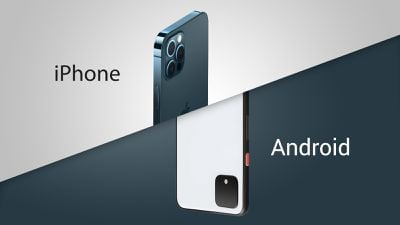
iPhone 12 v Android 2020
A study from Douglas Leith at Trinity College, reported by Ars Technica, says that while both OSes collect data from their users regularly, Android fair exceeded the amount collected compared to Apple's iOS.

Specifically, Leith says that, for example, on device startup, Android sends around 1MB of user data back to Google, while iOS only transmits about 42KB. Sitting idle, Android sends around 1MB of user data to Google every 12 hours, compared to Apple only receiving around 52KB over the same 12 hour period.

Where Android stands out, Leith said, is in the amount of data it collects. At startup, an Android device sends Google about 1MB of data, compared with iOS sending Apple around 42KB. When idle, Android sends roughly 1MB of data to Google every 12 hours, compared with iOS sending Apple about 52KB over the same period. In the US alone, Android collectively gathers about 1.3TB of data every 12 hours. During the same period, iOS collects about 5.8GB.

While the research clearly shows that Android collects more data from users, there are significant caveats. Leith says he used a jailbroken iPhone 8 running iOS 13.6.1 for the study, meaning the data is based on an iOS version that most iPhone and iPad users are no longer currently running. On Android, Leith used a Google Pixel 2, running Android 10, released last year.

In a statement, Google calls the researched flawed, stating that the notion that Android collects more user data compared to iOS is "off by an order of magnitude."

We identified flaws in the researcher's methodology for measuring data volume and disagree with the paper's claims that an Android device shares 20 times more data than an iPhone. According to our research, these findings are off by an order of magnitude, and we shared our methodology concerns with the researcher before publication.

This research largely outlines how smartphones work. Modern cars regularly send basic data about vehicle components, their safety status and service schedules to car manufacturers, and mobile phones work in very similar ways. This report details those communications, which help ensure that iOS or Android software is up to date, services are working as intended, and that the phone is secure and running efficiently

Apple told Ars Technica that it "provides transparency and control for personal information it collects" and that the research "gets things wrong." The research is available as a PDF for those interested in learning more.
Popular Stories

Multicolored Low Cost A18 Pro MacBook Feature

Apple Accidentally Leaks 'MacBook Neo'

Tuesday March 3, 2026 7:00 am PST by
Apple appears to have prematurely revealed the name of its rumored lower-cost MacBook model, which is expected to be announced this Wednesday. A regulatory document for a "MacBook Neo" (Model A3404) has appeared on Apple's website. Unfortunately, there are no further details or images available yet. While the PDF file does not contain the "MacBook Neo" name, it briefly appeared in a link...
imac video apple feature

Apple Unveils Two New Products

Monday March 2, 2026 7:49 am PST by
Apple today introduced two new devices, including the iPhone 17e and an updated iPad Air. iPhone 17e features the same overall design as the iPhone 16e, but it gains Apple's A19 chip, MagSafe for magnetic wireless charging and magnetic accessories, Apple's second-generation C1X modem for faster 5G, and a doubled 256GB of base storage. In the U.S., the iPhone 17e starts at $599, just like the ...
Apple iPhone 17e feature

Apple Announces iPhone 17e With A19 Chip, MagSafe, and More

Monday March 2, 2026 6:07 am PST by
Apple today announced the iPhone 17e, featuring the A19 chip, MagSafe connectivity, faster charging, and more. The iPhone 17e contains the A19 chip introduced in iPhone 17. It features a 6-core GPU and a 4-core GPU. Apple pointed out that this makes it up to 2x faster than the iPhone 11. The new 16-core Neural Engine is optimized for large generative models. The iPhone 17e also contains...
Top Rated Comments

64 months ago
Off by an order of magnitude... so in reality it’s 200x and not 20x? 😅
Score: 44 Votes (Like | Disagree)
64 months ago
When google say 'off by an order of magnitude', do they mean its actually 30x more data recorded... 🤔😏
Score: 41 Votes (Like | Disagree)
Pangalactic Avatar
64 months ago
A typical "study" designed just to put out an attention-grabbing headline.

No analysis of what exactly is being collected.

No multi-device testing.
No even current-gen device testing.
Hell, how does it even qualify as a study with a sample of two(!!!) devices?!

Literally, the only conclusion from this nonsense is that a jailbroken iPhone 8 sends less data than a Google Pixel 2.

I'm not saying that Android collects less data than iOS, but the way they are trying to prove it is ridiculous.
Score: 28 Votes (Like | Disagree)
breather Avatar
64 months ago
Well...
Googles business plan is to collect data about it's users and use it for ads or just selling it.
Apples business plan is to collect as much money as possible from its users by overpricing it's products.
Score: 22 Votes (Like | Disagree)
Havalo Avatar
64 months ago
Shocking! Said no one...

And what about having Google Apps on iOS, how much data is being collected?
Score: 7 Votes (Like | Disagree)
64 months ago
Google and Apple both say it's wrong, so it should be taken with a pinch of salt. That said, surely anyone using Google products (including Android OS) understands that you get those services free of charge (or provided on the cheap) because Google is getting valuable data from you that they will monetise.
Score: 6 Votes (Like | Disagree)