Skip to Content

Apple Requires User Permission Before Apps Can Access Personal Data in iOS 6

Earlier this year, Apple came under fire from consumers advocates and Congress after it was discovered that apps, most notably Path, were uploading users' entire address books to their servers without alerting users or asking for authorization. Path deleted the information, but a pair of U.S. Congressmen sent a letter to Apple asking for information on the company's data collection policies.

More recently, LinkedIn came under fire for transmitting information from iOS calendar entries back to its servers in plain text.
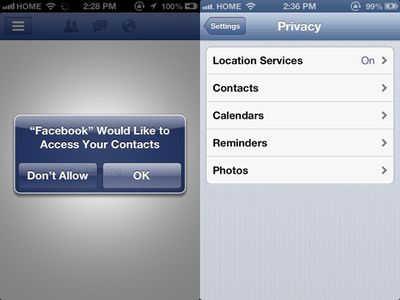
Facebookprivacy
In the OS X Mountain Lion beta, Apple began requiring apps to get explicit permission to access user's address book information, and Apple PR said in February that any iOS app "wishing to access contact data will require explicit user approval in a future software release."

Starting with iOS 6, Apple now requires apps to get explicit user permission before accessing Contacts, Calendars, Reminders, and Photos. From the "Data Privacy" section in Apple's iOS 6 Release Notes:

In addition to location data, the system now asks the user’s permission before allowing third-party apps to access certain user data, including:

- Contacts
- Calendars
- Reminders
- Photo Library

For contact, calendar, and reminder data, your app needs to be prepared to be denied access to these items and to adjust its behavior accordingly. If the user has not yet been prompted to allow access, the returned structure is valid but contains no records. If the user has denied access, the app receives a NULL value or no data. If the user grants permission to the app, the system subsequently notifies the app that it needs to reload or revert the data.

As the iPhone and iPad have grown in popularity, Apple has come under increasing scrutiny over the privacy practices of both Apple and developers participating in the App Store ecosystem. Last year, Senator Al Franken asked both Apple and Google to require app developers to have "clear and understandable" privacy policies.

Apple later agreed to comply with a new California law requiring links to privacy policies in consistent locations and provide a method for users to report apps that do not comply with privacy requirements.

Congress also got involved over the disclosure of location information to app makers, going so far as to introduce a bill that would force companies to get explicit authorization before disclosing the user's location to anyone. Apple now asks the iOS users if Location Services should be enabled during the initial setup process.

iOS 6 is currently in beta and is expected to be publicly released this fall.
Popular Stories

Multicolored Low Cost A18 Pro MacBook Feature

Apple Accidentally Leaks 'MacBook Neo'

Tuesday March 3, 2026 7:00 am PST by
Apple appears to have prematurely revealed the name of its rumored lower-cost MacBook model, which is expected to be announced this Wednesday. A regulatory document for a "MacBook Neo" (Model A3404) has appeared on Apple's website. Unfortunately, there are no further details or images available yet. While the PDF file does not contain the "MacBook Neo" name, it briefly appeared in a link...
imac video apple feature

Apple Unveils Two New Products

Monday March 2, 2026 7:49 am PST by
Apple today introduced two new devices, including the iPhone 17e and an updated iPad Air. iPhone 17e features the same overall design as the iPhone 16e, but it gains Apple's A19 chip, MagSafe for magnetic wireless charging and magnetic accessories, Apple's second-generation C1X modem for faster 5G, and a doubled 256GB of base storage. In the U.S., the iPhone 17e starts at $599, just like the ...
MacBook Neo Feature Pastel 1

Apple Announces $599 'MacBook Neo' With A18 Pro Chip

Wednesday March 4, 2026 6:15 am PST by
Apple today announced the "MacBook Neo," an all-new kind of low-cost Mac featuring the A18 Pro chip for $599. The MacBook Neo is the first Mac to be powered by an iPhone chip; the A18 Pro debuted in 2024's iPhone 16 Pro models. Apple says it is up to 50% faster for everyday tasks than the bestselling PC with the latest shipping Intel Core Ultra 5, up to 3x faster for on-device AI workloads,...

Top Rated Comments

179 months ago
Android has always done this. Fail

No it hasn't. You're told what the app has access to when you install it,you can't opt in or out of parts later.
Score: 24 Votes (Like | Disagree)
179 months ago
Android has always done this. Fail
This line of thinking is stupid.

I don't use Android. I couldn't care less what they do or don't do.

If it's added to iOS, then fine. I'm not sitting there going "hm, I'm going to base my like or dislike on this feature based on whether or not a phone I don't even use has".

Get over yourselves, Googlebots and Fandroids.
Score: 11 Votes (Like | Disagree)
jonnysods Avatar
179 months ago
Yes, I told Facebook to go fly a kite.
Score: 10 Votes (Like | Disagree)
179 months ago
I wish it also allowed Developer to have a small description of why Facebook or whatever app wants to access my calendar or whatever. instead of just going "hey they want access to X, okie?" -- it'd just be good to know at least one of the reasons why.
Score: 10 Votes (Like | Disagree)
179 months ago
a lll these security popups in ios6 and mountain lion remind me of

Image (http://www.technosamrat.com/wp-content/uploads/2008/10/readyboost-superfetch-and-user-account-controluac-in-windows-vista.jpg)

which apple criticised so heavily in vista.

You're not very creative. I bore of seeing posts like these. The problem with UAC wasn't its existence, it was its implementation. Cancel or allow every single time you launched certain programs with no way for an average user to whitelist a program without completely disabling the security of UAC.

Apple's security features are implemented very differently.
Score: 9 Votes (Like | Disagree)
Apple... Avatar
179 months ago
Apple: "No more lawsuits, please?"
Score: 9 Votes (Like | Disagree)