Steve Jobs' Idea for Ad-Supported Operating Systems Was Nearly a Reality
Back in late 2009, an Apple patent application surfaced showing that the company had explored ad-supported operating systems, with the user receiving free or discounted goods or services in exchange for viewing the advertisements. The patent application, which was filed in 2008 and shows ad integration in Mac OS X, was notable for listing Steve Jobs as the lead inventor.
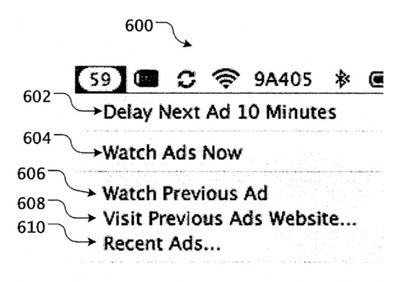
As Ken Segall reveals in his new book, Insanely Simple: The Obsession That Drives Apple's Success, the idea did indeed belong to Jobs, although he initially considered implementing it for the 1999 release of Mac OS 9.
Rather than charge the normal upgrade price, which in those days was $99, he was thinking of shipping a second version of Mac OS 9 that would be given away for free – but would be supported instead by advertising. The theory was that this would pull in a ton of people who didn't normally upgrade because of the price, but Apple would still generate income through the advertising. And any time an owner of the free version wanted to get rid of the advertising, he or she could simply pay for the ad-free version. Steve's team had worked out the preliminary numbers the concept seemed financially sound.
Jobs envisioned the ad-supported version of Mac OS 9 displaying a 60-second commercial from a "premium" company at startup, with the ads occasionally being automatically swapped out for new ones over the Internet. He also visualized the use of contextually relevant ads, such as an Epson printer ink ad being displayed when the user's printer was reporting that it was low on ink.
Segall was not in favor of the idea, but left that meeting under the impression that Apple was going to proceed with it as the TBWA\Chiat\Day team begin thinking about the premium companies it could target for high-quality advertising. But for whatever reason, Jobs and Apple ultimately decided to scrap the idea.
But while the genesis of the idea indeed appears to lie with Jobs, it is still unclear why Apple decided nine years later to file for a patent on the idea, whether it was due to a serious reconsideration of the idea or merely a tying up of loose ends that saw the company attempting to protect one of Jobs' ideas that had already been discarded.
Popular Stories
Apple is about to release iOS 26.2, the second major point update for iPhones since iOS 26 was rolled out in September, and there are at least 15 notable changes and improvements worth checking out. We've rounded them up below.
Apple is expected to roll out iOS 26.2 to compatible devices sometime between December 8 and December 16. When the update drops, you can check Apple's servers for the ...
Intel is expected to begin supplying some Mac and iPad chips in a few years, and the latest rumor claims the partnership might extend to the iPhone.
In a research note with investment firm GF Securities this week, obtained by MacRumors, analyst Jeff Pu said he and his colleagues "now expect" Intel to reach a supply deal with Apple for at least some non-pro iPhone chips starting in 2028....
Apple is actively testing under-screen Face ID for next year's iPhone 18 Pro models using a special "spliced micro-transparent glass" window built into the display, claims a Chinese leaker.
According to "Smart Pikachu," a Weibo account that has previously shared accurate supply-chain details on Chinese Android hardware, Apple is testing the special glass as a way to let the TrueDepth...
Apple's iPhone development roadmap runs several years into the future and the company is continually working with suppliers on several successive iPhone models at the same time, which is why we often get rumored features months ahead of launch. The iPhone 18 series is no different, and we already have a good idea of what to expect for the iPhone 18 Pro and iPhone 18 Pro Max.
One thing worth...
Apple today seeded the second release candidate version of iOS 26.2 to developers and public beta testers, with the software coming one week after Apple seeded the first RC. The release candidate represents the final version iOS 26.2 that will be provided to the public if no further bugs are found.
Registered developers and public beta testers can download the betas from the Settings app on...
Apple's senior vice president of hardware technologies Johny Srouji could be the next leading executive to leave the company amid an alarming exodus of leading employees, Bloomberg's Mark Gurman reports.
Srouji apparently recently told CEO Tim Cook that he is "seriously considering leaving" in the near future. He intends to join another company if he departs. Srouji leads Apple's chip design ...
Apple's chipmaking chief Johny Srouji has reportedly indicated that he plans to continue working for the company for the foreseeable future.
"I love my team, and I love my job at Apple, and I don't plan on leaving anytime soon," said Srouji, in a memo obtained by Bloomberg's Mark Gurman.
Here is Srouji's full memo, as shared by Bloomberg:I know you've been reading all kind of rumors and...
You'd expect things to be starting to wind down for the holidays by now, but that doesn't seem to be the case yet in the world of Apple news, with Apple just about ready to release iOS 26.2 and other operating system updates to the public.
There was also a flurry of news this week about Apple executive departures, some expected and some not so expected, while we also learned that Apple and...
Apple is expected to launch a new foldable iPhone next year, based on multiple rumors and credible sources. The long-awaited device has been rumored for years now, but signs increasingly suggest that 2026 could indeed be the year that Apple releases its first foldable device.
Subscribe to the MacRumors YouTube channel for more videos.
Below, we've collated an updated set of key details that ...