Skip to Content

iMessage and FaceTime Ranked as Most Secure Mass-Market Messaging Options

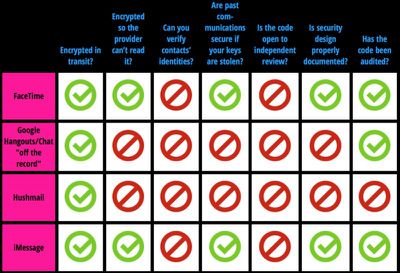
The Electronic Frontier Foundation or EFF, a non-profit digital rights group, has investigated the security of various messaging apps and created a new Secure Messaging Scorecard, ranking messaging apps and tools like iMessage, FaceTime, BlackBerry Messenger, Skype, Snapchat, and more, based on seven different factors:

- Is a message encrypted in transit?
- Is it encrypted so the provider is unable to read it?
- Can you verify contacts' identities?
- Are past communications secure if keys are stolen?
- Is the code open to independent review?
- Is security design properly documented?
- Has the code been audited?

Unsurprisingly, the apps that score highest on the EFF's chart are those dedicated to secure messaging, such as iPhone apps ChatSecure, Signal, and CryptoCat, both of which scored checkmarks in all categories.

Apple's iMessage scored five out of seven checkmarks, earning points for encrypting messages in transit and encryption that's unreadable by Apple, but the messaging app was faulted for an inability to verify contact identities and the fact that Apple's code is not open to independent review.
effchart
FaceTime was scored in the same way as iMessage, also offering encryption but no contact verification/independent review capabilities. Outside of dedicated secure chat messaging apps, both FaceTime and iMessage scored higher than competing messaging platforms like Skype, WhatsApp, Viber, Snapchat, Kik, Google Hangouts, and BlackBerry Messenger.

Few of the competing messaging services offer encryption that prevents the companies offering the services from accessing messages, though all encrypted messages in transit. Most iMessage/FaceTime competitors also fail to secure past communications if keys are stolen, and few had properly documented security design. QQ, a highly popular Chinese messaging app, failed at providing any of the qualities the EFF was looking for in a secure messaging app, not even bothering to encrypt messages.

According to the EFF, Apple's iMessage and FaceTime products were the "best of the mass-market options," which is not much of a surprise given Apple's unparalleled focus on user privacy. Apple has a comprehensive privacy site that details all of its privacy policies and the security of various apps and services, including iMessage and FaceTime.

On the site, Apple specifically says iMessage and FaceTime calls "are your business, not ours." The company offers end-to-end encryption and Apple has no way to decrypt it. "Unlike other companies' messaging services, Apple doesn't scan your communications and we wouldn't be able to comply with a wiretap order even if we wanted to," reads the site.

Popular Stories

MacBook Neo Feature Pastel 1

Apple Announces $599 'MacBook Neo' With A18 Pro Chip

Wednesday March 4, 2026 6:15 am PST by
Apple today announced the "MacBook Neo," an all-new kind of low-cost Mac featuring the A18 Pro chip for $599. The MacBook Neo is the first Mac to be powered by an iPhone chip; the A18 Pro debuted in 2024's iPhone 16 Pro models. Apple says it is up to 50% faster for everyday tasks than the bestselling PC with the latest shipping Intel Core Ultra 5, up to 3x faster for on-device AI workloads,...
MacBook Neo Feature Pastel 1

First MacBook Neo Benchmarks Are In: Here's How It Compares to the M1 MacBook Air

Thursday March 5, 2026 4:07 pm PST by
Benchmarks for the new MacBook Neo surfaced today, and unsurprisingly, CPU performance is almost identical to the iPhone 16 Pro. The MacBook Neo uses the same 6-core A18 Pro chip that was first introduced in the iPhone 16 Pro, but it has one fewer GPU core. The MacBook Neo earned a single-core score of 3461 and a multi-core score of 8668, along with a Metal score of 31286. Here's how the...
Multicolored Low Cost A18 Pro MacBook Feature

Apple Accidentally Leaks 'MacBook Neo'

Tuesday March 3, 2026 7:00 am PST by
Apple appears to have prematurely revealed the name of its rumored lower-cost MacBook model, which is expected to be announced this Wednesday. A regulatory document for a "MacBook Neo" (Model A3404) has appeared on Apple's website. Unfortunately, there are no further details or images available yet. While the PDF file does not contain the "MacBook Neo" name, it briefly appeared in a link...

Top Rated Comments

148 months ago
Whine Time

I want synced deleting!!! If I delete a message off my iPhone I want my iMac, iPad, and macbook to have deleted them as well.

:D


Edit: Or at least make it an option as others may like that it doesn't occur that way.
Score: 22 Votes (Like | Disagree)
148 months ago
TouchID could be used to fill the holes suggested here.

Imagine this use case: Jane and John both have iPhones and are chatting using iMessage. Jane wants to send sensitive information (boob pics) to John, but wants to make sure that John hasn't handed his phone to his friend Bobby at the time she sends it. She could flag the message as 'secret', and John has to use TouchID or his AppleID password to verify his identity before seeing that message.

Offtopic: I'd also like a private browser that is 'locked' with TouchID. I could keep all my porn windows open in Private mode, and no one could see them without me unlocking that specifically.
Score: 13 Votes (Like | Disagree)
148 months ago
can we go back to ICQ? good ol' days.
Score: 10 Votes (Like | Disagree)
148 months ago
What an ugly charts table.
Score: 9 Votes (Like | Disagree)
148 months ago
"Is security design properly documented?"

Huh? I don't understand how whether the security is documented or not actually improves the security.

Because if it is documented, independent parties can find flaws in the design. If it passes, the implementation can still be flawed however.
Score: 7 Votes (Like | Disagree)
148 months ago
Lol, open source

The column "Is the code open to independent reviewers", how on earth can the open source community continue to claim that their code is safe and secure because of peer review when HeartBleed and a slew of other major security holes and exploits have been found in open source code and has been their for years or even decades?

Just because a million monkeys review your code doesn't make it secure.
Score: 6 Votes (Like | Disagree)