iPad 3 with LTE, Quad-Core Processor and Retina Display Set for March Launch
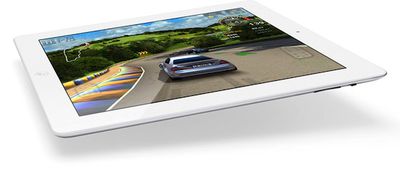
Bloomberg briefly reports that Apple's manufacturing partners have indeed begun on production of the iPad 3, with a ramp-up to full capacity taking place by February ahead of a March launch for the device. The report corroborates circulating rumors that the iPad will offer a quad-core processor and sport a high-resolution "Retina" display. The iPad 3 is also said to offer 4G LTE support for faster data connectivity on the go.
Apple Inc. (AAPL)’s next iPad tablet, due in March, will sport a high-definition screen, run a faster processor and work with long-term evolution wireless networks, according to three people familiar with the product. [...]
The tablet will use a quad-core chip, an enhancement that lets users more quickly jump between applications, two of the people said.
Rumors have been split on whether the iPad 3 will be slightly thicker, thinner, or the same form factor as the iPad 2, with those rumors apparently depending on whether Apple has been able to adopt Sharp's IGZO technology that would allow for a thinner display. While some sources have indicated that Sharp's displays are making the cut for the iPad 3, others have claimed that Sharp failed to win approval from Apple and that a slightly thicker form factor may be required to accommodate a dual light bar design to support the high-resolution IPS display from Samsung and LG.
Update: Bloomberg has now updated its article with additional information on the new features:
Apple is bringing LTE to the iPad before the iPhone because the tablet has a bigger battery and can better support the power requirements of the newer technology, said one of the people.
The new display is capable of greater resolution than the current iPad, with more pixels on its screen than some high- definition televisions, the person said. The pixels are small enough to make the images look like printed material, according to the person. Videos begin playing almost instantly because of the additional graphics processing, the person said.
Top Rated Comments
(View all)And I don't really care if it turns out to be slightly thinner or thicker.
I just bought two iPad2's for co-workers today!
They will be sooo happy when I tell them they will be obsolete very soon!
They won't be obsolete at all. The original iPad is still a very capable tablet.
Ive just got the funds for an ipad 2.. do i buy now or wait..will it be March?
Wait
Yes, however ARM Cortex-A9 MPCore can support up to four cores. The current A5 SoC has two.
Thus, the Apple A6 could be a quad-core ARM Cortex-A9 MPCore based design.
http://www.anandtech.com/show/4971/apple-iphone-4s-review-att-verizon/7 (note: numbers in this article are for the iPhone's A5 processor - the A5 processor in the iPad has higher clockspeeds).
It's really about expected that the A6 processor will be produced at a 28nm/32nm line (because Samsung and others are dumping the 45 nm line). This would allow a thinner, smaller processor which generates less heat and uses less energy. If Apple goes for a quad-core processor, it is very well possible it might use less energy than the current A5 processor.
If we look at the architecture, really anything is possible. Apple has never stuck on the same architecture for more than two generations, but it's too soon to get a good pattern. It will be either the Cortex A9 architecture or the Cortex A15 architecture.
CPU clock? No one really knows right now. If the A6 processor indeed turns out to be a quad-core processor, than it's likely it's clocked at 1 GHz for iPad 3 and 800 MHz for iPhone 6. If the A6 processor turns out to be, for example, a dual core cortex A15-processor, than it could stay clocked at 1 GHz (A15 architecture is faster than the A9 architecture at the same clock speed) or it could be higher.
There are really lots of possibilities for the A6 processor. Apple could, however, play it very aggressively. Most companies try to avoid to move to a new process (like from 45 nm to 32 nm) ánd architecture at the same time. Apple, however, has already done so in the past: with the iPhone 3GS they moved from a 90nm process to 65nm process and they went from the ARM11 architecture to the Cortex A8 architecture.
If Apple is going to pull of a similar trick with the A6 processor, than that is great for us: the iPhone 3GS probably wouldn't have gotten iOS 5 if it had the old ARM11 architecture - even at the same clock speed. A new architecture would be very advantageous for us.
GPU wise? No one really knows.
I think that Apple really wanted to put a retina display in last year's iPad 2. If we're looking at the facts, the GPU in the iPad 2 is really powerful and it could have easily run a retina display while keeping the same performance.
The question is if Apple is going to do this again. Apple didn't change the GPU from iPhone 3GS to iPhone 4, yet the iPhone 4 pushes four times as many pixels. So iPad 3 might not become any more powerful, GPU wise, at all.
Obviously, I do hope Apple puts in a much better GPU: this allows for better performance at higher resolution. :)
[ Read All Comments ]

Even as Apple is preparing to open its first Dutch retail store in Amsterdam on March 3, the company is moving closer to expanding its international reach even further as it has updated its Swedish...
Following reports yesterday that Apple would open its first Dutch retail store in Amsterdam on March 3, the company has confirmed that date today with emails to customers and a new dedicated store...
The Charlotte Observer reports that a total of 25 iPhones valued at over $16,000 have been reported stolen from Apple's Northlake Mall retail store in Charlotte, North Carolina. While...
German site iFun.de reports [Google translation] that has it has received information from a source "to be taken seriously" claiming that the iPad 3 will debut there on Friday, March 23.
...
AFP reports that Proview Technology has expressed a willingness to work toward a settlement with Apple in the "iPad" trademark dispute in China, even as the company continues to press forward...