Skip to Content

How to Keep Your Twitter Account Secure Without Having to Pay for the Privilege

by

Twitter in February 2023 announced that text message two-factor authentication (2FA) is set to become a premium feature for Twitter Blue accounts. Here's why the company's logic behind the decision doesn't make any sense from a security perspective, and why you don't need the feature anyway.

Twitter Feature
Twitter has said that it will soon be removing text message-based 2FA from non-paying accounts and turning it into a feature that will only be available to subscribers of its premium Twitter Blue offering, which costs $8 per month. This means that any users who don't pay for a Blue subscription and rely on Twitter to send them an SMS text message code to complete the login process will have the feature turned off and removed from their accounts by March 20. Their account password will become the only barrier to access.

Aside from purely financial reasons (presumably it costs Twitter to send you a text), making text-based 2FA a paid-for perk is an odd decision on Twitter's part.

Twitter has justified the policy change by saying, rightly, that SMS 2FA can be abused by bad actors. And there have indeed been "SIM swap attacks" where hackers convinced cell providers to assign a victim's phone number to a device they control, and by taking control of a person's phone number, the hacker can impersonate the victim, as well as receive text message codes to their account. But making SMS 2FA available only to Twitter Blue subscribers simply makes them more susceptible to attacks of this nature.

Twitter says that it is "committed to keeping people safe and secure on Twitter," and it's true that SMS 2FA is better than no 2FA at all, but its policy does nothing to encourage users to switch to a more secure form of 2FA – perhaps because doing so means paying Twitter absolutely nothing.

Switching to App-Based 2FA is the Solution

Rather than rely on SMS-based 2FA, Twitter users should be using a mobile authentication app, like Duo, Authy, or Google Authenticator, or the password authenticator built-in to iOS. App-based 2FA is a far more secure alternative, as it never leaves your device and doesn't involve you receiving a code sent to your phone via text message.

To use this method to secure your Twitter account, first ensure that you have your authenticator app of choice installed on your iPhone. Then follow these steps:

  1. Launch the Twitter app or log in to the Twitter website.
  2. Go to your account's Settings and privacy, found in the Settings and Support dropdown menu.
  3. Select Security and account access -> Security.
  4. Select Two-factor authentication.
  5. Check the mark next to Authentication app.
  6. Follow the prompts, entering your account password when requested.
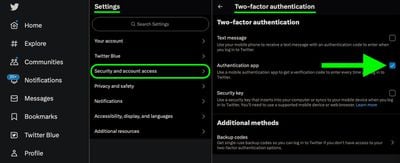
twitter 2fa

When you've completed the above steps, you should be able to log in to your Twitter account using your password, accompanied by a code generated by your authenticator app. Just be sure to keep a backup of your codes – if you don't have one and you lose your phone, you'll find it a lot harder to access your 2FA accounts.

Tag: Twitter

Top Rated Comments

contacos Avatar
40 months ago
I kept mine secure by deleting it. You should try it sometime. It’s also great for one’s mental health (sounds more serious than it is). I used to engage with strangers, which always put me in a bad mood afterwards. Now that I deleted it, I am like why did I care what strangers were thinking! So silly
Score: 36 Votes (Like | Disagree)
40 months ago

I kept mine secure by deleting it. You should try it sometime. It’s also great for one’s mental health (sounds more serious than it is). I used to engage with strangers, which always put me in a bad mood afterwards. Now that I deleted it, I am like why did I care what strangers were thinking! So silly
Now you spend that time engaging with strangers on Macrumors.
Score: 18 Votes (Like | Disagree)
marcinsf Avatar
40 months ago
much easier solution - don't use twitter.
It's free and doesn't cost anything to not use twitter :)
Score: 11 Votes (Like | Disagree)
judgeFire Avatar
40 months ago
In recent OS releases, the Settings > Passwords options include setting up Keychain based 2FA without the need for a third party app. It can also pop up the code when required, if it senses the field in question is for that. The SMS autofill is more consistent, tho
Score: 10 Votes (Like | Disagree)
adammusic Avatar
40 months ago
I feel like nobody knows about iOS built in 2fa.
Score: 9 Votes (Like | Disagree)
40 months ago
the fact that twitter is looking at cutting cost of sending auth SMSes is telling you a lot of how bad things are up there
they basically look for spare change between couch cushions
Score: 7 Votes (Like | Disagree)

Popular Stories

MacBook Neo Feature Pastel 1

First MacBook Neo Benchmarks Are In: Here's How It Compares to the M1 MacBook Air

Thursday March 5, 2026 4:07 pm PST by
Benchmarks for the new MacBook Neo surfaced today, and unsurprisingly, CPU performance is almost identical to the iPhone 16 Pro. The MacBook Neo uses the same 6-core A18 Pro chip that was first introduced in the iPhone 16 Pro, but it has one fewer GPU core. The MacBook Neo earned a single-core score of 3461 and a multi-core score of 8668, along with a Metal score of 31286. Here's how the...
MacBook Neo Feature Pastel 1

Apple Announces $599 'MacBook Neo' With A18 Pro Chip

Wednesday March 4, 2026 6:15 am PST by
Apple today announced the "MacBook Neo," an all-new kind of low-cost Mac featuring the A18 Pro chip for $599. The MacBook Neo is the first Mac to be powered by an iPhone chip; the A18 Pro debuted in 2024's iPhone 16 Pro models. Apple says it is up to 50% faster for everyday tasks than the bestselling PC with the latest shipping Intel Core Ultra 5, up to 3x faster for on-device AI workloads,...
Multicolored Low Cost A18 Pro MacBook Feature

Apple Accidentally Leaks 'MacBook Neo'

Tuesday March 3, 2026 7:00 am PST by
Apple appears to have prematurely revealed the name of its rumored lower-cost MacBook model, which is expected to be announced this Wednesday. A regulatory document for a "MacBook Neo" (Model A3404) has appeared on Apple's website. Unfortunately, there are no further details or images available yet. While the PDF file does not contain the "MacBook Neo" name, it briefly appeared in a link...