AppleInsider reports that Apple is currently overhauling the design of the MacBook, looking to bring a fresh exterior look to the aging entry-level notebook while also rebuilding the computer's interior architecture.
People familiar with Cupertino-based company's plans say the 13-inch portables are presently undergoing an industrial design overhaul that will see them reemerge in the coming months with a slimmer, lighter enclosure and restructured internal architecture to boot.
The report points to the likelihood of multiple models beginning at price points below the current $999 entry-level price, utilizing low-end components to allow Apple to better compete against budget PC notebooks.
Though details are few and far between, Apple is expected to achieve these markdowns through largely existing tactics, such as using lower-end components and previous-generation Core 2 Duo chips and architectures from Intel Corp. Battery life should receive a boost from cutting-edge technology that recently found its way into the company's other notebook offerings, while high-end legacy features like FireWire connectivity are likely to be sacrificed in the tradeoff.
Sources also claim that Apple had briefly considered using Intel's Atom processor in the MacBook as a way to quickly drop notebook prices, but decided against the move as the much-rumored tablet project came closer to fruition and allowed Apple to redevelop its ideas of the company's product mix for the future.
Apple's white polycarbonate MacBook has been viewed by many as sorely in need of a refresh, having been carried along as a single low-end model when the aluminum unibody MacBooks were introduced in October 2008 and left to carry the "MacBook" banner on its own when the aluminum models were rebranded as MacBook Pros in June 2009.
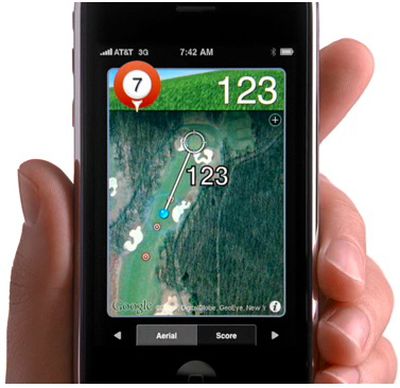
Apple has released a new iPhone 3GS commercial targeting sports enthusiasts. Like many recent iPhone ads, 'Avid' highlights three applications linked by a common theme and is available in Apple's iPhone ad gallery.
- Golfshot: Golf GPS [App Store, $29.99] - Provides GPS range-finding and aerial views for over 15,000 golf courses worldwide. - MLB.com At Bat 2009 [App Store, $9.99] - Offers live video streaming of limited Major League Baseball games, as well as audio streaming, video highlights and recaps, and "Gameday" live graphical pitch-by-pitch coverage. - TouchSports Tennis '09 [App Store, $0.99] - Offers a realistic 3D tennis game experience with multiple characters and courts to choose from.
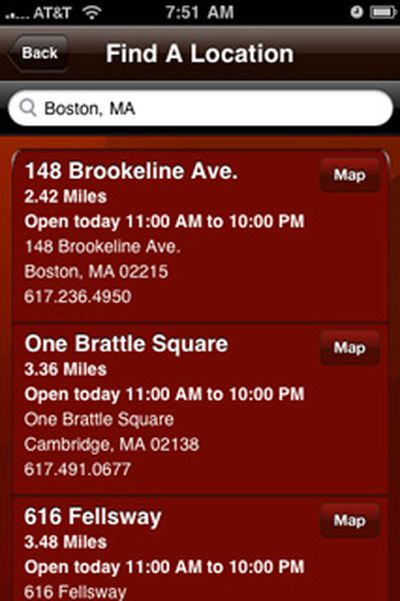
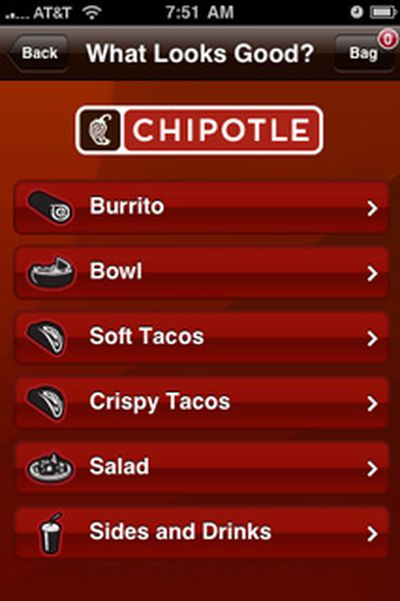
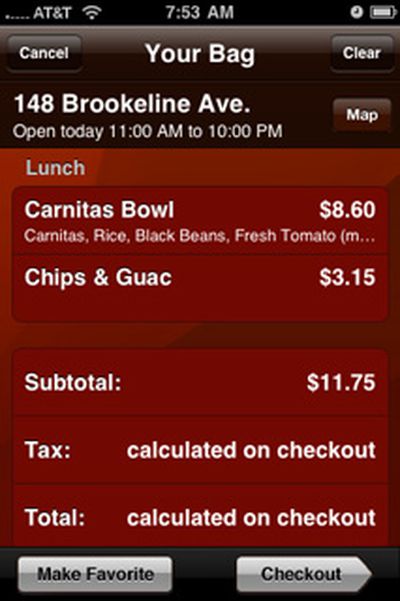
The Chipotle Ordering app is back in the App Store after only a short period of availability earlier this year. First appearing in January, the app was live for only a few hours and then pulled due to unanticipated demand that overloaded the servers handling orders. At that time, the plan was to have the app return to the App Store after a couple of weeks.
The app offers the ability to locate nearby Chipotle restaurants and browse the menu. Desired items can be ordered and paid for with a credit card. Favorite menu items can be saved for future orders.
The Chipotle Ordering app is free and can be found in the App Store here (link opens iTunes).
Parallels today introduced the Parallels Desktop Switch to a Mac Edition, bundling tutorial and migration tools with the company's Parallels Desktop 4.0 software that allows Macs to run Windows in a virtual environment, allowing users to switch between OS X and Windows without the rebooting required by Apple's Boot Camp solution. As the product name implies, the new edition is targeted at Windows users making the switch to Mac, and provides them with tools to easily move their Windows applications and data to their new Mac and offers them more than two hours of video tutorials to ease the transition to Mac.
"The growth in switching is partially due to the ease-of-use and cool capabilities of the Mac," said Serguei Beloussov, CEO of Parallels. "However, users don't want to lose the data they have accumulated and the applications they are already familiar with. Building on our proven track record of Mac innovation, we have addressed this concern and made learning the new operating system even simpler through interactive on-demand tutorials. These are combined with intelligent moving tools and our industry-leading Parallels Desktop for Mac, which offers the greatest performance and stability for running Windows seamlessly on Mac."
Training materials include video, on-screen demonstration and written prompts developed from the perspective of a Windows user and are user-directed allowing users to focus on areas of most interest to them. Migration tools include a USB transfer cable and Parallels Transporter software that allows users to easily move their entire Windows system into the Parallels Desktop virtual machine on their Mac.
Parallels Desktop Switch to a Mac Edition is available today at a suggested retail price of $99.99.
Apple has started airing two more "Get a Mac" ads featuring Justin Long as "Mac" and John Hodgman as "PC". The latest ads continue to target Microsoft's aggressive Laptop Hunters campaign which has focused on Apple's relatively higher prices than comparably equipped PCs.
The new ad called Top of the Line features actor Patrick Warburton who is best known for his portrayal of David Puddy from the Seinfeld sitcom. The new ad focuses on potential viruses and other "headaches" that may affect PCs, but not Macs. A second ad called Surprise was also posted today delivering a similar message.
The Wall Street Journal reports (subscription required) that Steve Jobs has been focusing almost exclusively on Apple's much-anticipated tablet computer since his late June return from a medical leave of absence for a liver transplant. The report notes that employees who had become accustomed to a certain level of freedom in their work during Jobs' leave of absence have found his close attention to even the minutiae of the project "jarring".
Since his return in late June, the 54-year-old has been pouring almost all of his attention into a new touch-screen gadget that Apple is developing, said people familiar with the situation.
Those working on the project are under intense scrutiny from Mr. Jobs, particularly with regard to the product's advertising and marketing strategy, said one of these people. The people familiar with the matter declined to give details on the tablet or disclose when the device would come out.
In a response to The Wall Street Journal's request for comment, Jobs simply reported that "much of [their] information is incorrect" while declining to provide additional specifics.
Jobs' attention to detail on the tablet is said to be similar to his singular focus on the iPhone in the months leading up to its 2007 launch. Jobs has been quite particular about the tablet project over the last several years, having set such high standards that he had reportedly nixed the project twice before finally finding the technology sufficient to achieve his vision.
At Apple, a tablet-like device has been many years in the making. Apple filed a patent related to a tablet device as early as 2000, according to a Thomson Reuters patent database.
But development has come in fits and starts. Mr. Jobs killed the project twice in recent years, the first time because the battery life was too short, and the second time because there was insufficient memory, said one of the people familiar with the matter.
The report concludes by summarizing recent rumors pointing to a tablet introduction later this year or early next year at a price point somewhere between the iPhone and the entry-level MacBook. Also unknown, according to the article and other observers, is whether the device will run full Mac OS X or if it will run a version of the iPhone OS.
In a note to clients released this morning, Piper Jaffray research analyst Gene Munster estimated that Apple will sell approximately 5 million copies of OS X Snow Leopard during the remainder of this quarter. Apple announced earlier this morning that the new version of the company's operating system will go on sale this Friday, August 28th.
Munster calculates an average selling price for Snow Leopard of $22, considering the product mix of Leopard upgrades ($29) and "Up-to-Date" purchases for those who have purchased a new Mac since June 8th ($9.95), yielding approximately $110 million in gross revenue for the quarter and about $66 million in net profit based on an estimated 60% profit margin. That result would add approximately $0.05 per share to Apple's earnings for the quarter, although Munster believes that that contribution is already factored into analyst's estimates for the quarter, as pricing and the estimated release date have been known for some time now.
Munster also sees OS X Snow Leopard as relatively minor upgrade, but one which that will allow Apple to position it as a value-priced upgrade for existing users and cutting-edge technology for new users against the "antiquated technology" of Windows users stuck on XP and Vista who are beginning to think about the upgrade path for Windows 7.
Apple sold two million copies of Mac OS X Leopard during its launch weekend in October 2007.
TomTom's highly-anticipated GPS app for the iPhone finally made it to the App Store last week. First announced WWDC on June 8, TomTom's demo video during the event promised a slick app that mimicked the look of its standalone-GPS products and applications for other smartphone platforms while promising an appropriately iPhone-esque interface. We've had a chance to put the app through some initial paces to see how it performs.
Download and set-up
The TomTom app for the U.S. and Canada takes some time to download given its 1.21 GB size. The size of the app is attributed mostly to the map data it holds, carrying street-level data for the all of the U.S. and Canada, including points of interest (POIs). It can be installed on to iPhone 3GS and 3G models, though would not install on a first-generation iPhone.
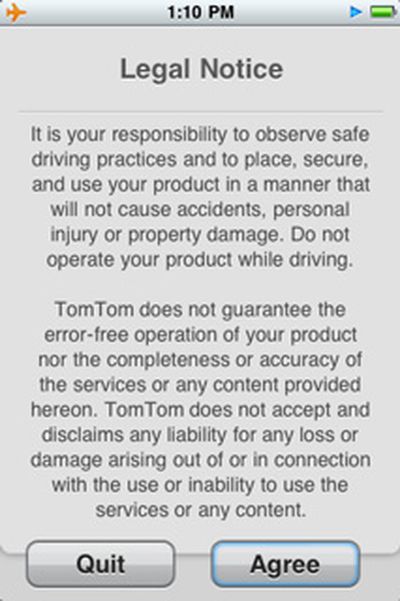
Opening the app for the first time prompts a legal advisory to pop up, which must be acknowledged in order to proceed. After this, you are free to roam about and explore the app, with no settings prompts or "getting started" information shown. The voice is set to "Lori," a female American English voice by default. If you want to change the voice, you have a whopping 75 from which to choose in languages from Afrikaans to Vlaams. There are 11 voice selections that speak English available, though none of these are computerized voices capable of pronouncing street names. Changing the voice guidance language does not change the language of the app's English interface.
First trips
On our first trips out using the TomTom app to navigate, getting a GPS fix in suburban Boston under clear skies took under 30 seconds. Relative to well-known surroundings, the app showed an accurate location most of the time, with only a couple of moments when the icon representing our location appeared off to the side of the current road. The graphics are sharp and professional, though tracking is just a wee bit jumpy on the 32GB iPhone 3GS used for testing, though this does not hamper navigation in any way. Switching between landscape and portrait mode is smooth when the iPhone's orientation is changed.
The volume of voice guidance is loud enough to be heard over music playing at a low volume through the car's stereo. Adjusting the voice's volume can be accomplished using the iPhone's volume rocker though you must do this while the voice is speaking, otherwise you'll only adjust the ringer volume. If you tap on the lower left corner of the information pane at the bottom where navigation information is shown, you'll get an on-screen volume slider that will adjust the voice's volume directly.
Music from the iPod application can be played during navigation, though it stops instantly when voice guidance is given, and then starts playing again right after. This is a pretty abrupt way to handle voice guidance and a fade-in/out effect would be less startling and easier on the ears.
When a call is received, navigation guidance stops and the standard iPhone incoming call screen is shown. If the call is accepted, the phone app takes precedence, displaying the standard in-call screen. Once the call has ended or an incoming call is rejected, Tomtom opens up on its own immediately, and navigation resumes once it obtains a GPS fix. The same behavior is exhibited if a call is initiated via a Bluetooth accessory, such as a car kit.
Unscientific eyeballing of the iPhone's built-in battery percentage meter showed about a 5% drop for every 10 minutes of guidance with Wi-Fi and Bluetooth on and connected to the car's Bluetooth system. Turning Wi-Fi and Bluetooth off should improve battery life during navigation, but connecting your iPhone to a power source would be wise to avoid a dead battery in the middle of navigating an unfamiliar place for all but the shortest trips.
Interface and features
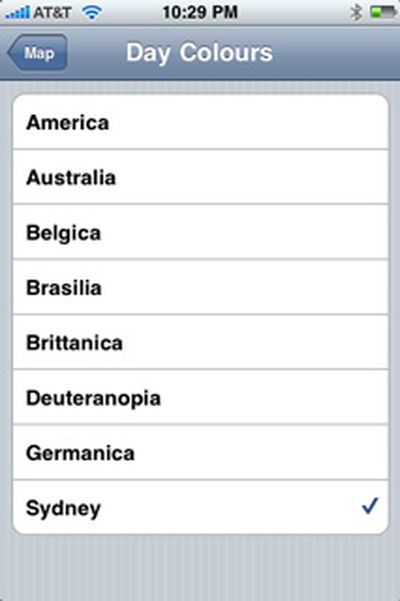
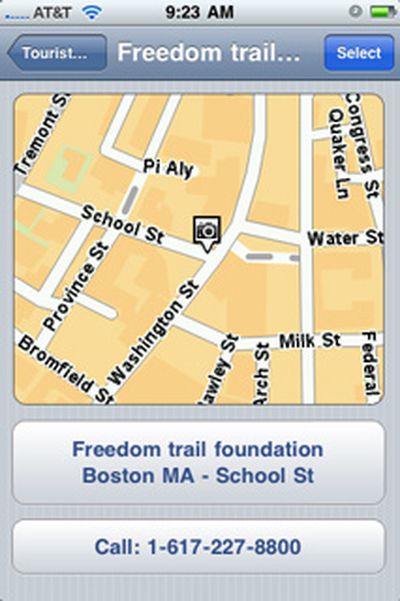
The TomTom app offers an interface that will be very familiar to anyone who has ever used a TomTom stand-alone device or app on another smartphone or PDA platform before. The ability to change the day and night color schemes is present, although a setting to allow the app to automatically switch between day and night color schemes using the iPhone's ambient light sensor seems to be missing. At first glance, POI data appears to be robust, allowing us to easily find retail store chain and government office locations. Many POIs have phone numbers, which can automatically be called through a shortcut button in the POI summary view.
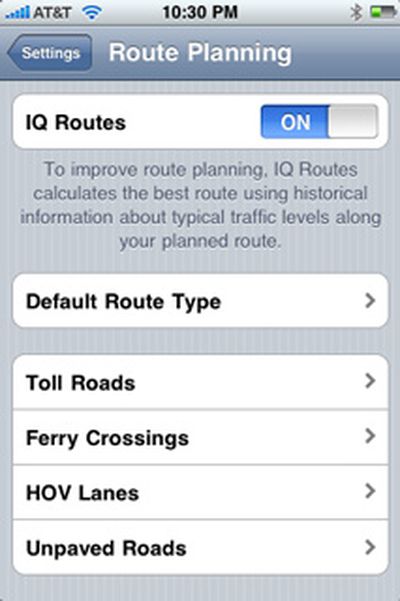
Also included is IQ Routes, a relatively recent offering from TomTom that promises to provide optimal route guidance based on historical traffic information for the route you need to travel. Looking at other features offered on their stand-alone units, the TomTom iPhone app has not inherited text-to-speech voice guidance nor live traffic information.
Initial thoughts
So far, the TomTom app shows promise, though it has some heavy competition from Navigon, Sygic, CoPilot and many others. Currently priced at $99, TomTom is the most expensive navigation app available for the U.S., coming in at over $60 more than the least expensive full-featured GPS app that covers the U.S. and Canada, CoPilot Live, which is priced at $34.99.
The accessory cradle, which will have its own GPS chip, a loudspeaker, and ports for charging and audio output, is not yet available nor is its price known though unconfirmed information points to a possible price of 99 + VAT for the cradle and app together and compatibility with the iPod touch. TomTom put out a new video of the cradle a few days ago, highlighting its features:
The upcoming main review of the TomTom app will include more information about the app's settings, customization options, POI database, as well as a more in-depth look at the app's performance on the road and its advance planning features.
The TomTom app for the U.S. and Canada can be found here (link opens iTunes) and costs $99.
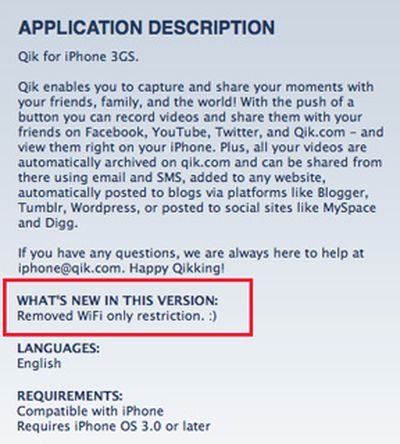
The Qik app that first arrived in the App Store earlier this month has already been updated to a new version that removes the Wi-Fi only restriction. At its initial release, the popular video sharing application was able to upload previously-recorded videos to Facebook, YouTube, Twitter, and Qik's own site via Wi-Fi only. Now, video uploads can also be done over a 3G or EDGE cellular data connection.
The Qik iPhone app still lacks the ability to stream live video, a feature present in versions available for other platforms.
The Qik app is free and can be found here (link opens iTunes).
Bloomberg reports on Apple's retail store performance amidst the current economic situation, noting that Apple's retail sales have held up remarkably well as other merchants have seen sales slip.
Apple, based in Cupertino, California, increased revenue at its stores by 2.5 percent in the first six months of the year to $3 billion as the rest of the retail industry suffered. During the same period, sales at all U.S. retailers fell 9.2 percent compared with the first half of 2008, according to the U.S. Commerce Department.
The report focuses on Apple's flagship Fifth Avenue store in New York City, noting that the store may be the highest-grossing retail outlet in the famed shopping district on a per-square-foot basis.
Apple's Fifth Avenue emporium probably has annual sales of more than $350 million, topping any of the chain's other outlets, said Jeffrey Roseman, executive vice president of real- estate broker Newmark Knight Frank Retail in New York. The location is 10,000 square feet, putting its sales per square foot at a minimum of $35,000, based on Roseman's estimate.
Other high-end retailers noted in the report, such as jewelry shops Tiffany & Co. and Harry Winston, are reported to be bringing in closer to $12,000 to $18,000 per square foot annually.
A previous report had pegged Apple's annual sales for its Fifth Avenue store at as much as $440 million, although that number may have been slightly inflated, as it came from the building's owner as it was being marketed for sale.
Gdgt reports that RealNetworks has submitted its Rhapsody app for the iPhone and iPod touch to the App Store for approval. The app will provide on-demand streaming music to Rhapsody subscribers and it will offer a limited free trial for non-subscribers to test the service.
The RealNetworks blog describes that the app will be easy and intuitive to use and will include the ability to search the entire Rhapsody library of over 8 million songs. A video demonstrating the app has been posted:
Apple today announced that Mac OS X v10.6 Snow Leopard will go on sale Friday, August 28 at Apple's retail stores and Apple Authorized Resellers, and that Apple's online store is now accepting pre-orders.
"Snow Leopard builds on our most successful operating system ever and we're happy to get it to users earlier than expected," said Bertrand Serlet, Apple's senior vice president of Software Engineering. "For just $29, Leopard users get a smooth upgrade to the world's most advanced operating system and the only system with built in Exchange support."
Snow Leopard is available as an upgrade for users of Mac OS 10.5 Leopard for $29 as a single user license and $49 as a family pack. For users of Mac OS 10.4 Tiger and earlier, the Mac Box Set includes Mac OS X Snow Leopard, iLife '09 and iWork '09 for $169 as a single user license and a family pack for $229. (prices in USD)
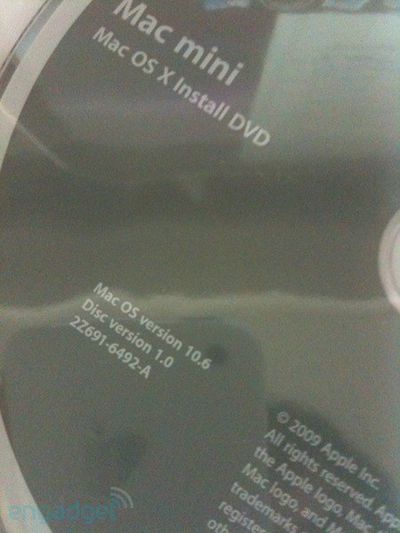
The Japanese version of Engadgetreports [Google translation] that a Mac mini purchaser appears to have received a Mac OS X Snow Leopard restore disc along with the computer. The source has provided a photo of the DVD, as well as several screenshots showing the Snow Leopard installer.
Meanwhile, several readers report that the status of their OS X Snow Leopard Up-to-Date pre-orders have changed to "Prepared for Shipment" and continue to indicate a shipping date of "By August 28th", adding yet another indication that the launch of Apple's new operating system is quickly approaching despite the lack of an official announcement from the company so far.
Starting off with background information on the iPhone and the App Store, Apple notes that the App Store now "offers over 65,000 iPhone applications, and customers have downloaded over 1.5 billion applications" and that it has "fostered competition as other companies (e.g., Nokia, Microsoft, RIM, Palm and Verizon) seek to develop their own mobile platforms and launch their own application stores." In describing the App Store approval process, criteria that serves to "protect consumer privacy, safeguard children from inappropriate content, and avoid applications that degrade the core experience of the iPhone" are listed and most rejections are based on bugs, with attempts made to provide feedback to the developer to help them improve it and increase the chances of an app's approval afterward.
In response to the question about the rejection of the Google Voice app, Apple states:
"Contrary to published reports, Apple has not rejected the Google Voice application, and continues to study it. The application has not been approved because, as submitted for review, it appears to alter the iPhones distinctive user experience by replacing the iPhones core mobile telephone functionality and Apple user interface with its own user interface for telephone calls, text messaging and voicemail. Apple spent a lot of time and effort developing this distinct and innovative way to seamlessly deliver core functionality of the iPhone."
Additionally, the response describes how the Google Voice application fails to make use of the Visual Voicemail feature and the native Messaging app, as well as the fact that it uploads a user's Contacts list to Google's servers with no "assurances from Google that this data will only be used in appropriate ways." Apple commits that it is still "continuing to study the Google Voice application and its potential impact on the iPhone user experience."
Regarding the role of AT&T in relation to the Google Voice app, Apple clearly explains that AT&T has no role in the app approval process, nor does anything in Apple's contract with AT&T have any bearing in this situation. It is noted, however, that the agreement with AT&T does require Apple to not "include functionality in any Apple phone that enables a customer to use AT&Ts cellular network service to originate or terminate a VoIP session without obtaining AT&Ts permission," which clearly provides the reasoning behind the Wi-Fi-only functionality of the Skype VOIP app and other similar apps.
Apple's response to Question 6 provides further details on the app approval process, describing that there are "40 full-time trained reviewers" and that "at least two different reviewers study each application so that the review process is applied uniformly." Apple also reveals there is also an executive review board that oversees policies and procedures and reviews apps escalated because they "raise new or complex issues."
USA Today reports that Apple, AT&T, and Google are expected to file comments with the U.S. Federal Communications Commission today regarding Apple's rejection of the official Google Voice iPhone application.
Apple (AAPL) and AT&T (T) Friday are expected to tell the Federal Communications Commission why Google's free voice application, called Google Voice, is banned from the Apple iPhone. Google is also filing comments.
The FCC moved quickly to investigate the application's rejection, looking to determine the extent of AT&T's role in the decision-making process as Apple and the wireless industry have both come under scrutiny in recent months for possible anti-competitive practices.
The report notes, however, that Google may also find itself facing inquiries about a similar issue in which users of handsets based on the company's Android mobile phone operating system are unable to take advantage of full Voice over Internet Protocol (VoIP) service from Skype.
Consumers who use Android, the Google-developed operating system for wireless devices, can't use Skype, a leading Voice over Internet Protocol (VoIP) service. A pioneer in free Internet calling, Skype allows you to talk as long as you want without draining cellphone minutes.
Android users get Skype Lite, a watered-down version of the original that routes calls over traditional phone networks -- not the Internet. As a result, long-distance calls are still cheap or free, but cellphone minutes are gobbled up every time a Skype Lite call is made.
In a statement, Google noted that it does have the ability to block VoIP services at the request of wireless providers. With T-Mobile currently being the only U.S. provider to offer Android-based phones, it would appear that the wireless company is responsible for the limitation on Android-based phones, but a T-Mobile spokesman has denied that that is the case.
USA Today notes that Google has been asked to address its application approval process for Android as part of the Google Voice investigation.
Satwaves reports that satellite radio company Sirius XM will be releasing a dock connector accessory receiver for the iPhone and iPod touch at a media event next Wednesday, allowing access full Sirius XM service via their devices.
Sources familiar with the situation are now confirming that Sirius XM will be unveiling the iPhone/iPod Touch accessory docks that I speculated about three months ago this Wednesday, August 26th. Sirius XM will be hosting a special invitation only media event in New York that day to show off their new products to be available this holiday season. The invitation reads: "View the new lineup of radios and accessories from Sirius XM for the home, office, vehicle and beyond."
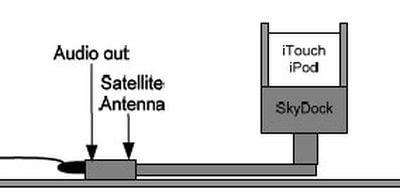
Satwaves points to a posting at XMFan showing a diagram of the accessory, which will reportedly be called the "XM SkyDock".
The XM SkyDock is a docking station for your iPod Touch or iPhone that turns it into a SATELLITE XM Radio receiver! Included is an XM antenna, power cord (also featuring the new transmitter technology), and docking station that turns your iPod/iPhone into an actual XM Satellite Radio receiver using the SiriusXM app. This may be the biggest breakthrough in satellite radio technology to date, and could possibly bring in millions of additional subscribers. This SKYDock kit is expected to sell for less than $100.
The XM SkyDock accessory will reportedly utilize the Sirius XM Premium Online iPhone application initially released in June as an interface for the satellite service.
Several readers have informed us that SlingPlayer Mobile 1.1 [App Store, $29.99] has appeared in the App Store. As we profiled last week, the update adds several new features, including support for 16x9 widescreen video and remote control integration with DISH Network.
What's New in this Version - Full 16x9 widescreen support (Slingbox SOLO, PRO, and PRO-HD only) - DISH Remote Access integration (DISH Network users only) - Faster start and channel change - Improved remote control interface
Unfortunately, SlingPlayer Mobile still only allows streaming over Wi-Fi, maintaining a limitation imposed on the initial version at the request of AT&T, which feared that allowing such uses on its 3G network would lead to congestion and service disruptions.
The Loop notes that Apple has begun shipping Logic Express 9, an updated version of the company's middle-tier audio suite positioned as offering additional tools to GarageBand users.
Logic Express fits between GarageBand at the low-end and Logic Pro at the high-end, in Apple's music software line-up. Logic Express is more like Logic Pro in its look and feel than GarageBand.
Announced last month alongside revamped versions of Final Cut Studio, Final Cut Server, and Logic Studio, Logic Express had simply been advertised as shipping in August. Logic Express is priced at $199.