MacRumors

CNET reports that Apple, Google, and twenty other companies have been sued by Eolas Technologies for patent infringement related to the use of browser plug-ins and Ajax to offer interactive content in Web browsers. The move comes several years after the conclusion of a similar lawsuit brought against Microsoft that resulted in an initial $521 million judgment in favor of Eolas, although the suit was eventually settled out of court for an undisclosed amount.

Eolas' suit is not to be taken lightly. Although the earlier Microsoft case took many years to resolve, and Eolas by no means won a complete victory, the patent involved did overall withstand heavy legal challenges despite many on the Web rallying to Microsoft's aid. Microsoft and Eolas won't describe terms of their 2007 settlement of the patent case, but Eolas did say it expected to pay its shareholders a 2007 dividend afterward.

The Microsoft suit, as well as the new one targeting Apple and others, focused on a patent held by Eolas stemming from work performed by Eolas founder Michael Doyle while at the University of California, San Francisco. The patent, which covers the use of such technologies as Flash and Java plug-ins, was the subject of intense scrutiny during the trial and was initially overturned by the U.S. Patent and Trademark Office before being reinstated and serving as the basis of the judgment against Microsoft.

The new suit also includes the use of Ajax Web development techniques for which Eolas has recently received a second patent as an extension of the original. Defendants in the new suit include Adobe, Amazon, Apple, Blockbuster, Citigroup, eBay, Frito-Lay, Go Daddy, Google, J.C. Penney, JPMorgan Chase, Office Depot, Perot Systems, Playboy Enterprises, Staples, Sun Microsystems, Texas Instruments, Yahoo, and YouTube.


Computerworld reports that research firm Gartner is forecasting significant growth in Google's Android operating system for smart phones, noting that it expects Android to surpass Apple's iPhone to claim the number two spot behind Symbian OS with 14.5% of the global smart phone market by 2012.

While the first Android product release, the T-Mobile G1, only won a lukewarm response, Android 1.5 (code-named Cupcake) is well thought-out, Dulaney said. Other expected improvements in Android for its application store and development environment will be "backed by the power of Google's search engine," he said. "Google's other up-and-coming consumer and enterprise products should make[Android] a dominant platform."

And because Android and Google operate in an "integrative and open environment, [they] could easily top ... the singular Apple," he said.

Android will also run on phones from several manufacturers, helping its growth, especially when compared to the iPhone, Dulaney said. In 2010, as many as 40 models of Android devices will ship, and the next OS update, code-named Donut, will ship in the second quarter, Dulaney predicted.

The predicted margin is small, however, with Apple predicted to grab 13.7% of the smart phone market in 2012. Both companies are forecasted to take significant share from Symbian, which currently holds approximately 50% market share but is expected to fall to 39% over that time.

Related Forum: iPhone

Amazon today announced that it is dropping the price of its basic Kindle e-Book reader from $299 to $259 and also partnering with AT&T to introduce a new version offering global wireless coverage in over 100 countries and territories. The new global version is priced at $279 and will begin shipping on October 19th.

Kindle wirelessly downloads books, newspapers, magazines, blogs, and personal documents to a crisp, high-resolution 6-inch electronic ink display that looks and reads like real paper. Kindle utilizes the same 3G wireless technology as advanced cell phones, so you never need to hunt for a Wi-Fi hotspot or sync with a PC. Readers can wirelessly shop the Kindle Store, download books in less than 60 seconds, automatically receive newspaper and magazine subscriptions, receive personal documents, and read from their library -- now in over 100 countries and territories.

The new version will also enable Amazon to offer the Kindle for sale in over 100 countries. The international Kindle Store catalog will offer over 200,000 books, slightly more than half the number currently available on the U.S. store.

Apple's much-anticipated tablet computer has been claimed to be focusing on e-Book capabilities, but described as attempting to redefine print media into an interactive experience not currently possible through dedicated e-Book readers such as Amazon's Kindle.

DigiTimes reports that Foxconn Electronics has been named as Apple's manufacturing partner for its much-anticipated tablet and that the device is expected to launch in the first quarter of 2010.

The device is expected to hit the market in the first quarter of 2010, with initial shipments from Foxconn being in the 300,000-400,000 range, the sources said.

The device will have a 10.6-inch display, and the sources speculated that perhaps Foxconn could secure panels from its subsidiary Innolux Display.

While a number of rumors have previously pegged the display on Apple's device in the 7-to-10 inch range, this report of a possibly slightly larger display than previously thought nearly matches recent claims of a 10.7" screen. Speculation that Innolux may provide screens for the new device conflicts, however, with earlier reports that Wintek had already been tabbed as the display provider.

Finally, the report notes that the device will place an emphasis on e-Book functionality, echoing claims that Apple is aiming to redefine print media with the device. Apple's extended-life battery technology such as that found in recent MacBook Pro revisions, Internet connectivity, and Apple's typical attention to user interface detail are all expected to be featured in the new device.

Dow Jones Newswires reports that U.S. Chamber of Commerce Chief Executive Tom Donohue responded to Apple CEO Steve Jobs today after the company announced its withdrawal from the organization over the Chamber of Commerce's stance on pending climate change legislation.

"It is unfortunate that your company didn't take the time to understand the Chamber's position on climate and forfeited the opportunity to advance a 21st century approach to climate change," U.S. Chamber of Commerce Chief Executive Tom Donohue wrote in a letter to the Apple chief executive. He said that the business group is committed to the environment but also to preserving the competitiveness of American business.

Donohue went on to note that the organization does support climate change legislation, but opposes currently proposed legislation that the organization claims would hurt American businesses and simply transfer greenhouse gas emissions to other countries rather than directly addressing the issue.

Apple's withdrawal places it in the company of such entities as Nike and Pacific Gas & Electric that have either resigned from or scaled back their relationships with the U.S. Chamber of Commerce over its climate change policies.

doubleTwist, the company run by famed digital rights management hacker Jon Lech Johansen ("DVD Jon"), today released a revamped doubleTwist for Mac application, adding a number of new features to its iTunes competitor. The most notable enhancement is the inclusion of a music store linked to the Amazon MP3 Store. The application offers an iTunes-like experience for browsing the Amazon MP3 Store, bypassing the traditional browser-based access for a streamlined desktop application environment.


Other features included in the software, which allows users to sync their media libraries to a wide array of devices, include new playlist support and search functionality.

As part of its advertising campaign for the launch, doubleTwist last week released a remake of Apple's legendary "1984" commercial, but utilizing a Steve Jobs-like character in the role of Big Brother.

Related Forum: Mac Apps

Following AT&T's announcement that it will now allow iPhone Voice over Internet Protocol (VoIP) services over its mobile network, Apple and VoIP provider Skype have issued public statements reacting to today's announcement.

The Associated Press reports that Apple will be moving forward as quickly as possible to enable customers to take advantage of the functionality.

Apple welcomed the announcement. "We are very happy that AT&T is now supporting VOIP applications," said Apple spokeswoman Natalie Kerris. "We will be amending our developer agreements to get VOIP apps on the App Store and in customers' hands as soon as possible."

Skype president Josh Silverman also applauded the move, as his company will now be able to expand the usability of its iPhone application, which has been limited to Wi-Fi access only for VoIP services.

All of us at Skype applaud today's announcement by AT&T (in an FCC filing to be published shortly - update, it's here in PDF format) that it'll open up its 3G network to Internet calling applications such as Skype. It's the right step for AT&T, Apple, millions of mobile Skype users and the Internet itself.

Silverman notes, however, that the company still hopes to see government policies enacted to provide for the openness necessary for Skype to be available throughout the industry.

Related Forum: iPhone

Apple today released Apple RAID Card (Early 2009) Firmware Update 1.1, bringing several updates for the company's RAID card offered as an option on the Mac Pro and Xserve. The update is recommended for all Early 2009 Mac Pros and Xserves using the Apple RAID card.

This update provides several fixes, including:

- Reliability improvements during boot and power fail recovery
- Improves handling of hard drives with bad blocks
- Improves RAID 1 read performance
- Improves hard drive compatibility with non-Apple drives
- Improves support for systems with 48GB or larger memory
- Improves battery handling and reporting

Additional information is available in Apple's support document on the update.

The update weighs in at 25.9 MB and requires Mac OS X 10.5.8 or later. Apple released a similar update for earlier Mac Pro and Xserve models last month.

The Washington Post reports that AT&T may be planning to announce support for Skype, Google Voice, and other related Voice over Internet Protocol (VoIP) services over its mobile networks, including via Apple's iPhone.

One source close to the thinking of AT&T executives said the company has been deliberating the decision for weeks and that top executives have said they were close to accepting voice over Internet services on all AT&T phones, including the iPhone. The source spoke on the condition of anonymity because a decision hadn't been officially announced. Skype currently operates on the iPhone through WiFi access, but not on AT&T's 3G mobile network.

Apple reportedly rejected a Google Voice iPhone application in late July, sparking an inquiry into the situation from the Federal Communications Commission (FCC). In its response to the FCC, Apple claimed that it had not formally rejected the application and was still reviewing it, but Google's response painted a very different picture, claiming that Apple senior vice president Phil Schiller had directly delivered the rejection notice to a Google executive via telephone.

For its part, AT&T noted that it played no role in the specific Google Voice iPhone application review process, although the company's agreement with Apple does reportedly require that it provide permission for any iPhone functionality to originate or terminate a VoIP connection on its network.

Update: AT&T has confirmed that it has notified Apple and the FCC that it will permit VoIP functionality on the iPhone over its 3G network.

AT&T today announced it has taken the steps necessary so that Apple can enable VoIP applications on iPhone to run on AT&T's wireless network. Previously, VoIP applications on iPhone were enabled for Wi-Fi connectivity. For some time, AT&T has offered a variety of other wireless devices that enable VoIP applications on 3G, 2G and Wi-Fi networks. AT&T this afternoon informed Apple Inc. and the FCC of its decision.

The announcement covers traditional VoIP services and does not address the issue of Google Voice, which is not strictly a VoIP service, although it provides some functionalities similar to VoIP. But it remains unclear whether AT&T has ever actually opposed Google Voice on the iPhone, as the company claimed that it played no role in the application review process.

Related Forum: iPhone

TechFlash noted yesterday that Verizon is rolling out a new advertising campaign targeting AT&T's network by focusing on the geographic coverage of the competing companies' networks. The campaign also employs a twist on Apple's "There's an app for that" iPhone slogan with its own tagline of "There's a map for that."

The fine print also is worth checking out. It reads: "Browse the Web and download music and apps, at 3G speed, in five times more places than the nation's number two wireless carrier. Before you pick a phone, pick a network."

A television commercial featuring the new campaign also debuted yesterday.

Related Forum: iPhone

Hardmac reports that Apple may be planning to introduce a revised version of its Final Cut Studio professional video editing software at the National Association of Broadcasters (NAB) conference in April 2010. According to the report's sources, the most recent version of Final Cut Studio, released just this past July, is actually a temporary version focused on providing Snow Leopard compatibility.

Many users consider this version as incomplete, and according to internal source, the current version 3.0 is tagged as a "temporary/transition". The main reason seems to be associated to Snow Leopard release. It seems that one could not integrate all changes expected in FCP 3.0 with Snow leopard development schedule. So, apparently the really new version should be unveiled by Apple during the NAB 2010 which will take place from April 10 to 15, 2010.

Apple has in the past used NAB as a forum for such product launches, debuting Final Cut Studio 2 and other associated products there in 2007. Apple, however, pulled out of the 2008 conference and did not return for 2009. Given Apple's continued move toward reducing its presence at trade shows, most notably with its departure from Macworld San Francisco, a return to NAB would be something of a surprise.

Hardmac notes that the source's information has not been confirmed, but that the source has been accurate in the past. Readers, however, are also cautioned that there is still plenty of time for plans to change prior to NAB 2010.

VMware today announced the October 27th launch of VMware Fusion 3, a significant update to the company's virtualization solution that allows Mac users to run Windows applications right alongside OS X applications. The new version reportedly brings over 50 new features and improvements, including Snow Leopard optimization and full Windows 7 compatibility.

Key highlights include:

- Optimized for Snow Leopard. Built from the ground up for the Mac, VMware Fusion 3 leverages Mac OS X Snow Leopard's advanced architecture with a new 64-bit core engine and native support for the 64-bit kernel, delivering even better Windows on Mac performance.

- Ultimate Windows 7 Experience. VMware Fusion 3 will be the first to enable the full Windows 7 experience, side-by-side with your Mac, complete with Windows Aero and Flip 3D.

- Switching Made Easy. VMware Fusion 3 will make it easy for users to bring their entire PC to their Mac in a few easy steps - wirelessly or with a simple Ethernet cable - allowing customers to protect investments in existing Windows software, and to keep using the programs they still need.

- Best-in-Class 3D Graphics. Support for OpenGL 2.1 and DirectX 9.0c Shader Model 3 will enable users to run their favorite 3D Windows games and applications - all without rebooting.

VMware Fusion 3 is now available for pre-order at a suggested price of $79.99, with upgrading pricing of $39.99 available to current VMware Fusion users.

At this point, it seems obvious that Apple had been working on adding a camera to the newest iPod Touch, but for some reason, the feature was cut at the last minute. Exactly how last minute seems evidenced by the fact that some case manufacturers seem to have mass produced cases adopting the new design, and have pushed these designs into retail stores.

The following clip/armband was spotted at a Best Buy in Texas, which shows an image of an iPod touch with camera:

000326 photo 500

Meanwhile, an actual case was spotted in a mall in Texas:


We've been told that Apple does not generally share pre-release design information with most case manufacturers. Instead, these case manufacturers simply have enormous financial incentive to obtain the information through other means to be able to manufacture cases ahead of launch. In this case, their gamble didn't quite pay off, though presumably the cases still work with the camera-less iPod touch..

Related Forum: iPod touch and iPod

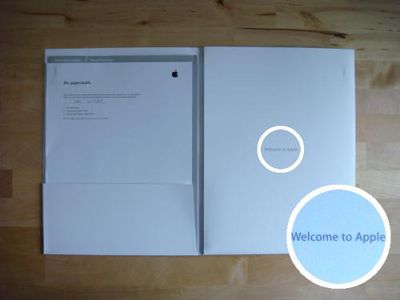
On his Deciphering Glyph blog, the founder of Twisted posts "unboxing" photos (via Gizmodo) of a job offer he recently received from Apple. The photos unsurprisingly reveal that the company that places such emphasis on design aesthetics for both products and packaging also appears to have put a fair amount of effort into its human resources materials, resulting in a sleek appearance likely to appeal to and impress potential employees.

The tension on the hinge of the folder is perfect: not too tense, not too loose. It opens easily and will lay flat on any work surface. In case I didn't actually know who they are or what it was, the words "welcome to apple" adorn the inner flap.

Tab separators along the tops of the section allow me to quickly find the files that I need. If you're not familiar with paper technology, this is not unlike the "tab" widgets you might see along the top of a browser window such as Firefox and Safari. They work by placing your finger on top of the desired "tab" and lightly pulling. Perfectly intuitive.

223831 ioffer 1 500

223831 ioffer 2 500

223832 ioffer 3 500

The Globe and Mail reports that wireless providers Bell and Telus will begin selling the iPhone in Canada next month, ending the exclusivity arrangement enjoyed by Rogers Wireless since the iPhone's introduction there in July 2008.

Neither Bell nor Telus would confirm that they would add the iPhone to their lineups. Apple also declined to comment. But people familiar with the matter said the two carriers will announce a working partnership with Apple as early as Tuesday or Wednesday and begin selling the device in time for the launch of their new network next month.

The news comes just a week after O2's exclusivity arrangement with Apple for the iPhone in the UK crumbled as both Orange and Vodafone announced plans to begin offering the iPhone in the near future.

Update: Both Bell and Telus have released brief statements confirming that they will begin offering the iPhone for sale in November.

Related Forum: iPhone

Multiple sources, including the Washington Post, are reporting that Apple has given up its membership in the the U.S. Chamber of Commerce over the Chamber's stance on climate change legislation.

In a letter to Thomas J. Donohue, President and CEO of the U.S. Chamber of Commerce, Apple's Vice President of Worldwide Government Affairs, Catherine A. Novelli, stated Apple's position and submitted Apple's resignation.

Apple is committeed to protecting the environment and the communities in which we operate around the world. We strongly object to the Chamber's recent comments opposing the EPA's effort to limit greenhouse gases.

Apple supports regulating greenhouse gas emissions, and it is frustrating to find the Chamber at odds with us in this effort. We would prefer that the Chamber take a more progressive stance on this critical issue and play a construtive role in addressing the climate crisis. However, because the Chamber's position differs so sharply with Apple's, we have decided to resign our membership effective immediately.

The Chamber's stance on regulation was stated in its Five Positions on Energy and the Environment and a press release.

Apple is not the first organization to resign from the Chamber over this issue. California's largest utility, Pacific Gas and Electric Co., and other companies have similarly resigned.

Apple recently launched an environmental publicity initiative to showcase its efforts on such issues.

Apple today seeded to developers a new build of Mac OS X Snow Leopard 10.6.2 (Build 10C514f).

The seed is said to contain dozens of minor bug fixes and performance improvements in these areas: Address Book, AppleScript, AppleScriptObjC, ATS, ColorSync, Component Manager, Core Animation, Core Audio, Core Chinese Engine, Core Data, Core Graphics, Core Text, File Manager, Garbage Collection, Graphic drivers, Help Viewer, ImageKit, IOHIDFamily, Networking, NS Image, OpenCL, OpenGL, OSA, QT Kit, Speech Recognition, Sync Services, and Xtype.

The seed notes reportedly include a caution that there is a known issue with optical drives: that they may not be recognized and the eject key may not eject the media, and that DVD Player may hang. As a result, not all developers may choose to install this build.

Mac OS X 10.6.1 was released September 10.

While Apple's iPhone has notably been left out of Adobe's new initiative with Flash Player 10.1 to bring an integrated Flash experience to browsers on smartphones and other platforms, TechCrunch notes that Adobe has also been using its Adobe MAX 2009 conference to show off capabilities found in the company's forthcoming Flash Professional CS5 that will allow developers to build Flash-based applications and then export them to the standard .ipa format used for native iPhone applications.

The new support for iPhone applications in the Flash Platform tooling will not allow iPhone users to browse web content built with Flash technology on iPhone, but it may allow developers to repackage existing web content as applications for iPhone if they choose to do so.

Flash Player uses a just-in-time compiler and virtual machine within a browser plug-in to play back content on websites. Those technologies are not allowed on the iPhone at this time, so a Flash Player for iPhone is not being made available today.

Flash Professional CS5 will enable developers to build applications for iPhone that are installed as native applications. Users will be able to access the apps after downloading them from Apple's App Store and installing them on iPhone or iPod touch

Applications created using Flash Professional CS5 meet all iPhone .ipa and SDK requirements, allowing them to be included in Apple's App Store via the standard iPhone Developer Program. Adobe has even featured seven current App Store applications that were built using a pre-release version of Flash Professional CS5.

Related Forum: iPhone