Apple appears to be moving to the next-generation Qi 2.2 wireless charging standard, according to regulatory filings on Taiwan's NCC certification website. Qi2.2 is the forthcoming update to the Wireless Power Consortium's (WPC) Qi standard, building on improvements introduced with Qi 2.1.
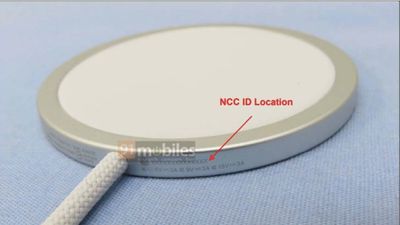
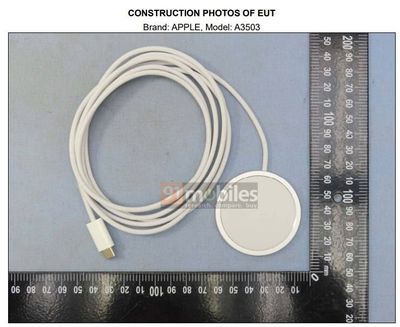
Spotted by 91mobiles.com, the filings reveal two new MagSafe charger models – A3503 and A3502 – that support the upgraded Qi 2.2 standard. The chargers feature the familiar white puck design with braided cables in 2-meter and 1-meter lengths, respectively.
It's a notable upgrade mainly because of the faster charging speed. Qi 2.2 is technically capable of up to 25W charging output. In contrast, the Qi 2 standard maxes out at 15W (although iPhone 16 models support upgraded MagSafe charging – with a 30W Apple charger, the iPhones can charge at up to 25W). The WPC has since released the Qi 2.1 standard, but no Apple devices officially support it.
Testing documents show the chargers work with devices ranging from the iPhone 16 back to the iPhone 11, indicating the Qi 2.2 pucks will have broad compatibility with existing devices, but charging speeds are going to be limited when using older models. Devices looking to take advantage of the faster charging speeds will need a corresponding advanced charging chip, similar to Samsung's Power Management Integrated Circuit (PMIC).
In addition to faster charging, Qi 2.2 offers improved magnetic alignment and charging efficiency compared to its predecessor. The standard also features backward compatibility with older Qi chargers.
Apple has not officially announced these new chargers, but their appearance in Taiwan's regulatory databases indicates we're likely to see a public release in the coming months. It also increases the likelihood that the upcoming iPhone 17 models will support the new charging standard – but that doesn't guarantee they will charge at the maximum 25W. Apple is expected to announce the iPhone 17 lineup around September, while the broader industry is expected to launch Qi 2.2-compatible phones, chargers, and accessories later this year.
Editor's note: This article originally reported that Qi 2.2 offers a maximum charging output of 50W, which turned out to be based on false information. We apologize for the error.
Apple is not expected to release a standard iPhone 18 model this year, according to a growing number of reports that suggest the company is planning a significant change to its long-standing annual iPhone launch cycle.
Despite the immense success of the iPhone 17 in 2025, the iPhone 18 is not expected to arrive until the spring of 2027, leaving the iPhone 17 in the lineup as the latest...
Language learning app Duolingo has apparently been using the iPhone's Live Activity feature to display ads on the Lock Screen and the Dynamic Island, which violates Apple's design guidelines.
According to multiple reports on Reddit, the Duolingo app has been displaying an ad for a "Super offer," which is Duolingo's paid subscription option.
Apple's guidelines for Live Activity state that...
The company behind the BlackBerry-like Clicks Keyboard accessory for the iPhone today unveiled a new Android 16 smartphone called the Clicks Communicator.
The purpose-built device is designed to be used as a second phone alongside your iPhone, with the intended focus being communication over content consumption. It runs a custom Android launcher that offers a curated selection of messaging...
Apple plans to introduce a 12.9-inch MacBook in spring 2026, according to TrendForce.
In a press release this week, the Taiwanese research firm said this MacBook will be aimed at the entry-level to mid-range market, with "competitive pricing."
TrendForce did not share any further details about this MacBook, but the information that it shared lines up with several rumors about a more...
Apple is planning to release a low-cost MacBook in 2026, which will apparently compete with more affordable Chromebooks and Windows PCs. Apple's most affordable Mac right now is the $999 MacBook Air, and the upcoming low-cost MacBook is expected to be cheaper. Here's what we know about the low-cost MacBook so far.
Size
Rumors suggest the low-cost MacBook will have a display that's around 13 ...
Apple today announced a number of updates to Apple Fitness+ and activity with the Apple Watch.
The key announcements include:
New Year limited-edition award: Users can win the award by closing all three Activity Rings for seven days in a row in January.
"Quit Quitting" Strava challenge: Available in Strava throughout January, users who log 12 workouts anytime in the month will win an ...
Wednesday December 31, 2025 9:59 am PST by Juli Clover
Apple hasn't updated the Mac Pro since 2023, and according to recent rumors, there's no update coming in the near future. In fact, Apple might be finished with the Mac Pro.
Bloomberg recently said that the Mac Pro is "on the back burner" and has been "largely written off" by Apple. Apple apparently views the more compact Mac Studio as the ideal high-end pro-level desktop, and it has almost...
As inductive charging gets faster, I’m always thinking, how much energy is lost to heat though? I really wish contact charging, something like the Smart Connector, became the standard. Very efficient, and can also do data.
I guess this is a stepping stone towards iPhone XX. Apple will likely ditch all ports in favor of "wraparound" design so the only way to charge will be a fast MagSafe charging.
As inductive charging gets faster, I’m always thinking, how much energy is lost to heat though? I really wish contact charging, something like the Smart Connector, became the standard. Very efficient, and can also do data.
Handwaving the calculations a bit, but power / heat dissipation can be generalized as [ICODE]I^2 * R[/ICODE], with [ICODE]R[/ICODE] being the resistance of the coils involved.
If the current [ICODE]I[/ICODE] can be kept the same at a higher voltage (as implied by the screenshot: [ICODE]5-15 V[/ICODE] with steady [ICODE]3 A[/ICODE] max), this would mean that a phone charging at, say, [ICODE]15 W[/ICODE] ([ICODE]5 V[/ICODE]@[ICODE]3 A[/ICODE]) would generate the same amount of heat per unit time as charging at [ICODE]45 W[/ICODE] ([ICODE]15 V[/ICODE]@[ICODE]3 A[/ICODE]).
Energy is power over time, so if a phone charges more quickly with the same heat dissipation, it's a net win for energy efficiency.