Developers Can Now Make Android Apps With Apple's Swift

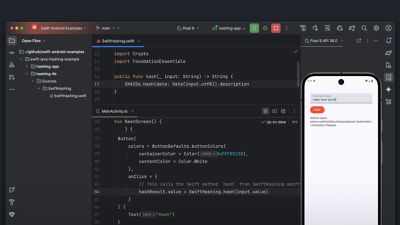
The first preview release of the Swift SDK for Android was published this week, allowing developers to build Android apps in Swift with official tooling and making it easier to share code across iOS and Android.
swift for android
The SDK enables Android apps to be built in Swift using officially supported tooling rather than community workarounds. In June, it was announced that Apple's Swift programming language would be officially extended to support Android app development through the establishment of a dedicated Android Working Group within the Swift open-source project.

Android interoperability is handled by swift-java, which can automatically generate bindings between Java and Swift so developers can use Swift code alongside existing Android APIs and Java code. The Swift Package Index now marks packages with Android support and says over 25% of all packages already build on Android, giving developers a base of reusable code.

The Swift SDK for Android is already available in nightly preview form bundled with the Swift for Windows installer or as a separate download for Linux and macOS users. A new Getting Started guide with end-to-end setup instructions and a set of example Android projects written in Swift to illustrate complete workflows is also available.

The group is preparing a vision document to set future priorities and is tracking progress on a public project board.
Tags: Android, Swift

Popular Stories

iPhone Top Left Hole Punch Face ID Feature Purple

iPhone 18 Pro Launching Later This Year With These 12 New Features

Thursday January 15, 2026 10:56 am PST by
While the iPhone 18 Pro and iPhone 18 Pro Max are not expected to launch for another eight months, there are already plenty of rumors about the devices. Below, we have recapped 12 features rumored for the iPhone 18 Pro models, as of January 2026: The same overall design is expected, with 6.3-inch and 6.9-inch display sizes, and a "plateau" housing three rear cameras Under-screen Face ID...
iPhone Top Left Hole Punch Face ID Feature Purple

New Leak Reveals iPhone 18 Pro Display Sizes, Under-Screen Face ID, and More

Wednesday January 14, 2026 7:09 am PST by
While the iPhone 18 Pro models are still around eight months away, a leaker has shared some alleged details about the devices. In a post on Chinese social media platform Weibo this week, the account Digital Chat Station said the iPhone 18 Pro and iPhone 18 Pro Max will have the same 6.3-inch and 6.9-inch display sizes as the iPhone 17 Pro and iPhone 17 Pro Max. Consistent with previous...
2024 iPhone Boxes Feature

Apple Adjusts Trade-In Values for iPhones, Macs, and More

Thursday January 15, 2026 11:19 am PST by
Apple today updated its trade-in values for select iPhone, iPad, Mac, and Apple Watch models. Trade-ins can be completed on Apple's website, or at an Apple Store. The charts below provide an overview of Apple's current and previous trade-in values in the United States, according to the company's website. Most of the values declined slightly, but some of the Mac values increased. iPhone ...
Apple MacBook Pro M4 hero

These 5 Apple Products Will Reportedly Be Upgraded With OLED Displays

Friday January 16, 2026 7:07 pm PST by
Apple plans to upgrade the iPad mini, MacBook Pro, iPad Air, iMac, and MacBook Air with OLED displays between 2026 and 2028, according to DigiTimes. Bloomberg's Mark Gurman previously reported that the iPad mini and MacBook Pro will receive an OLED display as early as this year, but he does not expect the MacBook Air to adopt the technology until 2028 at the earliest. A new iPad Air is...
Verizon New

Verizon Offering $20 Credit After Major Outage, Here's How to Get It

Thursday January 15, 2026 7:37 am PST by
Verizon today announced it will be offering customers a $20 account credit after a major outage on Wednesday, and action is required to receive it. The carrier said affected customers can accept the credit by logging into the My Verizon app, but it might take some time before this option shows up in the app. Affected customers will receive a text message when the credit is available. On...

Top Rated Comments

Rock_Artist Avatar
12 weeks ago
Just for clarification, Swift is open. But when developing to Apple eco system you interact with OS libraries.
For example, SwiftUI is an Apple library. So it’s not that simple making a SwiftUI app suddenly work on android.

However, Swift by itself allows making the logic of an app cross platform.
Score: 14 Votes (Like | Disagree)
ricketysquire Avatar
12 weeks ago
First Halo on PS5 and now this. Next thing you're going to tell me is that cats and dogs have made peace.
Score: 11 Votes (Like | Disagree)
deconstruct60 Avatar
12 weeks ago

I don't think they ever supported Java in Xcode directly.
Apple Developer Tools for Java > XCode. ( document archive)

https://developer.apple.com/library/archive/documentation/Java/Conceptual/Java14Development/02-JavaDevTools/JavaDevTools.html


The support faded over time. Over time Apple has become increasingly focused on moving folks from Objective-C ( and C derivatives ) to more broader usages of Swift . Xcode also shifted toward cranking out iOS apps where Java was pragmatically banned .

Oracle acquiring Java and starting to muck with the license didn’t help either.


At the risk of severely aging myself, I've been using Java since it came out ~1995 and would have moved to a Mac much earlier had Apple offered a decent "native" IDE for Java. The first IDE I used was VisualCafe - only available on Windows, which was somewhat ironic since Sun was competing with Microsoft back then and then Netbeans (which I've used ever since, with a detour to Eclipse and IntelliJ).
Netbeans started off as a “clone” of Delphi written in Java.

Netbeans runs on Java , so bootstrapping the IDE on Mac OS X wasn’t a big a deal as Apple baking their own branch of Java ( wanted the GUI integration “ just tright” ). A decent amount of Java development is backend , server side stuff so a choke point through Apple just slows that down a bit for new versions.

Google AI overview for ‘ historical apple development porting java to mac os x’

“…
Apple's relationship with Java on macOS (originally Mac OS X) has a rich and complex history, marked by periods of close integration, independent development, and eventual transition of responsibility.
Early Integration and Apple's Commitment:

* Mac OS Runtime for Java (MRJ): ('https://www.google.com/search?client=firefox-b-1-m&sca_esv=50bc830c1331a679&cs=0&q=Mac+OS+Runtime+for+Java+%28MRJ%29&sa=X&ved=2ahUKEwiJidLimcKQAxX2g4kEHUJyKXUQxccNegQICBAD&mstk=AUtExfDUt0vv6OPur5NP3wlcyOYy8GgZF6jw8LtnmDA8e1FRTLFjhgOOOv3Hl9_6IvOxX8qyuFS3egROOgtAmvUYDRq3CkEoTpD2KXjfSExLOASrFEJmJ5GWJlIuSes4lsSaZMg&csui=3')
In January 1997, Apple launched the MRJ, demonstrating an early commitment to Java.
* Mac OS X and First-Class Support: ('https://www.google.com/search?client=firefox-b-1-m&sca_esv=50bc830c1331a679&cs=0&q=Mac+OS+X+and+First-Class+Support&sa=X&ved=2ahUKEwiJidLimcKQAxX2g4kEHUJyKXUQxccNegQIERAD&mstk=AUtExfDUt0vv6OPur5NP3wlcyOYy8GgZF6jw8LtnmDA8e1FRTLFjhgOOOv3Hl9_6IvOxX8qyuFS3egROOgtAmvUYDRq3CkEoTpD2KXjfSExLOASrFEJmJ5GWJlIuSes4lsSaZMg&csui=3')
With the introduction of Mac OS X, Apple initially treated Java as a first-class language. This included shipping Java with the OS, providing libraries to integrate with OS X, and offering support within their Xcode IDE. Apple even had a Java application server platform called WebObjects.


* Apple's Own Build: ('https://www.google.com/search?client=firefox-b-1-m&sca_esv=50bc830c1331a679&cs=0&q=Apple%27s+Own+Build&sa=X&ved=2ahUKEwiJidLimcKQAxX2g4kEHUJyKXUQxccNegQIDxAD&mstk=AUtExfDUt0vv6OPur5NP3wlcyOYy8GgZF6jw8LtnmDA8e1FRTLFjhgOOOv3Hl9_6IvOxX8qyuFS3egROOgtAmvUYDRq3CkEoTpD2KXjfSExLOASrFEJmJ5GWJlIuSes4lsSaZMg&csui=3')
For a significant period, Apple maintained its own internal build of Java, allowing for security audits, custom patches, and deep integration with the OS.

Challenges and Transition of Responsibility:

* Declining Integration:
Over time, the tight integration of Java with OS X and the use of Apple's specific Java APIs diminished. The promised benefits of Java for desktop application development, particularly regarding native look and feel and performance, did not fully materialize as anticipated.
* Maintenance Burden:
Maintaining a separate, custom build of Java became increasingly challenging for Apple, especially as Oracle (which acquired Sun Microsystems, the creators of Java) made internal changes to Java that required refactoring of Apple's code.
* Security Concerns:
Java's history of security vulnerabilities, which prompted some experts to advise users to only enable Java on an as-needed basis, also played a role in Apple's reevaluation.


* Oracle Takes Over:
In 2010, Apple announced it would no longer be responsible for developing and maintaining Java on macOS. Oracle subsequently took over the development of the Mac JDK as part of OpenJDK …“

Also ..

“ Apple previously maintained its own build of Java for macOS, but this practice largely ceased with macOS 10.7 Lion. Apple no longer includes Java as a pre-installed component of macOS, nor does it provide its own updates for Java. “

So IDE that bootstrapped on top of Java had to adjust to whatever features Apple added. And Oracle porting to macOS is not a corporate core competency.


Anyway, if OSX did support Java at the time, I think I would have known as I was an avid Windows hater then. My first chance at full-time Java development didn't come until around 2007 and I used Netbeans IDE. I think at the time Apple did bundle the JDK or JRE but, again, I don't remember Xcode letting you build Java apps.
Apple adopted Java early . They just did it in an Apple fashion ( which is quirky from the outside ). If writing Java to primarily deploy off platform , then those quirks are not a feature.


As Java became more of a corporate software development platform ( not focused on Mac OS ) , Apple increasingly lost interest.
Score: 7 Votes (Like | Disagree)
icwhatudidthere Avatar
12 weeks ago

"...so developers can use Swift code alongside existing Android APIs and Java code" - does this mean Xcode will support Java?
Funny enough, about 20 years ago, they did.

https://jdeploy.substack.com/p/how-the-app-store-ended-a-golden

Back around 2002 or so I even went to a Javaworld conference and Apple was there signing up developers.
Score: 7 Votes (Like | Disagree)
Hajj.david Avatar
12 weeks ago

Now make it work well for websites and servers too.
This exists, Vapor is the biggest Swift for server API but there are other projects as well, a fellow swift dev friend of mine made a website using just Swift and Xcode, I forgot what tool he used.
Score: 5 Votes (Like | Disagree)
Plutonius Avatar
12 weeks ago
I'm curious if this will mostly be used to port Android code to iOS or to port iOS code to Android ?
Score: 5 Votes (Like | Disagree)