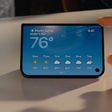
Reviews for the iPhone 14 Pro and iPhone 14 Pro Max have been published, offering a more detailed look at Apple's new high-end phones and all they have to offer, including an always-on display.
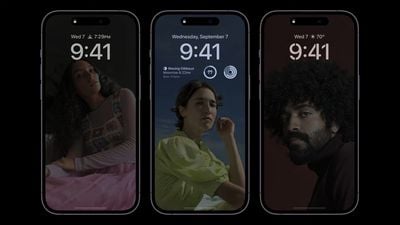
One detail confirmed today by the reviews is that the always-on display features no customization features, as it only displays a tinted version of a user's iOS 16 Lock Screen wallpaper, widgets, and Live Activities, if any are actively running. Users can't customize the always-on display, such as what information it chooses or whether it shows a darkened wallpaper or a black background.
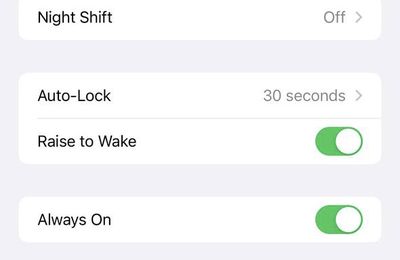
Users can, however, disable the always-on display entirely from within the Display and Brightness section of Settings. Reviewers noted that it's too early to tell whether or not the always-on display has a material impact on battery life, so we'll have to wait a few weeks before we know its effect.
The new iPhone 14 Pro and iPhone 14 Pro Max feature more power-efficient OLED displays with a variable refresh rate as low as 1Hz. This is just one of several power-saving features that the iPhone 14 Pro has for the always-on display. Today we learned from Engadget that in order to limit the impact of the always-on display on battery life, the iPhone 14 Pro prerenders individual frames for elements that predictably change, such as the time, and feeds them to the always-on display when appropriate.
As reported earlier this week, the iPhone 14 Pro intelligently detects if a user who's wearing an Apple Watch paired with the iPhone leaves the room, and when they do, it will disable the always-on display.
By disabling the always-on display when a user leaves the room, the iPhone 14 Pro saves battery life and helps safeguard privacy as the display doesn't show a user's wallpaper and widgets when they're not present.
Thursday January 29, 2026 10:07 am PST by Joe Rossignol
Apple today confirmed to Reuters that it has acquired Q.ai, an Israeli startup that is working on artificial intelligence technology for audio.

Apple paid close to $2 billion for Q.ai, according to sources cited by the Financial Times. That would make this Apple's second-biggest acquisition ever, after it paid $3 billion for the popular headphone and audio brand Beats in 2014.
Q.ai has...
Monday January 26, 2026 1:55 pm PST by Joe Rossignol
Apple today introduced its first two physical products of 2026: a second-generation AirTag and the Black Unity Connection Braided Solo Loop for the Apple Watch.
Read our coverage of each announcement to learn more:Apple Unveils New AirTag With Longer Range, Louder Speaker, and More
Apple Introduces New Black Unity Apple Watch BandBoth the new AirTag and the Black Unity Connection Braided...
Monday January 26, 2026 3:56 pm PST by Juli Clover
Alongside iOS 26.2.1, Apple today released an updated version of iOS 12 for devices that are still running that operating system update, eight years after the software was first released.
iOS 12.5.8 is available for the iPhone 5s and the iPhone 6, meaning Apple is continuing to support these devices for 13 and 12 years after launch, respectively. The iPhone 5s came out in September 2013,...
Tuesday January 27, 2026 2:39 pm PST by Joe Rossignol
Update: Apple Creator Studio is now available.
Apple Creator Studio launches this Wednesday, January 28. The all-in-one subscription provides access to the Final Cut Pro, Logic Pro, Pixelmator Pro, Motion, Compressor, and MainStage apps, with U.S. pricing set at $12.99 per month or $129 per year.
A subscription to Apple Creator Studio also unlocks "intelligent features" and "premium...
Thursday January 29, 2026 2:40 pm PST by Joe Rossignol
On an earnings call with equity analysts today, Apple CEO Tim Cook responded to fast-rising RAM and SSD storage chip prices in the supply chain.
Prices for RAM and NAND storage chips are surging lately due to high demand from companies building out AI servers, resulting in supply constraints.
Cook said that rising memory chip prices had a "minimal impact" on Apple's gross margin in the...
The very first review I watched (MKBHD) says he turned off always on display specifically because he noticed an impact on battery life. So I don't think it is "too early to tell".
This is not the right way to do always on display. It is too bright and includes too much.
I would love a very dim view of clock + widgets + some kind of notification indicator on a BLACK BACKGROUND.
Android has done this right forever. There is no excuse for Apple to be messing this up when it took so long to come to the iPhone in the first place.
The very first review I watched (MKBHD) says he turned off always on display specifically because he noticed an impact on battery life. So I don't think it is "too early to tell".
This is not the right way to do always on display. It is too bright and includes too much.
I would love a very dim view of clock + widgets + some kind of notification indicator on a BLACK BACKGROUND.
Android has done this right forever. There is no excuse for Apple to be messing this up when it took so long to come to the iPhone in the first place.
But Sara Dietschy says that she left it on for 12 hours untouched and the battery remained at 100%. Then again for another 12 hours and with a bunch of notifications coming in during the day hours and it went to 95%.
So indeed it's not too early to tell. We can possibly conclude that it does not negatively affect battery life. MKBHD probably used the phone as usual so he could not isolate how AOD affected the battery life.