A Geekbench score for the iPhone 14 Pro Max with the new A16 Bionic chip has revealed little performance improvement compared to the iPhone 13 Pro and Pro Max from last year.
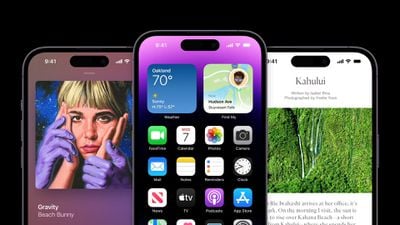
A Geekbench test result for iPhone15,3, the identifier for the iPhone 14 Pro Max, shows the new iPhone with a single-core score of 1879 and a multi-core score of 4664. The iPhone 13 Pro scores 1707 in single-core and 4659 in multi-core, only being marginally slower than the latest high-end iPhone.
The most significant new feature of the A16 Bionic chip is that it's the first chip from Apple based on the smaller 4nm process. The A15 Bionic chip, like Apple's M1 and M2 Apple silicon chips for the Mac, is based on the 5nm process.
Despite the smaller jump in performance that some may have hoped, Apple says the A16 Bionic chip is "the fastest chip ever in a smartphone." The A16 Bionic has a more powerful GPU that can provide up to 50% more memory bandwidth for graphics-intensive games. The A16 Bionic also has a new 16-core Neural Engine to power advanced machine learning tasks. In the CPU, the A16 Bionic features the same 6-core count as the A15 Bionic, but Apple says it's a "new 6-core CPU."
Update: This article has been updated to note that the Geekbench result is for an iPhone 14 Pro Max, not an iPhone 14 Pro. Both devices use the same A16 chip, however, so their scores should be similar.
Monday January 26, 2026 6:07 am PST by Joe Rossignol
Apple today introduced the second-generation AirTag, with key features including longer range for tracking items and a louder speaker.
For those who are not familiar, the AirTag is a small accessory that you can attach to your backpack, keys, or other items. Then, you can track the location of those items in the Find My app on the iPhone, iPad, Mac, Apple Watch, and iCloud.com.
The new...
Sunday January 25, 2026 11:46 am PST by Joe Rossignol
Apple plans to release new MacBook Pro, MacBook Air, Mac Studio, and Studio Display models in the first half of this year, according to Bloomberg's Mark Gurman.
In his Power On newsletter today, Gurman added that redesigned MacBook Pro models with an OLED touch screen "should be hitting toward the end of 2026," meaning that the MacBook Pro line would be upgraded twice this year.
First up...
Sunday January 25, 2026 6:02 pm PST by Joe Rossignol
2026 promises to be yet another busy year for Apple, with the company rumored to be planning more than 20 product announcements over the coming months.
Beyond the usual updates to iPhones, iPads, Macs, and Apple Watches, Apple is expected to release its all-new smart home hub, which was reportedly delayed until the more personalized version of Siri is ready. Other unique products rumored for ...
Friday January 23, 2026 12:31 pm PST by Joe Rossignol
iOS 26.3 is shaping up to be a relatively minor update, with only a couple of notable new features, but iOS 26.4 is expected to be much more significant.
We are still waiting for the iOS 26.3 Release Candidate to come out, so the first iOS 26.4 beta is likely still at least a few weeks away. Following beta testing, iOS 26.4 will likely be released to the general public at some point in March ...
Monday January 26, 2026 1:55 pm PST by Joe Rossignol
Apple today introduced its first two physical products of 2026: a second-generation AirTag and the Black Unity Connection Braided Solo Loop for the Apple Watch.
Read our coverage of each announcement to learn more:Apple Unveils New AirTag With Longer Range, Louder Speaker, and More
Apple Introduces New Black Unity Apple Watch BandBoth the new AirTag and the Black Unity Connection Braided...
They improved most in power efficiency, which I’d actually prefer at this point. Let’s be honest, even an Iphone XS doesn’t feel sluggish. When’s the last time you used an iPhone that did??
More important than always squeezing more horsepower out of the chip is also the battery life - and that’s again increased. I don’t think any other phone lasts this long and has this much horse power at the same time.
Looks like Moores Law is already catching up with Apple Silicon. But here I am on a plane using an iPhone X with an A11 chip. Who am I to complain really. These phones are so super fast that you get one, it’s gonna last you years. I am still using a 6s at home with a A9 as a backup phone. Apart from the sucky battery life, it’s still super fast.
But I think the SoC has reached a point now for Apple where it’s pretty much a solved problem. The issue is unleashing the existing power of what’s already on the market. So software and efficiency is really where it’s at.
Besides 5nm to 4nm, shouldn’t be that surprised. If A17 Bionic goes to 3 NM, might see some dramatic raw performance. But again, who is Apple competing with here? It’s certainly not Android phones, it’s obviously itself.
That's a 10% jump in single-core performance - the metric that is going to make the most difference in day to day usage of the phone. I'll take a quiet multi-core year if we get major energy consumption and heat-output reductions as a result. Also, we know when it comes to the M3, multi-core performance scales almost linearly by just packing in more cores, so I'm not concerned for Apple Silicon on the Mac.