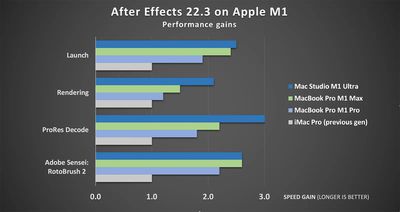
Adobe has updated its professional video editing software After Effects with native M1 support, offering customers up to 3x faster render speeds on Apple's latest Macs compared to high-end Macs with Intel processors.
On M1 computers, Adobe promises up to 2x faster performance in rendering and general app responsiveness. On M1 Ultra, Apple's most high-end chip found in the Mac Studio, Adobe says After Effects will be up to 3x faster for video editors. One specific way Adobe has optimized After Effects is with multi-frame rendering, which utilizes all available cores on Apple silicon to provide a playback experience that's up to 4x faster than a high-end iMac Pro with a 10-core Intel Xeon processor.
The newest version of After Effects will be rolling out to users in the coming days. Adobe also announced several other new features for After Effects and Premiere Pro such as Scene Edit Detection, Auto Color powered by AI, and more.
Apple announced the M6 chip last week, just ahead of its September iPhone event, providing the clearest indication yet of what the A20 will bring to the iPhone 18 lineup.
Apple silicon generations share much of their architecture across the A-series and the M-series, so a new A-series chip normally functions as a partial preview of the M-series chip that follows it. This year the order...
Apple today revealed the A20 Pro chip in the iPhone 18 Pro and iPhone 18 Pro Max, built on a brand new architecture using 2nm process technology.
Apple described the A20 Pro as "an exceptional chip that sets a new bar for mobile computing." The chip has a 6-core CPU design with two new super cores that Apple says are up to 20% faster, calling them "desktop class" and "the fastest in any...
Images claiming to show the inside of an Apple-made AI server, believed to power Private Cloud Compute, surfaced online this week, offering a first look at how the hardware is laid out.
The images were shared earlier this week by the X user @hsuchingpo, an account with a track record of Apple hardware and prototype leaks. Captioned simply "Apple M5 Server," the leaker said the hardware is "mo...
So many benchmarks seem to have had the goal of painting the Apple Silicon Macs in a bad light - usually through disingenuous tactics. I have seen many benchmarks optimised for non-apple API's (openGL anyone?) or comparing non-hardware accelerated against hardware accelerated. for example Handbrake encoding on Intel by default uses hardware acceleration, I have seen benchmarks comparing software rendering on M1 against hardware rendering on Intel/Windows. So much murky stuff designed to confirm a conclusion.
Anyone else wish Adobe just rewrote all their apps from the ground up? Illustrator, Photoshop and Indesign all run as if they've just been running the same code since PowerPC days...
I guess when all those “experts” used adobe for benchmarking, and we commented they didn’t know what they were talking about because adobe wasn’t optimized. Well, we were right, those benchmarks were crap