In today's iOS 15.4 beta that's available to developers, Apple added a useful new feature that changes the way Face ID works. There's now a Face ID with a Mask option that allows the iPhone to be unlocked when you're wearing a mask, but you need to have an iPhone 12 or newer.
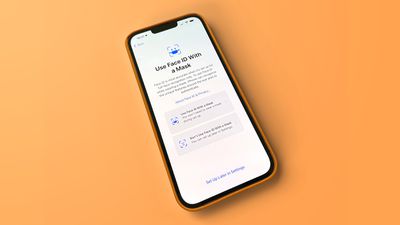
Right now, an iPhone can be unlocked with a mask if you have an Apple Watch for authentication to add an extra layer of security, but the new option removes the need for an Apple Watch. Face ID with a Mask works by recognizing the area around the eye when a mask is worn, which is less secure but more convenient. Unlike Face ID with the Apple Watch, the mask version works with Apple Pay and can be used to authenticate third-party apps.
Unfortunately, Face ID with a Mask is limited to some of Apple's newest iPhones, even though Face ID has been available since 2017 with the launch of the iPhone X. As noted on our forums, Face ID with a Mask is only an option on the iPhone 12 and later, so you'll need an iPhone 12, 12 mini, 12 Pro, 12 Pro Max or an iPhone 13, 13 mini, 13 Pro, or 13 Pro Max.
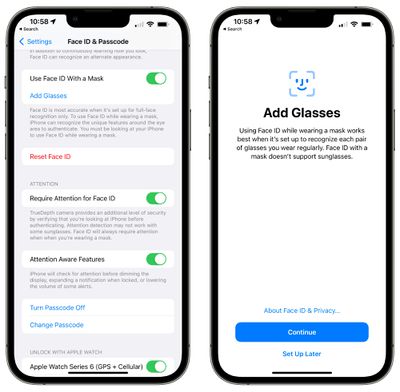
If you have an iPhone 11 or earlier, you will not see the Face ID with a Mask setup screen when updating to iOS 15.4, nor will you have the option to toggle it on in the Settings app.
It is not clear why Apple has limited Face ID with a Mask to the iPhone 12 and newer, but there may be some differences in Face ID hardware over the years that allow it to work for some devices and not others in terms of reasonable security. It's also possible that Apple will expand Face ID with a Mask to older iPhones in future betas.
Tuesday February 10, 2026 4:27 pm PST by Juli Clover
Apple is planning to launch new MacBook Pro models as soon as early March, but if you can, this is one generation you should skip because there's something much better in the works.

We're waiting on 14-inch and 16-inch MacBook Pro models with M5 Pro and M5 Max chips, with few changes other than the processor upgrade. There won't be any tweaks to the design or the display, but later this...

Wednesday February 11, 2026 10:07 am PST by Juli Clover
Apple today released iOS 26.3 and iPadOS 26.3, the latest updates to the iOS 26 and iPadOS 26 operating systems that came out in September. The new software comes almost two months after Apple released iOS 26.2 and iPadOS 26.2.
The new software can be downloaded on eligible iPhones and iPads over-the-air by going to Settings > General > Software Update.
According to Apple's release notes, ...
Tuesday February 10, 2026 6:33 am PST by Joe Rossignol
It has been a slow start to 2026 for Apple product launches, with only a new AirTag and a special Apple Watch band released so far. We are still waiting for MacBook Pro models with M5 Pro and M5 Max chips, the iPhone 17e, a lower-cost MacBook with an iPhone chip, long-rumored updates to the Apple TV and HomePod mini, and much more.
Apple is expected to release/update the following products...
Tuesday February 10, 2026 1:51 pm PST by Joe Rossignol
Apple plans to announce the iPhone 17e on Thursday, February 19, according to Macwelt, the German equivalent of Macworld.
The report said the iPhone 17e will be announced in a press release on the Apple Newsroom website, so do not expect an event for this device specifically.
The iPhone 17e will be a spec-bumped successor to the iPhone 16e. Rumors claim the device will have four key...
Apple acquired Canadian graph database company Kuzu last year, it has emerged.
The acquisition, spotted by AppleInsider, was completed in October 2025 for an undisclosed sum. The company's website was subsequently taken down and its Github repository was archived, as is commonplace for Apple acquisitions.
Kuzu was "an embedded graph database built for query speed, scalability, and easy of ...
Typical Apple. "Hey, if you want this feature, upgrade!".
I don’t think consumers would ever use this as leverage to upgrade. Think about it. They would have to know this feature would even exist in the first place and be annoyed enough to upgrade. (I suspect most average consumers don’t even know how to navigate properly through the settings on iOS.)
My guess? The ML chip on the iPhone 11 or older devices aren't powerful enough to enable FaceID with Mask, whereas the iPhone 12 and newer phones have the ML chip that is more powerful and can handle the FaceID with Mask feature.
This is a hardware limitation and it all has to do with two thing: Neural Engine on Ax series chip and the face mapping sensors on iPhone 12s and iPhone 13s
This is how FaceID with mask will basically work. Lot of it is machine learning that requires more processing power.