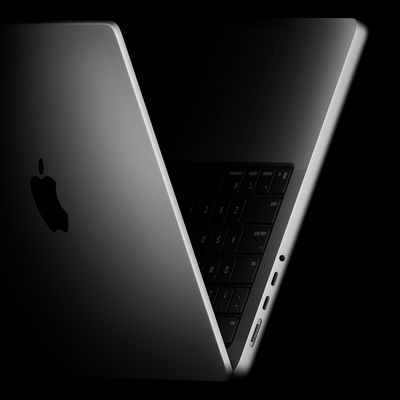
The new 16-inch MacBook Pro can be configured with either the M1 Pro or M1 Max chips. The M1 Max chip is the highest-end Apple silicon chip available, and alongside the added performance, the 16-inch MacBook Pro with the M1 Max chip comes with another difference — it's heavier, slightly.
As we've already highlighted, the new 16-inch MacBook Pro is heavier and thicker than the previous model. The added thickness and weight come from a new chassis, more ports, and other factors. Apple's specification breakdown page for the new 16-inch MacBook Pro says that models configured with the M1 Pro chip will weigh 4.7 pounds, or 2.1 kg, while models shipping with the M1 Max chip will weigh 4.8 pounds or 2.2 kg.
The M1 Max chip is physically bigger than the M1 Pro chip; however, the 14-inch MacBook Pro, which is also offered with the M1 Max chip, features the same weight regardless of the chip used. A footnote on Apple's page says that the weight difference on the larger 16-inch model between M1 Pro and M1 Max results from the "configuration and manufacturing process."
Apple has canceled plans for a foldable MacBook and a larger OLED MacBook Pro model, according to research firm Omdia.
In a new research note, Omdia said Apple has scrapped development of a large foldable MacBook that would have measured between 16.1 and 18 inches when unfolded. It was previously reported that this device had already slipped out of its original 2026 production window, with...
Tuesday September 1, 2026 12:34 pm PDT by Joe Rossignol
As noted by Broadcasts developer Steven Troughton-Smith, many Liquid Glass interface elements on the macOS Golden Gate beta have an even glassier appearance on certain high-end OLED displays with HDR support than they do on ordinary displays.
Apple reportedly plans to release new MacBook Pro or "MacBook Ultra" models with an OLED display by early 2027, so it is likely that macOS Golden Gate...
Thursday September 3, 2026 7:01 am PDT by Tim Hardwick
Apple has reportedly revised its plans for adopting OLED displays across its MacBook lineup, and its existing LCD-based MacBook Pro models with mini-LED backlighting are now expected to remain available for longer than anticipated.
According to a new OLED adoption roadmap published by research firm Omdia, Apple still intends long-term adoption of OLED panels across MacBooks and iPads, but...
20 grams difference. That's about $1 USD in quarters. You probably won't feel the difference when picking up both devices but you can do a lot with 20g of heat sink.
It might just be as simple as the 16” gets extra cooling that the 14” doesn’t get since it has more space. So likely the 14” will run the fans louder/faster than the 16” but will have the same performance.
Important to note that it's not just the APU, but with the M1 Max, it's 4 RAM chips, while the M1 Pro is 2 RAM chips. If they changed the number of RAM chips then it would affect the memory bandwidth performance, so a M1 Max with 64GB RAM will have 4x16GB chips, but one with 32GB RAM will have 4x8GB Chips. Likewise the M1 Pro with 32GB has 2x16GB chips, while the 16GB version will have 2x8GB chips, this is why the 64GB memory option is only available with the M1 Max.


/https://forums.macrumors.com/attachments/1870984/)