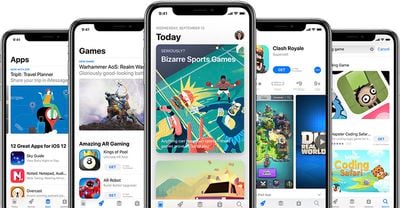
Consumer spending on the App Store totaled a record $193 million on Christmas Day 2019, representing a 16 percent increase year on year, according to a new report by Sensor Tower.
Approximately $84 million was spent on the Google Play store, representing year-on-year growth of 2.7 percent. Apple's App Store accounted for 70 percent of spending between the two platforms, which amounted to $277 million combined.
That total represented combined year-over-year growth of 11.3 percent for the two stores, which brought in $249 million combined in user spending on Christmas Day in 2018.
Sensor Tower says the increase in spending was largely due to new mobile device owners and people who received App Store gift cards, with games being the most popular purchase.
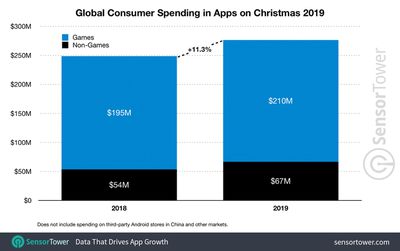
The majority of mobile spending on Christmas, approximately $210 million, was focused on the Games category, which generated 76 percent of revenue across both stores and grew about 8 percent Y/Y from $195 million. PUBG Mobile from Tencent’s TiMi studio led in-game spending with $8.5 million, up 431 percent from the $1.6 million players spent in the game on Christmas 2018.
Other apps accounted for approximately 2 percent more of all spending this Christmas compared to a year prior, bringing in an estimated $67 million. The top non-game app for overall spending on Christmas was reportedly the dating app Tinder, which brought in a gross global revenue near $2.1 million.
The App Store makes up a huge portion of Apple's services business. It currently receives a 30 percent cut of all revenue that developers earn from the App Store, with the exception of subscription apps. For apps where a customer maintains a subscription for more than a year, developers are entitled to an 85/15 split, with Apple taking a 15 percent cut rather than a 30 percent cut.
Friday December 5, 2025 9:40 am PST by Tim Hardwick
Apple is about to release iOS 26.2, the second major point update for iPhones since iOS 26 was rolled out in September, and there are at least 15 notable changes and improvements worth checking out. We've rounded them up below.
Apple is expected to roll out iOS 26.2 to compatible devices sometime between December 8 and December 16. When the update drops, you can check Apple's servers for the ...
Tuesday December 2, 2025 11:09 am PST by Juli Clover
Apple is encouraging iPhone users who are still running iOS 18 to upgrade to iOS 26 by making the iOS 26 software upgrade option more prominent.
Since iOS 26 launched in September, it has been displayed as an optional upgrade at the bottom of the Software Update interface in the Settings app. iOS 18 has been the default operating system option, and users running iOS 18 have seen iOS 18...
Wednesday December 3, 2025 10:33 am PST by Juli Clover
Apple today seeded the release candidate versions of upcoming iOS 26.2 and iPadOS 26.2 updates to developers and public beta testers, with the software coming two weeks after Apple seeded the third betas. The release candidates represent the final versions of iOS 26.2 and iPadOS 26.2 that will be provided to the public if no further bugs are found during this final week of testing....
Thursday December 4, 2025 9:30 am PST by Joe Rossignol
In a statement shared with Bloomberg on Wednesday, Apple confirmed that its software design chief Alan Dye will be leaving. Apple said Dye will be succeeded by Stephen Lemay, who has been a software designer at the company since 1999.
Meta CEO Mark Zuckerberg announced that Dye will lead a new creative studio within the company's AR/VR division Reality Labs.
On his blog Daring Fireball,...
Friday December 5, 2025 10:08 am PST by Joe Rossignol
Intel is expected to begin supplying some Mac and iPad chips in a few years, and the latest rumor claims the partnership might extend to the iPhone.
In a research note with investment firm GF Securities this week, obtained by MacRumors, analyst Jeff Pu said he and his colleagues "now expect" Intel to reach a supply deal with Apple for at least some non-pro iPhone chips starting in 2028....
Monday December 1, 2025 4:37 pm PST by Juli Clover
We're getting closer to the launch of the final major iOS update of the year, with Apple set to release iOS 26.2 in December. We've had three betas so far and are expecting a fourth beta or a release candidate this week, so a launch could follow as soon as next week.
Past Launch Dates
Apple's past iOS x.2 updates from the last few years have all happened right around the middle of the...
Monday December 1, 2025 3:00 am PST by Tim Hardwick
Apple is expected to launch a new foldable iPhone next year, based on multiple rumors and credible sources. The long-awaited device has been rumored for years now, but signs increasingly suggest that 2026 could indeed be the year that Apple releases its first foldable device.
Subscribe to the MacRumors YouTube channel for more videos.
Below, we've collated an updated set of key details that ...
A U.S. appeals court has upheld a temporary restraining order that prevents OpenAI and Jony Ive's new hardware venture from using the name "io" for products similar to those planned by AI audio startup iyO, Bloomberg Law reports.
iyO sued OpenAI earlier this year after the latter announced its partnership with Ive's new firm, arguing that OpenAI's planned "io" branding was too close to its...
The iPhone Air has recorded the steepest early resale value drop of any iPhone model in years, with new data showing that several configurations have lost almost 50% of their value within ten weeks of launch.
According to a ten-week analysis published by SellCell, Apple's latest lineup is showing a pronounced split in resale performance between the iPhone 17 models and the iPhone Air....
Thursday December 4, 2025 5:18 am PST by Tim Hardwick
iPhone 17 Pro models, it turns out, can't take photos in Night mode when Portrait mode is selected in the Camera app – a capability that's been available on Apple's Pro devices since the iPhone 12 Pro in 2020.
If you're an iPhone 17 Pro or iPhone 17 Pro Max owner, try it for yourself: Open the Camera app with Photo selected in the carousel, then cover the rear lenses with your hand to...
There's way more Android devices for every Apple device sold. The Google Play revenue is pitiful compared to Apple's. I wonder if Android users have a culture of not-wanting-to-pay for apps, or if some other big factor like piracy is involved.
It’s the same reason why Google pays Apple so much money every year to keep Google search the default engine in Safari. Through the iPhone, Apple has aggregated the best customers (those with the highest propensity to spend). So iphone users by and large are more willing to spend on content.
There is also the issue of higher piracy rates on android compared to iOS, which makes app development a lot less profitable on android.
This is what people who keep proselytising the larger android user base don’t get - it’s not more market share in a vacuum that determines how profitable a platform will be, but usage share.
There's way more Android devices for every Apple device sold. The Google Play revenue is pitiful compared to Apple's. I wonder if Android users have a culture of not-wanting-to-pay for apps, or if some other big factor like piracy is involved.
China. That's the primary explanation you both seemed to overlook. For a bit of perspective: Active Android devices in China - 731 million... and that was in 2018. That's more than twice the population of the entire US.
There's way more Android devices for every Apple device sold. The Google Play revenue is pitiful compared to Apple's. I wonder if Android users have a culture of not-wanting-to-pay for apps, or if some other big factor like piracy is involved.
There are way more devices, but most of them contribute no revenue to the Play Store. The Play Store gets no revenue from the #1 Android market in the world: China. That revenue goes to Chinese companies like Tencent, Baidu, and Xiaomi.
It’s the same reason why Google pays Apple so much money every year to keep Google search the default engine in Safari... {snipped for brevity and clarity}
Not only does the Play Store not get any revenue from the largest Android market, they it also competes with the individual stores from each of the handset makers. Oh, and Amazon. Play Store doesn't get any revenue from Amazon's flavor of Android.
The reasons you guys speculated would fall waaaaaaaaaaaaaaaaay down the list of contributing factors. China is the answer. Imagine Apple's App Store revenue without China.
Logic says iPhone should be available for free or for a ridiculously low price, cross-financed by Games and Services, providing the iOS platform to more people.
Reality however shows that iOS customers love to spend big