FCC Says iPhone Didn't Exceed Radiofrequency Radiation Safety Levels

iPhones from Apple and smartphones from Samsung did not violate FCC rules on maximum radiofrequency exposure levels, the FCC said today (via Bloomberg).

Back in August, an investigation launched by The Chicago Tribune suggested that some of Apple's iPhones were emitting radiofrequency radiation that exceeded federal safety limits.
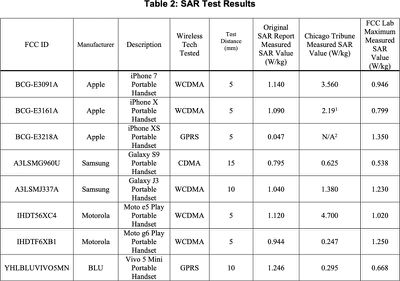
fccsarresultsrfexposure

The FCC's testing results for iPhone and other smartphones

The newspaper hired an accredited lab to test several smartphones, including Apple's iPhones, according to federal guidelines and found that some of Apple's iPhones violated federal guidelines.

Apple at the time disputed the results and said that the testing was inaccurate "due to the test setup not being in accordance with procedures necessary to properly assess the ‌‌iPhone‌‌ models."

"All ‌‌iPhone‌‌ models, including ‌‌iPhone‌‌ 7, are fully certified by the FCC and in every other country where ‌‌iPhone‌‌ is sold," the statement said. "After careful review and subsequent validation of all ‌‌iPhone‌‌ models tested in the (Tribune) report, we confirmed we are in compliance and meet all applicable ... exposure guidelines and limits."

In response to the investigation, the FCC promised to do its own testing of smartphones from Apple and Samsung, and the FCC's testing disagrees with the findings from The Chicago Tribune.

The FCC tested the ‌iPhone‌ 7, the ‌iPhone‌ X, and the ‌iPhone‌ XS using models that were purchased from the open market and those provided by Apple. No FCC test showed the results that The Chicago Tribune got from its independent testing.

All sample cell phones tested by the FCC Laboratory, both grantee-provided and FCC- purchased samples, produced maximum 1-g average SAR values less than the 1.6 W/kg limit specified in the FCC rules. Therefore, all tested sample devices comply with the FCC RF radiation exposure general population/uncontrolled limits for peak spatial-average SAR of 1.6 W/kg, averaged over any 1 gram of tissue as specified in 47 CFR Sn. 2.1093(d)(2), and these tests did not produce evidence of violations of any FCC rules regarding maximum RF exposure levels.

Full results from the testing can be seen in the document released today by the FCC. [PDF]

After The Chicago Tribune's report went live, law firm Fegan Scott launched its own investigation and last week said that its laboratory also found that iPhones exceeded the federal safety limits for radiofrequency radiation.

Fegan Scott filed a lawsuit against Apple, claiming to use "actual use conditions" in its test, rather than "conditions set by manufacturers." The FCC modeled its testing after the testing done by The Chicago Tribune, evaluating the ‌iPhone‌ by using a fluid-filled head and body replica and testing RF absorption at the highest possible smartphone power levels.

The law firm did not provide details on its testing methods and it is not clear if the case will progress now that the FCC's research and testing has worked out in Apple's favor.
Popular Stories

m5 macbook pro deal

Why You Shouldn't Buy the Next MacBook Pro

Tuesday February 10, 2026 4:27 pm PST by
Apple is planning to launch new MacBook Pro models as soon as early March, but if you can, this is one generation you should skip because there's something much better in the works. We're waiting on 14-inch and 16-inch MacBook Pro models with M5 Pro and M5 Max chips, with few changes other than the processor upgrade. There won't be any tweaks to the design or the display, but later this...
iOS 26

Apple Releases iOS 26.3 and iPadOS 26.3

Wednesday February 11, 2026 10:07 am PST by
Apple today released iOS 26.3 and iPadOS 26.3, the latest updates to the iOS 26 and iPadOS 26 operating systems that came out in September. The new software comes almost two months after Apple released iOS 26.2 and iPadOS 26.2. The new software can be downloaded on eligible iPhones and iPads over-the-air by going to Settings > General > Software Update. According to Apple's release notes, ...

Apple Logo Zoomed

Apple Expected to Launch These 10+ Products Over the Coming Months

Tuesday February 10, 2026 6:33 am PST by
It has been a slow start to 2026 for Apple product launches, with only a new AirTag and a special Apple Watch band released so far. We are still waiting for MacBook Pro models with M5 Pro and M5 Max chips, the iPhone 17e, a lower-cost MacBook with an iPhone chip, long-rumored updates to the Apple TV and HomePod mini, and much more. Apple is expected to release/update the following products...
iPhone 16e Bottom Crop

Apple Reportedly Unveiling a New iPhone Next Week

Tuesday February 10, 2026 1:51 pm PST by
Apple plans to announce the iPhone 17e on Thursday, February 19, according to Macwelt, the German equivalent of Macworld. The report said the iPhone 17e will be announced in a press release on the Apple Newsroom website, so do not expect an event for this device specifically. The iPhone 17e will be a spec-bumped successor to the iPhone 16e. Rumors claim the device will have four key...
Apple Logo Black

Apple Acquires New Database App

Wednesday February 11, 2026 6:44 am PST by
Apple acquired Canadian graph database company Kuzu last year, it has emerged. The acquisition, spotted by AppleInsider, was completed in October 2025 for an undisclosed sum. The company's website was subsequently taken down and its Github repository was archived, as is commonplace for Apple acquisitions. Kuzu was "an embedded graph database built for query speed, scalability, and easy of ...

Top Rated Comments

GreenPixel Avatar
80 months ago

perhaps the iPhones pass a specific test, but obviously they DO emit harmful radiation when kept close to the body. The iPhone hasn't been vindicated. It's still hazardous to hold it close regardless of what the FCC tests shows
Obviously? On what basis do you think this is so obvious? I have seen zero evidence to support any claim that iPhones emit ionizing radiation. (Because they don’t.)
Score: 13 Votes (Like | Disagree)
80 months ago
Of course they don’t. Ridiculous premise.
Score: 8 Votes (Like | Disagree)
realtuner Avatar
80 months ago

Crappy Intel modem in the iPhone XS emitting way too much.
Except it’s not.

Who wants to bet those idiotic lawyers don’t drop their lawsuit and will claim the FCC numbers are wrong?
Score: 7 Votes (Like | Disagree)
twocents Avatar
80 months ago
Main counterargument is it's in Apple's best interest to keep their customers healthy and living longer to buy more products. Pumping out hundreds of millions of radiation emitting devices would undercut that
Score: 7 Votes (Like | Disagree)
D.T. Avatar
80 months ago
My testicles say otherwise ...
Score: 6 Votes (Like | Disagree)
80 months ago

Crappy Intel modem in the iPhone XS emitting way too much.
Post some evidence or don't post this nonsense.
Score: 5 Votes (Like | Disagree)