Skip to Content

Apple Sued Over Not Letting Customers Disable Two-Factor Authentication After Two Weeks

New York resident Jay Brodsky has filed a frivolous class action lawsuit against Apple, alleging that the company's so-called "coercive" policy of not letting customers disable two-factor authentication beyond a two-week grace period is both inconvenient and violates a variety of California laws.
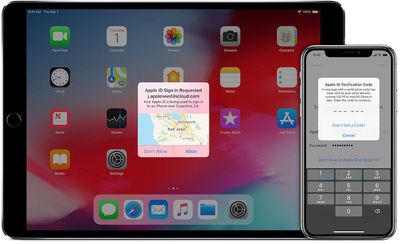
two factor apple
The complaint alleges that Brodsky "and millions of similarly situated consumers across the nation have been and continue to suffer harm" and "economic losses" as a result of Apple's "interference with the use of their personal devices and waste of their personal time in using additional time for simple logging in."

In a support document, Apple says it prevents customers from turning off two-factor authentication after two weeks because "certain features in the latest versions of iOS and macOS require this extra level of security":

If you already use two-factor authentication, you can no longer turn it off. Certain features in the latest versions of iOS and macOS require this extra level of security, which is designed to protect your information. If you recently updated your account, you can unenroll for two weeks. Just open your enrollment confirmation email and click the link to return to your previous security settings. Keep in mind, this makes your account less secure and means that you can't use features that require higher security.

The complaint is riddled with questionable allegations, however, including that Apple released a software update around September 2015 that enabled two-factor authentication on Brodsky's Apple ID without his knowledge or consent. Apple in fact offers two-factor authentication on an opt-in basis.

Brodsky also claims that two-factor authentication is required each time you turn on an Apple device, which is false, and claims the security layer adds an additional two to five minutes or longer to the login process when it in fact only takes seconds to enter a verification code from a trusted device.

The complaint goes on to allege that Apple's confirmation email for two-factor authentication enrollment containing a "single last line" alerting customers that they have a two-week period to disable the security layer is "insufficient."
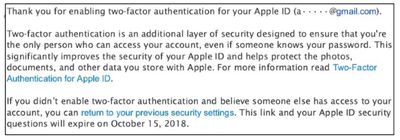
apple two factor email
Brodsky accuses Apple of violating the U.S. Computer Fraud and Abuse Act, California's Invasion of Privacy Act, and other laws. He, on behalf of others similarly situated, is seeking monetary damages as well as a ruling that prevents Apple from "not allowing a user to choose its own logging and security procedure." Read the full document.

Popular Stories

Multicolored Low Cost A18 Pro MacBook Feature

Apple Accidentally Leaks 'MacBook Neo'

Tuesday March 3, 2026 7:00 am PST by
Apple appears to have prematurely revealed the name of its rumored lower-cost MacBook model, which is expected to be announced this Wednesday. A regulatory document for a "MacBook Neo" (Model A3404) has appeared on Apple's website. Unfortunately, there are no further details or images available yet. While the PDF file does not contain the "MacBook Neo" name, it briefly appeared in a link...
imac video apple feature

Apple Unveils Two New Products

Monday March 2, 2026 7:49 am PST by
Apple today introduced two new devices, including the iPhone 17e and an updated iPad Air. iPhone 17e features the same overall design as the iPhone 16e, but it gains Apple's A19 chip, MagSafe for magnetic wireless charging and magnetic accessories, Apple's second-generation C1X modem for faster 5G, and a doubled 256GB of base storage. In the U.S., the iPhone 17e starts at $599, just like the ...
MacBook Neo Feature Pastel 1

Apple Announces $599 'MacBook Neo' With A18 Pro Chip

Wednesday March 4, 2026 6:15 am PST by
Apple today announced the "MacBook Neo," an all-new kind of low-cost Mac featuring the A18 Pro chip for $599. The MacBook Neo is the first Mac to be powered by an iPhone chip; the A18 Pro debuted in 2024's iPhone 16 Pro models. Apple says it is up to 50% faster for everyday tasks than the bestselling PC with the latest shipping Intel Core Ultra 5, up to 3x faster for on-device AI workloads,...

Top Rated Comments

mentaluproar Avatar
92 months ago
Yea, it's such a pain having to remember my PIN too. The ATM should just give me money.
Score: 87 Votes (Like | Disagree)
92 months ago
*rolls eyes*

So stupid lol.
Score: 50 Votes (Like | Disagree)
calzon65 Avatar
92 months ago
Seems if people want to disable this and stupidly reduce their personal security, it should be their right.
Score: 34 Votes (Like | Disagree)
92 months ago
While the plaintiff might have some stupid points, I do agree that enabling or disabling two-factor should be the user's choice.
Score: 26 Votes (Like | Disagree)
aaronhead14 Avatar
92 months ago
I think this is great, actually.

To be clear, I do think two-factor authentication is much more secure (obviously). But I hate that Apple is so determined to force its users into using it. If someone doesn't want it then they have the right to disable it. Plain and simple. Our devices and accounts should be ours to control.
Score: 26 Votes (Like | Disagree)
92 months ago
I’m just going to sue apple for feature requests now. The phone icon is prejudiced against young people who aren’t familiar with what a telephone looks like. It’s ageist and insensitive. Now give us all three cents for the emotional damage this has caused us.
Score: 25 Votes (Like | Disagree)