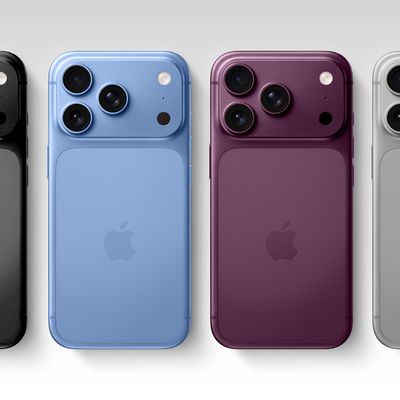
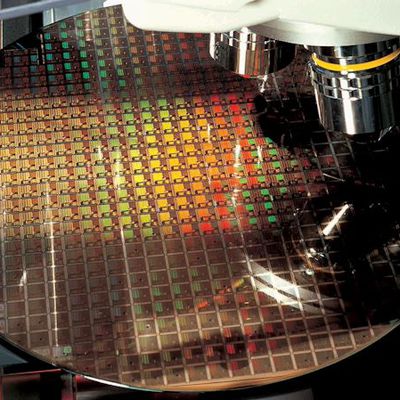
According to a new report from Economic Daily News (via DigiTimes), Taiwan Semiconductor Manufacturing Company has plans to double the output capacity of its 16nm chip production from 40,000 12-inch wafers in February to 80,000 in March. The news corroborates previous reports that suggested TSMC was ready to expand its 16nm FinFET production capacity in the second quarter of 2016, solely for the iPhone 7.

iphone_7_render_mr
In a recent investors meeting, TSMC's co-CEO CC Wei said that the company's percentage share of the 14/16nm market is expected to increase from 40 percent in 2015 to over 70 percent in 2016. Apple isn't specifically referenced in the report today, but among TSMC's other purported 16nm customers -- Xilinx, MediaTek, HiSilicon, Spreadtrum and Nvidia -- it is one of the bigger names.

The upcoming ramp-up of 16nm production capacity will buoy TSMC's sales performance starting March, the report quoted market watchers as indicating. The foundry's 16nm FinFET processes consisting of 16FF (16nm FinFET), 16FF+ (16nm FinFET Plus) and 16FFC (16nm FinFET Compact) will generate more than 20% of its total wafer revenues in 2016.

Previous rumors around the iPhone 7 production have pointed to Apple picking TSMC to be the sole manufacturer of the smartphone's processor, presumably called the A10. The foundry was said to have won over Apple because of its 10nm manufacturing process, and a likely attempt at avoiding the dual-sourced A9 chip blowback Apple saw in the iPhone 6s and iPhone 6s Plus.
Tag: TSMC
Related Forum: iPhone

Top Rated Comments

journeyy Avatar
129 months ago
The rumor in this article states that the A10 will stay at 16nm like the A9. The improvement due to "3D Transistor stacking" or whatever will be very minimal.
http://wccftech.com/iphone-7-tsmc/

20% expected.
Score: 2 Votes (Like | Disagree)
chrmjenkins Avatar
129 months ago
Bit confused, so it's going to be 16nm or 10nm chip?
16nm, 10nm won't be ready for Fall devices.
Score: 2 Votes (Like | Disagree)
rp2011 Avatar
129 months ago
I'm thinking this years iPhone is just a better 6, rather than a full fledged completely new device.

We have read that the dual camera is still a year away. That the 10nm chip is still a year away. That the new oled displays are still at least a year away. That the iPhone will be the exact same dimensions minus one mm in thickness due to an improved thinner display..
Also note that new 4" iPhone will be in a old case. I would imagine they would have crafted a completely new one unless it wasn't just a kind of placeholder until the next complete iPhone iteration.

I think Apple is working to to get all those things into the iPhone but they are just not quite ready.
Score: 1 Votes (Like | Disagree)
Benjamin Frost Avatar
129 months ago
This is good news if it takes care of ChipGate.

Let's hope a TSMC chip is guaranteed in all iPhones so as to ensure better battery life.
Score: 1 Votes (Like | Disagree)
vertsix Avatar
129 months ago
http://wccftech.com/iphone-7-tsmc/

20% expected.
Oooooh. Neat stuff.

Yeah, a 20% speed jump is what I'd consider minimal. The A9 was nearly twice as fast as the A8 and at least twice as fast as the A7.

The A8 was like up to 30% faster than the A7 I believe.
[doublepost=1456938442][/doublepost]
I'm thinking this years iPhone is just a better 6, rather than a full fledged completely new device.

We have read that the dual camera is still a year away. That the 10nm chip is still a year away. That the new oled displays are still at least a year away. That the iPhone will be the exact same dimensions minus one mm in thickness due to an improved thinner display..

I think Apple is working to to get all those things into the iPhone but they are just not quite ready.
More like they can't because profit margins.
Score: 1 Votes (Like | Disagree)
chrmjenkins Avatar
129 months ago
http://wccftech.com/iphone-7-tsmc/

20% expected.
That's wccftech just repeating the assessment made from Bernstein ('http://blogs.barrons.com/asiastocks/2015/10/22/tsmc-apple-will-pioneer-info-to-build-thinner-phones-bernstein-raises-target/'). Here's the relevant bit:

Compared with the Flip Chip-PoP (Package-on-Package, or simply FC-POP) technology employed currently, InFO removes substrate from package and hence can reduce the thickness of mobile SoC from 1mm to 0.8mm or lower. The shorter distance between logic die and printed circuit board also enables faster thermal dissipation, higher maximal allowable power consumption and possibly 20% better performance (but with power penalty).

In fact, TSMC’s InFO is just one of many variants of fan-out wafer-level package (FOWLP) which has been tried by many but with limited success thus far. With a satisfactory packaging yield, we estimate InFO (or FOWLP in general) will incur just 5-10% higher cost over the flip chip package. However, low packaging yield results in high cost from die loss, which has kept the technology from mass adoption so far. Though there are still execution risks from now to 3Q16, apparently TSMC is making progress and likely can overcome the yield challenge. This is further supported by the recent announcement of Ultratech (an equipment vendor) which we believe just received a major order for TSMC’s InFO capacity build-up.
What that means is higher performance in the same thermal envelope. That means Apple would have to be willing for the SoC to consume more power, which means less battery life or a bigger battery.

Also, if the A9 was indeed of TSMC's 16FF, then the move to 16FF+ would have a few small performance benefits on its own, similar to Samsung's own 14LPP ('http://www.samsung.com/semiconductor/foundry/process-technology/14nm/') (10%).

This post ('https://www.macrumors.com/2015/11/06/tsmc-a10-production-info-wlp/') goes into InFO in more detail.

edit: one last note- they talk about removing the substrate. That would be the substrate above the die between the memory and application processor. You still need the interface between the die and board, which is a substrate. With InFO WLP, you just route all your dies on that one piece. To have no substrate would be chip-on-board, which isn't possible because board vendors can't make boards with the extremely fine pitches that logic die bumps have. That's why vendors are starting to introduce actual passive silicon wafers (interposers) into the process to get really dense routing to greater I/O to memory and other devices.
Score: 1 Votes (Like | Disagree)

Popular Stories

Touchscreen MacBook Feature

Apple Is Expected to Launch These Four MacBooks in 2026

Friday January 9, 2026 8:17 am PST by
2026 could be a bumper year for Apple's Mac lineup, with the company expected to announce as many as four separate MacBook launches. Rumors suggest Apple will court both ends of the consumer spectrum, with more affordable options for students and feature-rich premium lines for users that seek the highest specifications from a laptop. Below is a breakdown of what we're expecting over the next ...
iPhone Top Left Hole Punch Face ID Feature Purple

10 Reasons to Wait for This Year's iPhone 18 Pro

Thursday January 8, 2026 2:56 am PST by
Apple's iPhone development roadmap runs several years into the future and the company is continually working with suppliers on several successive iPhone models at the same time, which is why we often get rumored features months ahead of launch. The iPhone 18 series is no different, and we already have a good idea of what to expect for the iPhone 18 Pro and iPhone 18 Pro Max. One thing worth...
proposed unicode emoji 18%402x

Squinting Face, Pickle, and Lighthouse Among New Emoji Coming to iOS

Friday January 9, 2026 4:24 am PST by
The Unicode Consortium has published a draft list of emoji that could come to smartphones and other devices in the future. The list shared by Emojipedia outlines 19 emoji candidates under consideration for Emoji 18.0, which is expected to be finalized in September 2026. Among the proposed additions are a squinting face emoji, left- and right-pointing thumb gestures, a pickle, a lighthouse, a ...
apple homekit ios 18 5

Apple Reminding Users of Pending Home App Upgrade Requirement

Friday January 9, 2026 10:08 am PST by
Back in late 2022 and early 2023, Apple rolled out a new architecture for its Apple Home platform to deliver improved performance and compatibility, although the rollout came with some hiccups that forced Apple to pull and later re-release the upgrade. Three years later, Apple is now on the verge of ending support for the old version of the Home architecture, which may result in access to...
grok logo purple gradient

U.S. Senators Ask Apple and Google to Remove X and Grok Apps Over Sexualized Image Generation

Friday January 9, 2026 9:43 am PST by
In a letter to Apple CEO Tim Cook and Google CEO Sundar Pichai, U.S. Senators Ron Wyden, Ben Ray Lujan, and Edward Markey have requested that Apple and Google remove X Corp's X and Grok apps from their app stores over recent incidents of "mass generation of nonconsensual sexualized images of women and children." X has come under fire over the past week amid reports of Grok's AI image...
iOS 26 Glass Feature

iOS 26 Shows Unusually Slow Adoption Months After Release

Thursday January 8, 2026 3:44 pm PST by
iOS 26 is showing unusually slow adoption among iPhone users months after release, according to third-party analytics. Usage data published by StatCounter (via Cult of Mac) for January 2026 indicates that only around 15 to 16% of active iPhones worldwide are running any version of iOS 26. The breakdown shows iOS 26.1 accounting for approximately 10.6% of devices, iOS 26.2 for about 4.6%, and ...
iphone fold text

iPhone Fold to Pave Way for Thinner, Brighter Display on iPhone Air 2

Friday January 9, 2026 3:37 am PST by
The iPhone Fold will be the first Apple device to adopt a Samsung-made OLED technology called CoE (Color Filter on Encapsulation), which could make the display brighter and thinner than previous panels, reports The Elec. In a traditional OLED panel, a polarizing film sits above the display to cut reflections and improve contrast. The drawback is that this film also absorbs some of the OLED's ...