Skip to Content

iPhone 6 and 6 Plus Equipped With Two Accelerometers for Power Management, Improved User Experience

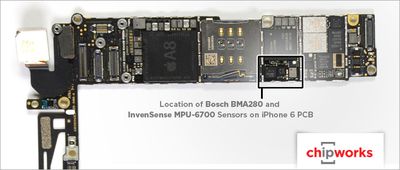
Apple has opted to equip the iPhone 6 and 6 Plus with two separate accelerometers, as discovered in Chipworks' comprehensive iPhone 6 and 6 Plus teardown. There's a three-axis Bosch BMA280 accelerometer and what Chipworks believes is a MPU-6700 six-axis accelerometer from InvenSense.

According to Chipworks, Apple may have decided to incorporate two accelerometers into the iPhone 6 and 6 Plus to both minimize power consumption and "improve the overall user experience."

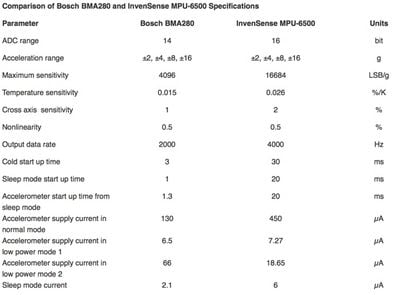
The InvenSense accelerometer has a range of functions, allowing it to operate in several different modes, but it can draw more power than the Bosch accelerometer due to its higher sensitivity. The maximum sensitivity of the InvenSense is at 16684 LSB/g, much higher than the Bosch's 4096.
accelerometers

The InvenSense device can operate as a six axis inertial sensor, or as either a three-axis gyroscope or a three-axis accelerometer. It is rated to consume 3.4 mA in the six-axis mode, 3.2 mA in the gyroscope mode and 450 µA in the accelerometer normal mode. By contrast, the Bosch device operates as a 3-axis accelerometer only and it consumes 130 µA of current in the accelerometer normal mode. Both devices offer two low power levels of operation for the accelerometer function. The InvenSense device actually consumes less current in its lowest power mode, with a 1 Hz update rate.

The main benefit of the InvenSense is full six-axis integration of the data by the on-chip digital motion processor (DMP). This will provide a direct benefit for gaming and other applications that need sophisticated inertial sensing capabilities. In addition the InvenSense provides significantly higher sensitivity than the Bosch device. The price however, is higher power consumption.

The Bosch accelerometer is able to operate at a lower power than the InvenSense and it has a "much faster" cold start up time, at 3ms compared to 30ms, allowing it to be used when complete six-axis integration is unnecessary. Chipworks speculates that it may be used for tasks where higher sensitivity is unneeded, perhaps for rotating the screen from landscape to portrait mode or for pedometer functionality.
specificationcomparison
According to Chipworks, the inclusion of two accelerometers in the iPhone 6 and 6 Plus is an example of Apple's "elegant engineering." A single InvenSense accelerometer would have enabled the device to work perfectly well, but the addition of the Bosch accelerometer allows for lower power consumption in the appropriate situations.

Popular Stories

Multicolored Low Cost A18 Pro MacBook Feature

Apple Accidentally Leaks 'MacBook Neo'

Tuesday March 3, 2026 7:00 am PST by
Apple appears to have prematurely revealed the name of its rumored lower-cost MacBook model, which is expected to be announced this Wednesday. A regulatory document for a "MacBook Neo" (Model A3404) has appeared on Apple's website. Unfortunately, there are no further details or images available yet. While the PDF file does not contain the "MacBook Neo" name, it briefly appeared in a link...
imac video apple feature

Apple Unveils Two New Products

Monday March 2, 2026 7:49 am PST by
Apple today introduced two new devices, including the iPhone 17e and an updated iPad Air. iPhone 17e features the same overall design as the iPhone 16e, but it gains Apple's A19 chip, MagSafe for magnetic wireless charging and magnetic accessories, Apple's second-generation C1X modem for faster 5G, and a doubled 256GB of base storage. In the U.S., the iPhone 17e starts at $599, just like the ...
MacBook Neo Feature Pastel 1

Apple Announces $599 'MacBook Neo' With A18 Pro Chip

Wednesday March 4, 2026 6:15 am PST by
Apple today announced the "MacBook Neo," an all-new kind of low-cost Mac featuring the A18 Pro chip for $599. The MacBook Neo is the first Mac to be powered by an iPhone chip; the A18 Pro debuted in 2024's iPhone 16 Pro models. Apple says it is up to 50% faster for everyday tasks than the bestselling PC with the latest shipping Intel Core Ultra 5, up to 3x faster for on-device AI workloads,...


Top Rated Comments

Patriot24 Avatar
149 months ago
All Android devices from here on will have at least 3 accelerometers as a result.
Score: 74 Votes (Like | Disagree)
149 months ago
I am glad that we are finally getting back on track with actual iPhone specs and NOT the bendability results.
Score: 31 Votes (Like | Disagree)
Patriot24 Avatar
149 months ago
OK, so I got the obvious, witty Android joke out of the way. Here's the real point:

A lot of people look at these devices being released every year with the sense that all these companies do (LG, Samsung, and others included) is slap the same old components on the inside and change the case or screen size. In reality, they are re-architecting a lot of the technology every year or two. This is not easy to do.

Only when we get tear downs and such do we get the full story of everything going on inside the shell. These guys are doing amazing work to move technology forward. The result is better devices and increased convenience/utility for the user.

The engineers that put this particular solution together aren't going to be recognized or win any awards, but they're doing great things.
Score: 28 Votes (Like | Disagree)
149 months ago
I would have rather had 2 gigz of ramz.

It is exactly this type of clever engineering which is why Apple don't need to include 2Gb of ram just to look good in the specs race.
Score: 25 Votes (Like | Disagree)
Dionte Avatar
149 months ago
I would have rather had 2 gigz of ramz.
Score: 17 Votes (Like | Disagree)
149 months ago
And if apple would of made it thicker we could of had the 3 accelerometers it clearly should have!
HAVE.. FOR THE LOVE OF GOD... HAVE... :cool:
Score: 15 Votes (Like | Disagree)