The five major U.S. carriers have come to an agreement with the FCC over a set of voluntary industry principles to make it easier for wireless customers to unlock their devices and switch from carrier to carrier if they wish. The CTIA -- the industry trade group representing AT&T, Sprint, T-Mobile, U.S. Cellular and Verizon in the matter -- says it will recommend the principles be added to the group's "Consumer Code for Wireless Service" and the carriers will commit to implement them within 12 months.
- Disclosure: Each carrier will post on its website its clear, concise, and readily accessible policy on postpaid and prepaid mobile wireless device unlocking.
- Postpaid Unlocking Policy: Carriers, upon request, will unlock mobile wireless devices or provide the necessary information to unlock their devices for their customers and former customers in good standing and individual owners of eligible devices after the fulfillment of the applicable postpaid service contract, device financing plan or payment of an applicable early termination fee.
- Prepaid Unlocking Policy: Carriers, upon request, will unlock prepaid mobile wireless devices no later than one year after initial activation, consistent with reasonable time, payment or usage requirements.
- Notice: Carriers that lock devices will clearly notify customers that their devices are eligible for unlocking at the time when their devices are eligible for unlocking or automatically unlock devices remotely when devices are eligible for unlocking, without additional fee. Carriers reserve the right to charge non-customers/non-former customers a reasonable fee for unlocking requests. Notice to prepaid customers may occur at point of sale, at the time of eligibility, or through a clear and concise statement of the policy on the carrier's website.
- Response Time: Within two business days after receiving a request, carriers will unlock eligible mobile wireless devices or initiate a request to the OEM to unlock the eligible device, or provide an explanation of why the device does not qualify for unlocking, or why the carrier reasonably needs additional time to process the request.
- Deployed Personnel Unlocking Policy: Carriers will unlock mobile wireless devices for deployed military personnel who are customers in good standing upon provision of deployment papers.
Carriers reserve the right to decline an unlock request if they have a reasonable basis to believe the request is fraudulent or the device is stolen.
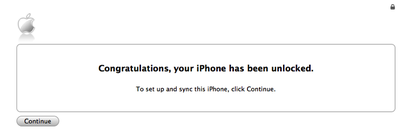
In a statement issued after the agreement was announced, the CTIA noted that "unlocking devices may not necessarily mean full interoperability since devices that work on one provider’s network may not be technologically compatible with another wireless provider’s network" and that unlocking a device may enable some functionality but not necessarily all.
Early this year, the Library of Congress ruled that it was illegal for certain mobile phone owners to unlock their phones unless specifically authorized by their carrier. This past September, the Obama administration filed a petition with the FCC, asking that carriers be required to unlock mobile devices. This voluntary agreement between the FCC and carriers would appear to forestall the need for legal action by either Congress or the FCC.

Friday December 5, 2025 9:40 am PST by Tim Hardwick
Apple is about to release iOS 26.2, the second major point update for iPhones since iOS 26 was rolled out in September, and there are at least 15 notable changes and improvements worth checking out. We've rounded them up below.
Apple is expected to roll out iOS 26.2 to compatible devices sometime between December 8 and December 16. When the update drops, you can check Apple's servers for the ...
Friday December 5, 2025 10:08 am PST by Joe Rossignol
Intel is expected to begin supplying some Mac and iPad chips in a few years, and the latest rumor claims the partnership might extend to the iPhone.
In a research note with investment firm GF Securities this week, obtained by MacRumors, analyst Jeff Pu said he and his colleagues "now expect" Intel to reach a supply deal with Apple for at least some non-pro iPhone chips starting in 2028....
Monday December 8, 2025 4:54 am PST by Tim Hardwick
Apple is actively testing under-screen Face ID for next year's iPhone 18 Pro models using a special "spliced micro-transparent glass" window built into the display, claims a Chinese leaker.
According to "Smart Pikachu," a Weibo account that has previously shared accurate supply-chain details on Chinese Android hardware, Apple is testing the special glass as a way to let the TrueDepth...
Monday December 1, 2025 2:40 am PST by Tim Hardwick
Apple's iPhone development roadmap runs several years into the future and the company is continually working with suppliers on several successive iPhone models at the same time, which is why we often get rumored features months ahead of launch. The iPhone 18 series is no different, and we already have a good idea of what to expect for the iPhone 18 Pro and iPhone 18 Pro Max.
One thing worth...
Apple's senior vice president of hardware technologies Johny Srouji could be the next leading executive to leave the company amid an alarming exodus of leading employees, Bloomberg's Mark Gurman reports.
Srouji apparently recently told CEO Tim Cook that he is "seriously considering leaving" in the near future. He intends to join another company if he departs. Srouji leads Apple's chip design ...
Monday December 8, 2025 10:18 am PST by Juli Clover
Apple today seeded the second release candidate version of iOS 26.2 to developers and public beta testers, with the software coming one week after Apple seeded the first RC. The release candidate represents the final version iOS 26.2 that will be provided to the public if no further bugs are found.
Registered developers and public beta testers can download the betas from the Settings app on...
You'd expect things to be starting to wind down for the holidays by now, but that doesn't seem to be the case yet in the world of Apple news, with Apple just about ready to release iOS 26.2 and other operating system updates to the public.
There was also a flurry of news this week about Apple executive departures, some expected and some not so expected, while we also learned that Apple and...
Monday December 8, 2025 9:23 am PST by Joe Rossignol
Apple's chipmaking chief Johny Srouji has reportedly indicated that he plans to continue working for the company for the foreseeable future.
"I love my team, and I love my job at Apple, and I don't plan on leaving anytime soon," said Srouji, in a memo obtained by Bloomberg's Mark Gurman.
Here is Srouji's full memo, as shared by Bloomberg:I know you've been reading all kind of rumors and...
A U.S. appeals court has upheld a temporary restraining order that prevents OpenAI and Jony Ive's new hardware venture from using the name "io" for products similar to those planned by AI audio startup iyO, Bloomberg Law reports.
iyO sued OpenAI earlier this year after the latter announced its partnership with Ive's new firm, arguing that OpenAI's planned "io" branding was too close to its...
The entire concept of locking phones is comical. Customers should pay their bills because they owe the money, not because the carrier can hold them hostage. If bills aren't paid, multi-billion dollar cellular service corporations have the same avenues to collect past due amounts as any other company, they need not keep our phones hostage.
I always hate "voluntary" agreements companies make because they can change if and when the companies want. Many people don't realize that safety recalls in the US are nearly always voluntary, even for things that are clearly a health risk (salmonella, etc.).
Government does actually serve a purpose, and protecting the safety and rights of consumers is certainly one thing that governments should be doing. So while this is a step in the right direction, companies should be forced to unlock devices that consumers have paid for, it shouldn't be just if the carriers decide they want to be nice enough to do it.
I hope you vote, because we need more people like you.
I always hate "voluntary" agreements companies make because they can change if and when the companies want. Many people don't realize that safety recalls in the US are nearly always voluntary, even for things that are clearly a health risk (salmonella, etc.).
Government does actually serve a purpose, and protecting the safety and rights of consumers is certainly one thing that governments should be doing. So while this is a step in the right direction, companies should be forced to unlock devices that consumers have paid for, it shouldn't be just if the carriers decide they want to be nice enough to do it.
The entire concept of locking phones is comical. Customers should pay their bills because they owe the money, not because the carrier can hold them hostage. If bills aren't paid, multi-billion dollar cellular service corporations have the same avenues to collect past due amounts as any other company, they need not keep our phones hostage.
I couldn't have said it better myself.
What we really need is companies like Apple and Samsung to simply make one model unlocked phone, instead of caving into the carriers and allowing them to be locked in the first place. This would certainly help with making it much easier to sell the phones and also with manufacturing. Imagine how nice it would be to not have to be asked "what carrier" when you go to buy an iPhone.