Researchers Crack iOS-Generated Hotspot Passwords in 50 Seconds - MacRumors
Skip to Content

Researchers Crack iOS-Generated Hotspot Passwords in 50 Seconds

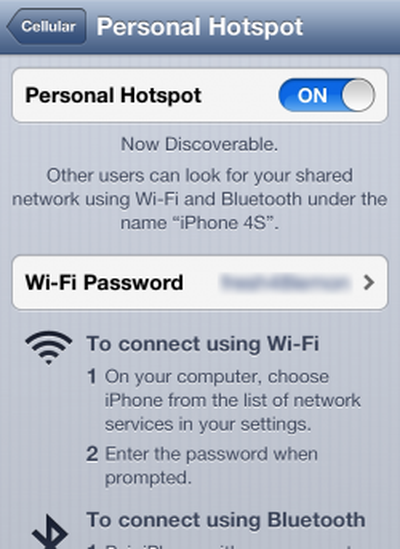
personalhotspotWhen tethering an iPhone or an iPad, iOS users have the option of using an automatically generated password for their personal hotspots, which Apple implemented to provide all users with a secure password option.

According to researchers at Germany's University of Erlangen (via ZDNeT), the way that the keys are generated – with a combination of a short English word along with random numbers – is predictable to the point where the researchers are able to crack the hotspot password in less than a minute.

In their paper, the three researchers detail the process that they used to figure out the weak spots in the hotspot's protection. Apple's word list uses approximately 52,500 entries, so initially, cracking the hotspot took almost 50 minutes. After finding a WiFi connection, the researchers used an AMD Radeon HD 6990 GPU to run through word and number combinations.

"This list consists of around 52,500 entries, and was originated from an open-source Scrabble crossword game. Using this unofficial Scrabble word list within offline dictionary attacks, we already had a 100 percent success rate of cracking any arbitrary iOS hotspot default password," the researchers wrote.

The team discovered that only a small set of Apple's larger word list was being used, so with GPU cluster of four AMD Radeon HD 7970s, they narrowed their iOS-generated hotspot password cracking time down to just 50 seconds. In the paper, the team goes on to criticize Apple's password generation standards, suggesting that system generated passwords be composed of random letters and numbers.

"In the context of mobile hotspots, there is no need to create easily memorizable passwords. After a device has been paired once by typing out the displayed hotspot password, the entered credentials are usually cached within the associating device, and are reused within subsequent connections," the paper states.

"System-generated passwords should be reasonably long, and should use a reasonably large character set. Consequently, hotspot passwords should be composed of completely random sequences of letters, numbers, and special characters."

As noted by ZDNet though Apple's password generation system is flawed, it is a more robust solution than what is used by other companies like Microsoft. For example, the Windows 8 phone utilizes default passwords that consist of eight digit numbers.

To avoid a weak iPhone hotspot password, users can still choose to use passwords of their own creation, which should contain a sequence of random numbers and letters for enhanced security.
Popular Stories

iOS 27 Next to iPhone

Here's When iOS 27 Rolls Out Today in Every Time Zone [Update: It's Out]

Sunday September 13, 2026 3:00 am PDT by
Update 10:04 a.m.: iOS 27 is rolling out now, though it may take a bit for all users to see it, so keep checking! Apple is about to release iOS 27, which will finally deliver more advanced Siri AI capabilities as well as a variety of other refinements, improvements, and new features to iPhones. It's Apple's biggest software update of the year, and Apple announced at Wednesday's iPhone event...
iOS 27 Icon iPhone

iOS 27 Available Now With These 8 New Features

Monday September 14, 2026 9:00 am PDT by
Update — 10 a.m. Pacific Time: Apple has released iOS 27. During its iPhone 18 Pro and iPhone Duo event last week, Apple announced that iOS 27 will be released widely on Monday, September 14. iOS 27 should be available around 10 a.m. Pacific Time / 1 p.m. Eastern Time today via the Settings app, under General → Software Update. Below, we have highlighted eight new features and...
Apple iCloud Plus expansion hero

iCloud+ Now Includes Apple TV, Apple Arcade, and Curated Apple Music Stations in Over 100 Countries

Tuesday September 15, 2026 1:43 am PDT by
Apple today announced a new subscription initiative that turns paid iCloud+ subscriptions into a broader services bundle in more than 100 countries. In select countries, Apple says every paid iCloud+ plan, including the cheapest 50GB tier, now includes Apple TV and Apple Arcade "at no additional cost," while family sharing extends the storage, TV and Arcade access to up to five people....

Top Rated Comments

173 months ago
Wow, I guess next time I setup a personal hotspot to check my email on my laptop, I'd better watch out for someone nearby with a "GPU cluster of four AMD Radeon HD 7970s". I mean seriously, who sets up a wireless hotspot on their iPhone using the password generator and then transmits some sensitive data which is at risk of (and in range of) some hacker that would have the ability (or desire) to crack their wireless hotspot security? It's hard enough to even get people to turn on any security much less worry about whether it could potentially be hacked. These "researchers" need to spend their time on something more useful.
Score: 13 Votes (Like | Disagree)
173 months ago
I always use my birthdate as password.
Score: 12 Votes (Like | Disagree)
kkat69 Avatar
173 months ago
Mines easy, no need for massive data crunching... 1-2-3-4-5. I use the same on my luggage.
Score: 10 Votes (Like | Disagree)
173 months ago
I can imagine folks just roaming airports with these AMD systems looking for iPhone passwords.
Score: 10 Votes (Like | Disagree)
173 months ago
This does not appear to be an issue in iOS 7.

The passwords generated in the beta are not based on dictionary words and are considerably more randomized.
Score: 9 Votes (Like | Disagree)
Menel Avatar
173 months ago
" so with GPU cluster of four AMD Radeon HD 7970s"

Using my iPad out in a park away from building WIFI. I think that, with a gas generator out in a park might be obvious and suspicious...

Also, use Bluetooth. The connection is persistent. iPad reconnects without fiddling with Phone because the phone doesn't idle it's bluetooth like it does WIFI. Also more secure as you will have to manually approve the connection. Problem solved, and everything fixed.
Score: 9 Votes (Like | Disagree)