Skip to Content

Apple Blocks Java 7 Plug-in on OS X to Address Widespread Security Threat

As noted by ZDNet, a major security vulnerability in Java 7 has been discovered, with the vulnerability currently being exploited in the wild by malicious parties. In response to threat, the U.S. Department of Homeland Security has recommended that users disable the Java 7 browser plug-in entirely until a patch is made available by Oracle.

Hackers have discovered a weakness in Java 7 security that could allow the installation of malicious software and malware on machines that could increase the chance of identity theft, or the unauthorized participation in a botnet that could bring down networks or be used to carry out denial-of-service attacks against Web sites.

"We are currently unaware of a practical solution to this problem," said the DHS' Computer Emergency Readiness Team (CERT) in a post on its Web site on Thursday evening. "This vulnerability is being attacked in the wild, and is reported to be incorporated into exploit kits. Exploit code for this vulnerability is also publicly available."

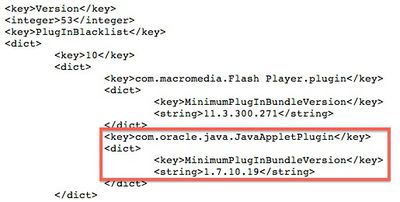
Apple has, however, apparently already moved quickly to address the issue, disabling the Java 7 plug-in on Macs where it is already installed. Apple has achieved this by updating its "Xprotect.plist" blacklist to require a minimum of an as-yet unreleased 1.7.0_10-b19 version of Java 7. With the current publicly-available version of Java 7 being 1.7.0_10-b18, all systems running Java 7 are failing to pass the check initiated through the anti-malware system built into OS X.
java 7 blacklist
Apple's updated plug-in blacklist requiring an unreleased version of Java 7

Apple historically provided its own support for Java on OS X, but in October 2010 began pushing support for Java back to Oracle, with Steve Jobs noting that the previous arrangement resulted in Apple's Java always being a version behind that available to other platforms through Oracle. Consequently, Jobs acknowledged that having Apple responsible for Java "may not be the best way to do it."

It wasn't until last August that the transition was essentially complete, with Oracle officially launching Java 7 for OS X. Java 7 does not ship by default on Mac systems, meaning that many users are not affected this latest issue or other recent ones, but those users who have manually installed Java 7 may be experiencing issues with their systems.

There is no word yet on when an updated version of Java addressing the issue will be made available by Oracle.

Update: As detailed in the National Vulnerability Database, the issue affects not only the Java 7 plug-in, but at least some versions of Java 4 through 7.

Popular Stories

Apple Announces Special Event in New York Feature 1

Apple Teases 'A Big Week Ahead' With Announcements Starting Monday

Thursday February 26, 2026 6:06 am PST by
Apple CEO Tim Cook today teased "a big week ahead," with announcements starting Monday. His post included an #AppleLaunch hashtag with a colorful Apple logo, along with a short video that ultimately shows an Apple logo on the lid of a Mac. Apple is reportedly planning a three-day stretch of product announcements from Monday, March 2 through Wednesday, March 4, with up to five new products...
iphone fold text

iPhone Fold Crease Measurements Revealed as Device Hits Production

Wednesday February 25, 2026 5:37 am PST by
Apple has submitted production line orders for its upcoming foldable iPhone, effectively confirming that the device will launch this year, claims a Chinese leaker. According to the Weibo account "Fixed Focus Digital," assembly lines recently received the orders from Apple, which has apparently allowed the leaker to learn the crease measurements for the device's 7.8-inch inner display....
m3 macbook pro blue

M5 Pro and M5 Max MacBook Pro: What to Expect

Wednesday February 25, 2026 3:02 pm PST by
Apple is working on a new MacBook Pro that could launch next week ahead of the "Special Experience" planned for March 4, so we thought we'd highlight all of the rumors about the device so far. Design There are no rumors of design changes, and we are expecting the upcoming M5 MacBook Pro models to look just like the M4 versions. Apple will continue to offer 14-inch and 16-inch size options,...

Top Rated Comments

KnightWRX Avatar
171 months ago
com.oracle.java.JavaAppletPlugin = Browser plug-in.

Apple has not blocked Java 7 on OS X.

Please correct the headline ASAP before this thread becomes a major flamewar.
Score: 23 Votes (Like | Disagree)
xionxiox Avatar
171 months ago
Java is the worst thing ever. Always buggy and slow. Oracle doesn't give a damn about Macs.
Score: 19 Votes (Like | Disagree)
171 months ago
Wow. The Apple fix for this is both elegant and scary - I tested it on mine and I definitely get the popup that Java is unsecure and out of date, and blocked - but I didn't have to do anything to get that update to xprotect.plist. No software update, no nothing. That's rather scary.

I suppose at this point I'm willing to trade the 0-day security for Apple's ability to reach in and tweak settings.
Score: 14 Votes (Like | Disagree)
WildCowboy Avatar
171 months ago
I tested it on mine and I definitely get the popup that Java is unsecure and out of date, and blocked - but I didn't have to do anything to get that update to xprotect.plist. No software update, no nothing. That's rather scary.
OS X systems check for an updated version of that file on a daily basis. It's primarily used for malware definitions, but can also be used to require minimum versions of certain plugins, as with Flash and Java.


com.oracle.java.JavaAppletPlugin = Browser plug-in.

Apple has not blocked Java 7 on OS X.

Please correct the headline ASAP before this thread becomes a major flamewar.
You are of course correct, and I've updated accordingly to make things more clear.
Score: 8 Votes (Like | Disagree)
inkswamp Avatar
171 months ago
Well, I don't think I will join the debate about Java, but a temporary fix to enable Java (I know, it is a security hazard, however I don't have another option as I have to use the Juniper SSL VPN network connect client).
So,
1. close Safari
2. Open a terminal
3. sudo vi /System/Library/CoreServices/CoreTypes.bundle/Contents/Resources/XProtect.meta.plist
4. Find the string <key>MinimumPlugInBundleVersion</key>
5. Just under that line you should see the version. Change the last portion of the number from 19 to 1.
6. Save and exit
7. Start up Safari and you should work. You must keep in mind that this file may be updated by Apple again, so this is only temporary and should only be done if you *must* use your current version of Java.

best of luck....

Thanks so much for posting this. The company I work for uses a payroll system that requires the Java plug-in and I was unable to access it. Would have been stuck without this.

I like that Apple is clearly looking out for the safety of their users, but at the same time, it would be nice if they would put in a user interface for temporarily side-stepping this kind of thing instead of having to hack around in the system files. Just a simple prompt of "This plug-in/app has been disabled due to security issues. Do you want to run it this one time?" That would serve the dual purposes of not leaving their users stranded and giving an explanation for why it suddenly doesn't work.
Score: 6 Votes (Like | Disagree)
Stella Avatar
171 months ago
Seriously? From a programmer's perspective: http://tech.jonathangardner.net/wiki/Why_Java_Sucks
Thanks for the reply.

I write Java on a daily basis, I wanted to know from you why you thought 'Java Sucks'... or if you were just on some bandwagon. Some reasons why Java sucks are now invalid and have been for a long time - such as 'Java is Slow'... which is a gross generalization.

Some of those points or valid in the link, others are just his opinion, others may disagree or agree.

Java can be a good choice on the server side, on the GUI side, not so much. Saying that, writing webapps with Java is not a great experience - there are better choices - YMMV.
Score: 6 Votes (Like | Disagree)