Intel Demonstrates Cableless Computing Made Possible by Future Skylake Platform
At Computex in Taiwan this week, Intel demonstrated a variety of wireless accessories that will be enabled by the company's future Skylake processor platform, reports CNET. Reference designs for the Broadwell successor will include the possibility of eliminating all of the cables that currently connect to a personal computer, replacing both data and power cables with wireless options.
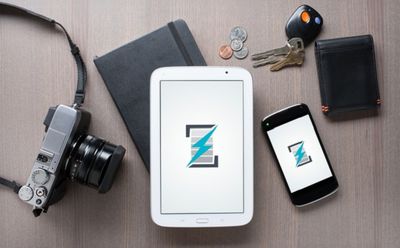
Wireless Charging concept from Rezence
The demonstration by Kirk Skaugen, Intel's senior vice president and general manager of the PC Client Group, showcased a wireless display, as well as a computer with wireless docking and charging capabilities. Intel uses technology from
A4WP's Rezence, which transfers power wirelessly using the principles of magnetic resonance, for its wireless charging solution.
The system can be installed under a table surface, with magnetic resonance capable of charging through 2 inches of wood. It can also charge any number of devices at the same time, unlike inductive charging technologies.
Skaugen demonstrated a table that charged a laptop, phone, headset and tablet all at once.
For docking and display purposes, Intel relies on Wi-Gig to govern the wireless data transfer. First outlined in 2010, Wi-Gig is an established wireless standard that uses unlicensed 60 GHz spectrum to provide data transfer rates up to 7 Gbps.
The technology is still in the early stages, with Intel's Skylake platform expected to debut in late 2015. Products natively supporting these wireless protocols will be available publicly sometime in 2016. Apple is not currently listed as a member of the extensive A4WP consortium, but the company is undoubtedly pursuing its own potential solutions and its use of Intel's chips in Macs means that it will be able to take advantage of the technologies packaged into the future Skylake platform.
Popular Stories
Apple today shared an ad that shows how the upgraded Center Stage front camera on the latest iPhones improves the process of taking a group selfie.
"Watch how the new front facing camera on iPhone 17 Pro takes group selfies that automatically expand and rotate as more people come into frame," says Apple. While the ad is focused on the iPhone 17 Pro and iPhone 17 Pro Max, the regular iPhone...
In select U.S. states, residents can add their driver's license or state ID to the Apple Wallet app on the iPhone and Apple Watch, and then use it to display proof of identity or age at select airports and businesses, and in select apps.
The feature is currently available in 13 U.S. states and Puerto Rico, and it is expected to launch in at least seven more in the future.
To set up the...
Apple is planning to launch new MacBook Pro models as soon as early March, but if you can, this is one generation you should skip because there's something much better in the works.
We're waiting on 14-inch and 16-inch MacBook Pro models with M5 Pro and M5 Max chips, with few changes other than the processor upgrade. There won't be any tweaks to the design or the display, but later this...
Wednesday February 11, 2026 10:07 am PST by
Juli CloverApple today released iOS 26.3 and iPadOS 26.3, the latest updates to the iOS 26 and iPadOS 26 operating systems that came out in September. The new software comes almost two months after Apple released iOS 26.2 and iPadOS 26.2.
The new software can be downloaded on eligible iPhones and iPads over-the-air by going to Settings > General > Software Update.
According to Apple's release notes, ...
It has been a slow start to 2026 for Apple product launches, with only a new AirTag and a special Apple Watch band released so far. We are still waiting for MacBook Pro models with M5 Pro and M5 Max chips, the iPhone 17e, a lower-cost MacBook with an iPhone chip, long-rumored updates to the Apple TV and HomePod mini, and much more.
Apple is expected to release/update the following products...