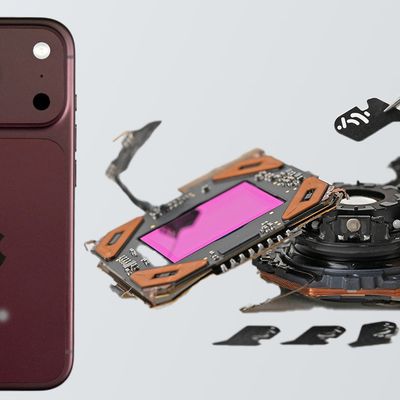
The M2 Pro and M2 Max MacBook Pro models feature a considerably smaller heatsink due to supply chain issues, teardowns suggest.
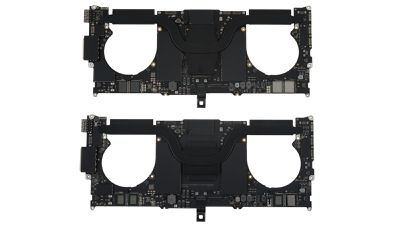
Top: M1 Pro logic board with larger heatsink. Bottom: M2 Pro logic board with smaller heatsink (via iFixit).
The new MacBook Pro's revised thermal architecture appears to be caused by the reduced overall footprint of the M2 Pro and M2 Max SoCs inside the device, as noted by iFixit and Max Tech. The M1 Pro and M1 Max MacBook Pro models contained two, large memory modules, but the M2 Pro and M2 Max MacBook Pro models contain four slimmer memory modules. Even though the M2 Pro and M2 Max dies are physically larger than those of the M1 Pro and M1 Max, the SoCs as a whole take up less space.
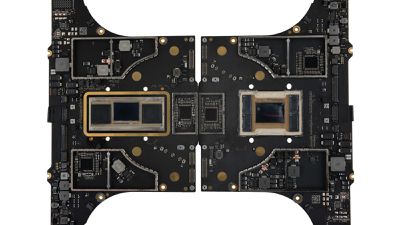
Left: M1 Pro SoC. Right: M2 Pro SoC (via iFixit).
This means that the M2 Pro and M2 Max MacBook Pro models do not require a heatsink as large as the one used for the previous generation. It is not clear if this significantly impacts thermal efficiency.
The reason for the use of four smaller memory modules appears to be supply chain issues. The entire SoC is mounted on a substrate, so four smaller modules allow Apple to use a smaller substrate, making a saving on materials and reducing complexity as a result. Dylan Patel, Chief Analyst at SemiAnalysis, told iFixit:
ABF substrates were in very short supply when Apple made the design choice. By using four smaller modules rather than two larger ones, they can decrease routing complexity within the substrate from the memory to the SoC, leading to fewer layers on the substrate. This allows them to stretch the limited substrate supply further.
The M2 Pro and M2 Max deliver up to 20 percent better CPU performance and 30 percent better GPU performance than their predecessors, but since the chips continue to be based on TSMC's 5nm process, some users have noted that Apple may have made thermal tradeoffs in order to deliver improved performance.

Apple is planning to debut a high-end secondary version of AirPods Pro 3 this year, sitting in the lineup alongside the current model, reports suggest.
Back in September 2025, supply chain analyst Ming-Chi Kuo reported that Apple is planning to introduce a successor to the AirPods Pro 3 in 2026. This would be somewhat unusual since Apple normally waits around three years to make major...
Sunday January 18, 2026 3:51 pm PST by Joe Rossignol
iOS 27 is still many months away, but there are already plenty of rumors about new features that will be included in the software update.

The first beta of iOS 27 will be released during WWDC 2026 in June, and the update should be released to all users with a compatible iPhone in September.

Bloomberg's Mark Gurman said that iOS 27 will be similar to Mac OS X Snow Leopard, in the sense...
Sunday January 18, 2026 6:50 pm PST by Joe Rossignol
MacBook Pro availability is tightening on Apple's online store, with select configurations facing up to a two-month delivery timeframe in the United States.
A few 14-inch and 16-inch MacBook Pro configurations with an M4 Pro chip are not facing any shipping delay, but estimated delivery dates for many configurations with an M4 Max chip range from February 6 to February 24 or even later. At...
Tuesday January 20, 2026 2:34 am PST by Tim Hardwick
Over the last few months, rumors around the iPhone 18 Pro's front-panel design have been conflicted, with some supply-chain leaks pointing to under-display Face ID, reports suggesting a top-left hole-punch camera, and debate over whether the familiar Dynamic Island will shrink, shift, or disappear entirely.
Today, Weibo-based leaker Instant Digital shared new details that appear to clarify the ...
Thursday January 15, 2026 10:56 am PST by Joe Rossignol
While the iPhone 18 Pro and iPhone 18 Pro Max are not expected to launch for another eight months, there are already plenty of rumors about the devices.
Below, we have recapped 12 features rumored for the iPhone 18 Pro models, as of January 2026:
The same overall design is expected, with 6.3-inch and 6.9-inch display sizes, and a "plateau" housing three rear cameras
Under-screen Face ID...
That's not a heatsink. That's just the interface block that you are describing. The heat is transferred to the two radiator fins. The fans then blow air across the fins. The radiator fins are the heat sink. At least, that's what I classically think of as the heatsink.
This interface block completely covers the chip. It's fine.