Apple Executives Discuss watchOS 9's New Health Features Like AFib History and Tracking Your Sleep Stages - MacRumors
Skip to Content

Apple Executives Discuss watchOS 9's New Health Features Like AFib History and Tracking Your Sleep Stages

Following the WWDC 2022 keynote last week, Apple's VP of health Dr. Sumbul Desai, operations chief Jeff Williams, and VP of fitness technologies Jay Blahnik spoke with TechCrunch's Darrell Etherington about new health features added in watchOS 9.
watchos 9 afib history
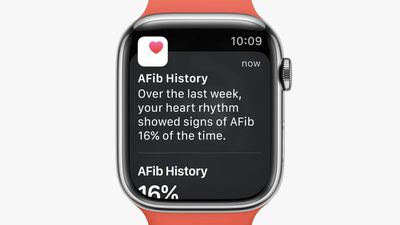
One of the Apple Watch's new health features is AFib History, which allows individuals diagnosed with atrial fibrillation to view an estimate of how frequently their heart is in this type of arrhythmia, according to Apple. Apple says the feature is intended for individuals aged 22 years or older who have been diagnosed with atrial fibrillation.

Desai said the AFib History feature received FDA clearance in the United States after being validated in a clinical study.

"As Jeff alluded to, everything we do in health is based on the science, and AFib history was validated in a clinical study, with participants wearing both Apple Watch and an FDA-cleared reference device," said Desai. "In that study, the average difference in weekly measurements between the two devices is actually less than 1%."

Williams said the AFib History feature could prove useful when a patient receives an ablation treatment for chronic atrial fibrillation, but the treatment is unsuccessful at first attempt and the patient continues to experience atrial fibrillation.

AFib History is not currently approved in all countries or regions, according to Apple, so availability of the feature will be limited at launch.

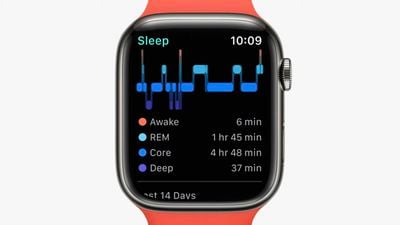
Starting with watchOS 9, the Apple Watch also offers sleep stage tracking, which lets you see how much time you spent in REM, core, or deep sleep, as well as when you might have woken up. (Apple refers to what is typically known as "light sleep" as "core sleep.")
watchos 9 sleep stage tracking
"Prior to sleep stages, we were really focused on helping people meet their sleep duration goals, since that's really important — that consistency — but we wanted to go a little further and dig into the science, and provide users with more information around their sleep cycles," said Desai. "So using the signals from Apple Watch's accelerometer and heart rate sensor, users will now be able to see their sleep stages while they're in REM, core, and deep sleep."

On watchOS 9, the Workout app displays more information, including views of metrics like Activity rings, heart rate zones, power, and elevation, but Blahnik assured that the app remains suitable for "both beginners and advanced athletes."

The full discussion can be read at TechCrunch. watchOS 9 is currently in beta for developers and will be released to all users around September.
Related Roundup: Apple Watch 11
Buyer's Guide: Apple Watch (Neutral)

Popular Stories

iOS 26

iOS 26.4 Adds Two New Features to CarPlay

Tuesday March 24, 2026 1:55 pm PDT by
iOS 26.4 was released today, and it includes a couple of new features for CarPlay: an Ambient Music widget and support for voice-based chatbot apps. To update your iPhone 11 or newer to iOS 26.4, open the Settings app and tap on General → Software Update. CarPlay will automatically offer the new features so long as the iPhone connected to your vehicle is running iOS 26.4 or later....
AirPods Pro Firmware Feature

Apple Releases New Firmware for AirPods Pro 3, AirPods Pro 2 and AirPods 4

Tuesday March 24, 2026 12:31 pm PDT by
Apple today released new firmware for the AirPods Pro 2, AirPods Pro 3, and the AirPods 4. The firmware has a version number of 8B39, up from 8B34 on the AirPods Pro 3, 8B28 on the AirPods Pro 2, and 8B21 on the AirPods 4. There is no word on what's included in the firmware, but Apple has a support document with limited notes. Most updates are limited to bug fixes and performance...
apple tv 4k new orange

tvOS 26.4 Adds These New Features to Your Apple TV

Wednesday March 25, 2026 3:33 pm PDT by
Apple this week released tvOS 26.4, and the software update includes a handful of new features and changes for the Apple TV. tvOS 26.4 is compatible with all Apple TV 4K and Apple TV HD models released since 2015. To update your Apple TV, open the Settings app on the device, navigate to System → Software Updates, and select Update Software. Below, we have recapped what is new in tvOS...

Top Rated Comments

50 months ago
I’ve been using the sleep tracking since the beta was released on Monday and it’s really accurate. I notice what time I go to bed each night and when I check it in the morning, it’s usually spot on. I also noticed I don’t sleep enough. Lol.
Score: 20 Votes (Like | Disagree)
Nitrokevin Avatar
50 months ago

What good is sleep tracking if your watch's battery doesn't fast charge?
Its fine with a short charge before bed and a charge while you get ready in the morning
Score: 14 Votes (Like | Disagree)
50 months ago

I am FULLY convinced that this kind of detection is NOT accurate.

As a lot of other kind of measurement performed by Apple Watch (and the problem is not the Apple Watch itself, but the fact that it measures on the wrist, that it is not the best place for some measurement -like O2, temperature- or it is good but it is insufficient, in the sense that MORE sensor placed ALSO elsewhere are needed to gather full data, see EGC).

In this specific case of sleep tracking, the big problem is that it is based on accelerations (and heart rate), not by measurement of cerebral activity (the only thing that can tell you your REAL sleep phase). Me for e.g., sometime I had difficult to fall asleep but sometime will waiting sleep I stay motionless.

This is the reason because most 'health' related features are a complete ********. Instead of doing a real measure of you want measure, they measure ANOTHER thing, then they try to deduce what they want measure with machine learning.

Like for e.g. if I want to estimate how it is tall a person from a picture without having any reference size in this picture, but basing myself on suppositions about other objects in the picture. Yes, I could obtain a value that most of time is reasonable... but not real, only reasonable, and only some of the time.

Even the activity tracking is a ******** (BTW each ride with my electric scooter is recognised as a bicycle ride, and calories burned are are completely useless). Also drop detection sometime is triggered by a very fast arm movement (e.g. pound the table with fists because you are very angry :D ), even if you are sitting!

It would be interesting to place one sensor for each limb (maybe two), to have multiple accelerometers, multiple limb leads for ECG (and a real heart rate measurement, based on electric not on supposed color changes in blood). I could be an Apple Watch + multiple and lighter 'smart wristbands' on each limb connected to the Apple Watch.

In this case we could have real data and not simply ********. But it is too cumbersome for a consumer product, I dont see the interest to develop such product...so...smartwatches, for health related data, are simply toys.

(And I am an Apple Watch fan, I like a lot. But for another kind of usage)
Sure there are compromises. It sounds like you'd prefer to have NO tool instead because practically speaking, not many would wear something that required the daily application of multiple sensors on different parts of their body. So, we take the compromise of the single package solution with (hopefully) some understanding that it is not a hospital grade monitoring system.

My own experience: it identified multiple instances of 'signs of afib', none of which were actually afib. BUT, I had another condition that was previously undetected. I am now in the care and monitoring of a cardiologist where perhaps it would have taken a much more serious event to get there. So yes, it was inaccurate, but recognized something was not right.
Score: 6 Votes (Like | Disagree)
ericwn Avatar
50 months ago

I seriously doubt it. Fan club members will always find an excuse to pay more for Apple products, but most others won't. I have a Garmin watch I bought many years ago for around $100 that keeps charged for 5 days, is small and more comfortable to wear at night, and likely tracks my sleep as well as an Apple watch. This isn't rocket science after all. Why on earth would I pay hundreds of dollars for a huge, clunky, overpriced behemoth that can't even run a full 24 hours without running out of charge? I just don't buy into form over function, especially when it comes to my health. And as buggy as all of the current Apple OSes are, I don't feel comfortable in trusting watchOS, or any other makers's watches either, with my health. For people who really need to monitor their health, wearing a fashion statement is not important, but accurate health data is. Apple still cares more about the fashion statement aspect...
Do you find yourself spending much time commenting on articles discussing improvements for products you seemingly don’t like and don’t use?
Score: 6 Votes (Like | Disagree)
SFjohn Avatar
50 months ago

can it now detect sleep even during the day?
Yes.
Score: 4 Votes (Like | Disagree)
50 months ago

Hyped a bit for the sleep tracking. Although the watch is intrusive and not a passive as other solutions on the market.
I'm waiting for the 'daydreaming' tracker to come out...that would help me out a lot.
Score: 4 Votes (Like | Disagree)