MediaTek Demos Next-Gen Wi-Fi 7 Standard Boasting Near Thunderbolt 3 Speeds - MacRumors
Skip to Content

MediaTek Demos Next-Gen Wi-Fi 7 Standard Boasting Near Thunderbolt 3 Speeds

MediaTek has conducted the world's first live demo of Wi-Fi 7 for "key customers and industry collaborators," paving the way for the wireless network technology to enter mainstream consumer hardware as early as next year, according to the company.
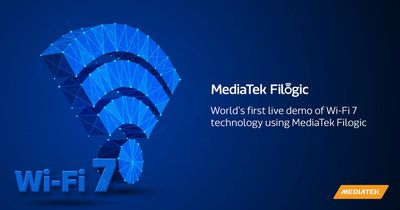
wi fi 7
Taiwan-based MediaTek said the demos demonstrated the ability of Wi-Fi 7 to achieve the maximum speed defined by IEEE 802.11be, the official name for the Wi-Fi 7 standard. The company said it also highlighted its multi-link operation (MLO) technology. MLO aggregates multiple channels on different frequency bands at the same time to allow network traffic to still flow seamlessly even if there is interference or congestion on the bands. "Filogic" simply refers to MediaTek's Wi-Fi 7 connectivity portfolio.

"The rollout of Wi-Fi 7 will mark the first time that Wi-Fi can be a true wireline/Ethernet replacement for super high-bandwidth applications," said Alan Hsu, corporate vice president and general manager of the Intelligent Connectivity business at MediaTek. "MediaTek’s Wi-Fi 7 technology will be the backbone of home, office and industrial networks and provide seamless connectivity for everything from multi-player AR/VR applications to cloud gaming and 4K calls to 8K streaming and beyond."

"Faster broadband Internet access and more demanding applications such as higher resolution video streaming and VR gaming are driving demand for Wi-Fi 6, Wi-Fi 6E, and soon Wi-Fi 7," said Mario Morales, group vice president, Semiconductors at IDC. "Wi-Fi 7's advances in channel width, QAM, and new features such as multi-link operation (MLO) will make Wi-Fi 7 very attractive for devices including flagship smartphones, PCs, consumer devices and vertical industries like retail and industrial; as service providers begin to deploy a wider spectrum of hotspots across these market segments."

Wi-Fi 7 is said to deliver 2.4x faster speeds than Wi-Fi 6, even with the same number of antennas, since Wi-Fi 7 can utilize 320Mhz channels and supports 4K quadrature amplitude modulation (QAM) technology.

The Wi-FI Alliance says Wi-Fi 7 could provide speeds of "at least 30" gigabits per second (Gbps) and should exceed that to reach 40Gbps, which is the same speed as Thunderbolt 3. As noted by ArsTechnica, Wi-Fi 6 supports speeds up to 9.6Gbps, while its predecessor, WiFi 5, has a max output of 3.5Gbps. Wi-Fi 6 is the marketing name given to 802.11ax technology, which is supported by all iPhone 11 and later models, the newest iPad mini, iPad Air, iPad Pro, and all Macs powered by Apple silicon.

The next step up from Wi-Fi 6 is Wi-Fi 6E. Devices supporting Wi-Fi 6E use a dedicated 6E spectrum with up to seven additional 160MHz channels, while Wi-Fi 6 devices share the same spectrum as other Wi-Fi 4, 5, and 6 devices, and they only operate on two 160MHz channels. Some reports suggested Apple's iPhone 13 series would include Wi-Fi 6E, but the rumors never panned out. Looking ahead, this year's iPhone 14 is expected to adopt Wi-Fi 6E and Apple's forthcoming AR/VR headset is also expected to support it to meet the needs of the high-end, immersive experience it will deliver, according to analyst Ming-Chi Kuo.

MediaTek has been involved in the development of the Wi-Fi 7 standard since its inception and is eager to drum up excitement for its Wi-Fi 7 Filogic connectivity portfolio, but the protocol hasn't been finalized by the Wi-FI Alliance yet, so it's difficult to say when consumer devices will actually support it. MediaTek says products with Wi-Fi 7 are expected to hit the market starting in 2023. Regardless, given that Apple has yet to adopt Wi-Fi 6E in any of its devices, support for Wi-Fi 7 is likely to be some way away.


Popular Stories

Four iPhone 18 Pro Colors Mock Feature

iPhone 18 Pro Launching Later This Year With These 10 New Features

Tuesday May 26, 2026 6:32 am PDT by
While the iPhone 18 Pro and iPhone 18 Pro Max are not launching until September, there are already plenty of rumors about the devices. It was initially reported that the iPhone 18 Pro models would have fully under-screen Face ID, with only a front camera visible in the top-left corner of the screen. However, the latest rumors indicate that only one Face ID component will be moved under the...
Apple Watch Ultra 2 Black Titanium

watchOS 27 Will Add These New Features to Your Apple Watch

Sunday May 24, 2026 11:53 am PDT by
Apple will unveil watchOS 27 during its WWDC 2026 keynote on Monday, June 8, and a handful of new features have been rumored already. The first developer beta of watchOS 27 should be available immediately following the keynote, and a public beta typically follows in July. The update should be released to all users with a compatible Apple Watch model in September. Below, we recap watchOS...


Apple Watch Blood Glucose Monitoring Feature 2

Apple Watch for Diabetes: The Latest on Apple's Plans for Non-Invasive Blood Sugar Monitoring

Tuesday May 26, 2026 9:30 am PDT by
For many years now, it has been rumored that the Apple Watch will eventually gain non-invasive blood sugar monitoring capabilities, which would enable millions of people with diabetes to track their blood glucose levels without needing to prick their skin with a needle or wear a dedicated continuous glucose monitor. According to Bloomberg's Mark Gurman, Apple recently shifted oversight of...

Top Rated Comments

RamGuy Avatar
57 months ago
This just in: Misleading marketing keeps on being misleading.

These numbers are the absolute best-case scenario when you aggregate performance using 6x6 320MHz. Clients will mostly stay 1x1 and 2x2 as a result of power usage and limited space for antennas.

Even with a client using 6x6 you wouldn't be anywhere close to these numbers as you are filling the entire spectrum so unless you live in a very remote area with barely any interference using up the entire spectrum all at once for a single device is not going to happen.

Comparisons with Thunderbolt 3 is also downright false and stupid as Thunderbolt is full-duplex, WiFi is half-duplex. Meaning that Thunderbolt can push data upstream and downstream at the same time, WiFi can't so when you have upstream and downstream on WiFi the throughput is instantly cut in half.

That's why you don't really need anything more than 1Gbps ethernet for 802.11ax/WiFi6 access points even if 4x4 802.11ax/WiFi6 in theory can go beyond 1Gbps. All these people convince themselves they need 2.5Gbps ports on their WiFi6 routers and access points are just fooling themselves.

Their numbers for WiFi6 are just as stupid. You won't see anywhere close to 9.6Gbps using WiFi6 in any scenario.
Score: 21 Votes (Like | Disagree)
57 months ago
Be sure to use expensive Monster cables for your wireless connection to guarantee no drop outs!
Score: 13 Votes (Like | Disagree)
Michael Scrip Avatar
57 months ago
I just hope they're doing all the hard work now to make WIFI 7 good enough to last a while.

I don't want WIFI 7E announced shortly afterwards...

🤣
Score: 13 Votes (Like | Disagree)
hortod1 Avatar
57 months ago
But can I still land my plane?
Score: 7 Votes (Like | Disagree)
Shirasaki Avatar
57 months ago
So, high speed, but how about energy consumption? Matching wire connection? Not to mention eavesdropping easier than wire. My iPhone XS Max can’t sustain long time continuous 4G network usage without massively thermal throttling. How about this one?

And 90% of people around the world don’t even have 10Mbps down broadband. So far the best case scenario I could see is wifi 7 paving ways for apple to wirelessly connect latest iPhone iPad with Mac, or Apple Watch with iPhone. That’s about it.
Score: 7 Votes (Like | Disagree)
TheYayAreaLiving 🎗️ Avatar
57 months ago
Oh wow! That’s very impressive. Can never go wrong with faster Wi-Fi.
Score: 6 Votes (Like | Disagree)