Skip to Content

Latest iOS 14.7 Beta Patches Bug That Disables iPhone's Ability to Connect to Wi-Fi

The latest beta for iOS and iPadOS 14.7, released to developers this week, patches a bug that disabled an iPhone's ability to connect to Wi-Fi if a user connected to a specific Wi-Fi network with the name "%p%s%s%s%s%n."
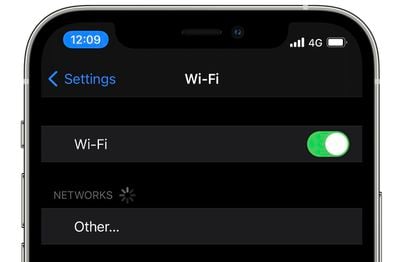
ios wifi settings
In his latest video rounding up the latest changes in the beta, YouTuber Zollotech found that the update has silently patched the bug that caused an iPhone to become unable to connect to Wi-Fi networks.

The bug was discovered on Twitter last month and consisted of an ‌iPhone‌ connecting to a Wi-Fi SSID with the name "%p%s%s%s%s%n." According to user reports, doing so would "permanently disable" an ‌iPhone‌'s Wi-Fi functionality, making the bug rather dangerous.

While some have claimed the bug "permanently" disabled their ‌iPhone‌'s Wi-Fi, other users found that resetting their network settings after connecting to the network restored Wi-Fi for the ‌iPhone‌.

Apple has been testing iOS and iPadOS 14.7 with developers and public beta testers for the past few weeks. Apple can be expected to publicly release the update soon, given the crucial bug fix that it provides to ‌iPhone‌ user.

Last month, Apple previewed iOS 15, the next major update to iOS destined for a public launch this fall. The upcoming update to iOS 14 will likely be the last major update to the operating system ahead of iOS 15's fall release.
Popular Stories

imac video apple feature

Apple Unveils Two New Products

Monday March 2, 2026 7:49 am PST by
Apple today introduced two new devices, including the iPhone 17e and an updated iPad Air. iPhone 17e features the same overall design as the iPhone 16e, but it gains Apple's A19 chip, MagSafe for magnetic wireless charging and magnetic accessories, Apple's second-generation C1X modem for faster 5G, and a doubled 256GB of base storage. In the U.S., the iPhone 17e starts at $599, just like the ...
Apple iPhone 17e feature

Apple Announces iPhone 17e With A19 Chip, MagSafe, and More

Monday March 2, 2026 6:07 am PST by
Apple today announced the iPhone 17e, featuring the A19 chip, MagSafe connectivity, faster charging, and more. The iPhone 17e contains the A19 chip introduced in iPhone 17. It features a 6-core GPU and a 4-core GPU. Apple pointed out that this makes it up to 2x faster than the iPhone 11. The new 16-core Neural Engine is optimized for large generative models. The iPhone 17e also contains...
iPad Air M4 Chip 1

Apple Unveils iPad Air With M4 Chip, Increased RAM, Wi-Fi 7, and More

Monday March 2, 2026 6:05 am PST by
Apple today introduced a new iPad Air, with key upgrades including Apple's M4 chip for faster performance, an increased 12GB of RAM, Apple's N1 wireless networking chip with Wi-Fi 7 support, and Apple's custom C1X modem in cellular models. The new iPad Air has the same overall design as the previous-generation model, which is equipped with the M3 chip, 8GB of RAM, and Wi-Fi 6E support....

Top Rated Comments

CarlJ Avatar
61 months ago
Sigh. Never use data from external sources without sanitizing it first, and never hand arbitrary data to printf and friends as a template string - sure, it'll work most of the time... but then this.

This is not esoteric guru stuff, it's programming 101 (okay, maybe 201).
Score: 7 Votes (Like | Disagree)
DeepIn2U Avatar
61 months ago

COVID will never truly go away, just getting controlled. Just saying.

As for “dangerous”, if a mere resetting network setting could fix it, then it is not so “dangerous”. Inconvenient sure but “dangerous” is slightly over the board.
https://www.forbes.com/sites/gordonkelly/2021/07/06/apple-iphone-wifi-security-hack-ios-iphone-upgrade/?sh=4351967e2b86


The Increased Damage

The first development came via Carl Shou, the reverse engineer who initially discovered the hack ('https://www.forbes.com/sites/gordonkelly/2021/06/20/apple-iphone-warning-wifi-vulnerability-exploit-new-iphone-problem/'). Shou found that joining WiFi networks with specific symbols in their name (SSID) could disable any iPhone’s WiFi until the phone’s network settings were reset. Shou has subsequently managed to increase the damage this hack does ('https://twitter.com/vm_call/status/1411630091038203909'), with WiFi only being restored from a custom factory reset where the iPhone backup file is manually edited to remove malicious entries ('https://twitter.com/vm_call/status/1411753482437148683').


Fears had already been expressed ('https://www.forbes.com/sites/gordonkelly/2021/07/03/apple-iphone-security-warning-airborne-attack-threat-new-iphone-exploit/') that this hack - known as a format string flaw - could be amplified. The end game being to use it to inject and execute malicious code onto devices and even whole networks.

The Hidden Threat

The flip side to this escalating threat, was that iPhone owners would have to join a strangely named WiFi network to be hacked. But the second development suggests this may no longer be the case.

originally reported from above link:

https://www.forbes.com/sites/gordonkelly/2021/07/03/apple-iphone-security-warning-airborne-attack-threat-new-iphone-exploit/?sh=820e3d454ae9


Following revelations last month that all iPhones are vulnerable to a simple WiFi hack ('https://www.forbes.com/sites/gordonkelly/2021/06/20/apple-iphone-warning-wifi-vulnerability-exploit-new-iphone-problem/'), new research ('https://www.aireye.tech/post/the-apple-format-string-bug-from-a-silly-prank-to-an-airborne-attack') from Amichai Shulman, CTO of wireless security specialist AirEye, has claimed this type of threat is potentially more dangerous than was first reported and can also spread to macOS.


“Our response research on the format string flaw revealed that the vulnerability is not only restricted to the iOS operating system,” states Shulman. “It also has the potential to affect the macOS operating system used by many corporations for employee stations.”


“The nature of format string vulnerabilities is that when carefully crafted they can be used to write arbitrary code into random, or chosen, parts of a machine’s memory - and even eventually inject and execute code,” Shulman explains. “Since it is possible for the vulnerable iOS and macOS devices to be connected to the larger corporate network, this code can eventually be used for lateral movement even if it only stemmed from an employee accidentally joining an unknown SSID. Once the malicious code has infiltrated a device on the network, it can exploit corporate data without the need to ‘access the network first’ in the typical ways.”
I'd say it's dangerous enough for Apple to consider it important to patch.
Score: 2 Votes (Like | Disagree)
TheYayAreaLiving 🎗️ Avatar
61 months ago
Hopefully it’s out in public next week.
Score: 2 Votes (Like | Disagree)
61 months ago
Saved! I really don't know how I have survived with that bug in 14.6.

Yes - I do realise some people might really have a problem but I suspect the other things in 14.7 are likely far more important to the majority.
Score: 2 Votes (Like | Disagree)
Apple_Robert Avatar
61 months ago

My setting will ASK if I want to join any unknown WIFI, so in theory, My phone should be save from this big … yes?
As long the phone prompts for a reply and you don't mess up the reply, you should be fine. The chances of you coming across a public WiFi name that messes up your phone is less than a percent, in my opinion.


Score: 2 Votes (Like | Disagree)
Shirasaki Avatar
61 months ago

No this is actually quite important! Glad Apple coding team has made fast work of this - considering more and more of us are now fully able to explore our communities and world again. buy-bye pandemic.
COVID will never truly go away, just getting controlled. Just saying.

As for “dangerous”, if a mere resetting network setting could fix it, then it is not so “dangerous”. Inconvenient sure but “dangerous” is slightly over the board.
Score: 2 Votes (Like | Disagree)