Skip to Content

Apple Music Spatial Audio to Get Dynamic Head Tracking in the Fall

Apple is currently rolling out spatial audio and lossless audio for Apple Music, offering subscribers a more immersive and higher-quality audio experience. Later this year, however, Apple will also bring dynamic head tracking to songs in the Apple Music catalog.
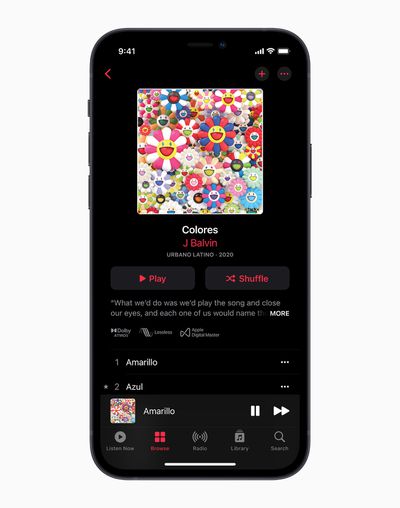
apple music spatial audio
From the FAQ section of a newly updated Apple support document:

Is spatial audio with dynamic head tracking available for music?

We are excited to announce that spatial audio with dynamic head tracking is coming to Apple Music in the fall. Dynamic head tracking creates an even more immersive experience for spatial audio. It brings music to life by delivering sound that dynamically adjusts as you turn your head. And you can experience spatial audio with dynamic head tracking on AirPods Pro and AirPods Max with a compatible iPhone or iPad.

When you consider Apple's current implementation of dynamic head tracking, it's not entirely clear how it will apply to music. In its existing form, dynamic head tracking can be experienced when watching video on iPhone and iPad with headphones that support spatial audio, but it's the video element that's key.

Spatial audio uses the gyroscope and accelerometer in the ‌headphones‌ and the iOS device to track the motion of your head and your ‌device's position, comparing the motion data, and then remapping the sound field so that it stays anchored to your device even as your head moves.

Apple Music videos with spatial audio enabled already support dynamic head tracking in this way, but given that there's no visual element involved when listening to audio tracks, Apple presumably has a different implementation in mind that will create more depth to the listening experience. Individual instruments and effects may remain locked in place in a virtual soundstage when you turn your head, evoking the experience of being in the audience at a live gig, for example.


At any rate, Apple says that Apple Music subscribers will be able to experience it for themselves "in the fall," which is also when iOS 15 will be released to the public, so the two could well drop together.


Popular Stories

Multicolored Low Cost A18 Pro MacBook Feature

Apple Accidentally Leaks 'MacBook Neo'

Tuesday March 3, 2026 7:00 am PST by
Apple appears to have prematurely revealed the name of its rumored lower-cost MacBook model, which is expected to be announced this Wednesday. A regulatory document for a "MacBook Neo" (Model A3404) has appeared on Apple's website. Unfortunately, there are no further details or images available yet. While the PDF file does not contain the "MacBook Neo" name, it briefly appeared in a link...
MacBook Neo Feature Pastel 1

Apple Announces $599 'MacBook Neo' With A18 Pro Chip

Wednesday March 4, 2026 6:15 am PST by
Apple today announced the "MacBook Neo," an all-new kind of low-cost Mac featuring the A18 Pro chip for $599. The MacBook Neo is the first Mac to be powered by an iPhone chip; the A18 Pro debuted in 2024's iPhone 16 Pro models. Apple says it is up to 50% faster for everyday tasks than the bestselling PC with the latest shipping Intel Core Ultra 5, up to 3x faster for on-device AI workloads,...
imac video apple feature

Apple Unveils Two New Products

Monday March 2, 2026 7:49 am PST by
Apple today introduced two new devices, including the iPhone 17e and an updated iPad Air. iPhone 17e features the same overall design as the iPhone 16e, but it gains Apple's A19 chip, MagSafe for magnetic wireless charging and magnetic accessories, Apple's second-generation C1X modem for faster 5G, and a doubled 256GB of base storage. In the U.S., the iPhone 17e starts at $599, just like the ...

Top Rated Comments

62 months ago
It's working already in the iOS15 Beta, as far as I can tell. I move my head and the music sound field stays fixed in the same position. eg. the vocals appear to be anchored to a certain place in the room around me.

Honestly, I think this is a total game changer. It's like stereo on steroids.
Score: 11 Votes (Like | Disagree)
62 months ago

It's working already in the iOS15 Beta, as far as I can tell. I move my head and the music sound field stays fixed in the same position. eg. the vocals appear to be anchored to a certain place in the room around me.

Honestly, I think this is a total game changer. It's like stereo on steroids.
The haters can hate but Spatial Audio is in a class of its own. There's a few tracks where it's abysmal but that comes down to the engineer. Other tracks, like many of Ariana Grande's, a few of the Weeknd's and especially that Marvin Gaye remaster are masterpieces.
Score: 5 Votes (Like | Disagree)
Canubis Avatar
62 months ago
Honestly I thought that’s what yesterday’s launch of spatial audio was all about? instead we just got music in a different audio format, slightly differently mixed? At least to my understanding Spatial Audio was all about interactivity, if I move my head the sound mix would adapt to feel as if I am directly in the sound scene, adding an extra level of immersion.
But in reality it’s still output just like stereo material, just with a fixed fake sound stage…? Maybe I am over critical but what’s the point?
Plus fun fact: the promo videos for Spatial Audio in Apple Music actually Support The head tracking.
Super confusing marketing/rollout for this product…
Score: 5 Votes (Like | Disagree)
62 months ago

Except you're just listening through Stereo headphones, so all you're hearing is a different mix...in stereo.

In fact i'm pretty sure I could just recreate the sound of the spatial audio in stereo - it can't do anything but pan it left and right when mixes down to stereo anyway.
Dude, HRTF aka A head-related transfer function, is a response that characterizes how an ear receives a sound from a point in space. As sound strikes the listener, the size and shape of the head, ears, ear canal, density of the head, size and shape of nasal and oral cavities, all transform the sound and affect how it is perceived, boosting some frequencies and attenuating others.

You do understand you have only two holes in your head but with those two holes and the magic of our own sound processing we know where the sound is coming from. The different sound directions can be simulated with normal headphones. However, in order to make this convincing this needs heavy sound manipulation. With enough processing power and 100% isolation you can make headphones virtual surround as good as the real thing.
Score: 3 Votes (Like | Disagree)
62 months ago

I'd think you do want head tracking when your phone's in your pocket, but it should be tracked relative to your phone. So you walk along looking forward and the sound stays the same (even if you go round a corner), but look to your side and it changes.
I didn’t explain well :P

What I mean is it won‘t use the phone to place where your head is at, it will use the AirPods - so when your head tilts you do hear instruments in different locations (but in same place) - so the headphones and phone will create a virtual space and place those instruments… I can’t explain lol
Score: 3 Votes (Like | Disagree)
Kier-XF Avatar
62 months ago
To say that Dolby Atmos in headphones is simply a stereo downmix with vocals plopped in the centre is a bit of a misunderstanding of the technology. When played through headphones, the Atmos decoder will use HRTF to build a genuine three dimensional (including height) sound field from the Atmos data using only two output channels - which are piped directly into the listener's entirely-surround-capable ears.
Score: 2 Votes (Like | Disagree)