Intel Aiming to Bring Face ID-Like Authentication to ATMs, Gates, Door Locks, and More With 'RealSense ID'
Intel today introduced RealSense ID, a purpose-built hardware module that will bring Face ID-like facial authentication to the point-of-sale, smart door locks, access control points like gates, ATMs, airport kiosks, and more.
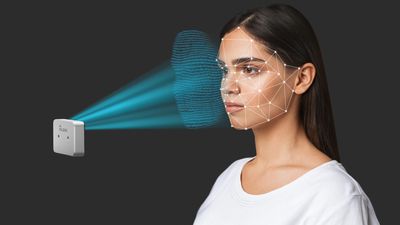
According to Intel, RealSense ID combines a depth sensor with a specialized neural network designed to deliver secure, accurate, and user-aware facial authentication, with all facial data processed locally and encrypted. RealSense ID adapts to users over time as their appearance changes, including facial hair and glasses, and the technology works in various lighting conditions for people with a wide range of heights or complexions.
Intel says RealSense ID has built-in "anti-spoofing technology" to protect against false entry attempts using photographs, videos, or masks, resulting in a one in a million false acceptance rate. This rate is in line with Face ID, as Apple claims that the probability that a random person in the population could look at someone else's iPhone and unlock it using Face ID is also approximately one in a million.
RealSense ID is only activated through user awareness and will not authenticate unless prompted by a pre-registered user, according to Intel. A built-in infrared illuminator allows for indoor or outdoor operation, day or night.
Businesses and enterprise customers can pre-order the module for $99 on Intel's website.
Popular Stories
Last year, Apple launched CarPlay Ultra, the long-awaited next-generation version of its CarPlay software system for vehicles. Nearly nine months later, CarPlay Ultra is still limited to Aston Martin's latest luxury vehicles, but that should change fairly soon.
In May 2025, Apple said many other vehicle brands planned to offer CarPlay Ultra, including Hyundai, Kia, and Genesis.
In his Powe...
Apple today confirmed to Reuters that it has acquired Q.ai, an Israeli startup that is working on artificial intelligence technology for audio.
Apple paid close to $2 billion for Q.ai, according to sources cited by the Financial Times. That would make this Apple's second-biggest acquisition ever, after it paid $3 billion for the popular headphone and audio brand Beats in 2014.
Q.ai has...
The calendar has turned to February, and a new report indicates that Apple's next product launch is "imminent," in the form of new MacBook Pro models.
"All signs point to an imminent launch of next-generation MacBook Pros that retain the current form factor but deliver faster chips," Bloomberg's Mark Gurman said on Sunday. "I'm told the new models — code-named J714 and J716 — are slated...
Apple recently updated its online store with a new ordering process for Macs, including the MacBook Air, MacBook Pro, iMac, Mac mini, Mac Studio, and Mac Pro.
There used to be a handful of standard configurations available for each Mac, but now you must configure a Mac entirely from scratch on a feature-by-feature basis. In other words, ordering a new Mac now works much like ordering an...
Apple is planning to launch new MacBook Pro models with M5 Pro and M5 Max chips alongside macOS 26.3, according to Bloomberg's Mark Gurman.
"Apple's faster MacBook Pros are planned for the macOS 26.3 release cycle," wrote Gurman, in his Power On newsletter today.
"I'm told the new models — code-named J714 and J716 — are slated for the macOS 26.3 software cycle, which runs from...